Napoleon III in five minutes
Napoleon III is the Napoleon people forget, and the one who actually ruled France for the longest time after the revolution. Born Charles-Louis-Napoléon Bonaparte, he was the nephew of the first emperor. He used that name to win the presidency of the Second Republic in 1848, turned the presidency into an empire in 1852, and ruled until 1870. His reign gave France the Paris we picture today, railways and banks, and a more active role in Europe. It ended in a single afternoon of defeat at Sedan.
He belongs to the long aftermath of the Napoleonic Era (1799–1815). His uncle's legend was the reason he came to power, and the dream of repeating that glory was a reason he fell.
Early life: a pretender in exile
Louis-Napoléon was born in Paris on 20 April 1808. His father was Louis Bonaparte, whom Napoleon had made King of Holland, and his mother was Hortense de Beauharnais, the stepdaughter of Napoleon. After the empire collapsed in 1815, the Bonaparte family was banned from France. The boy grew up in Switzerland, Germany and Italy, and learned to see himself as the heir to a movement as well as a family.
That mattered more after 1832, when the son of Napoleon (see Napoleon II and Napoleon's Descendants) died young and Louis-Napoléon became the family's leading claimant. He tried to start an uprising at Strasbourg in 1836 and another at Boulogne in 1840. Both failed. After the second he was jailed in the fortress of Ham, where he wrote on politics and social questions, and he escaped in 1846 and went to London.
How he won power, 1848–1852
The February Revolution of 1848 overthrew King Louis-Philippe and created the Second Republic. Louis-Napoléon returned to France and ran in the first presidential election by universal male suffrage, held in December 1848. He won about three votes in four. Voters knew the name, and the peasants and the middle class who feared more upheaval trusted it more than the republican politicians.
The constitution allowed only one four-year term, and the assembly would not change it. So on 2 December 1851, the anniversary of Austerlitz and of his uncle's coronation, he dissolved the assembly, arrested opponents and used the army to crush resistance in Paris and the provinces. A plebiscite approved his action by a huge margin. A year later, on 2 December 1852, he took the title Napoleon III. (The numbering counts Napoleon II, the king of Rome, who never reigned.) The writer Victor Hugo, who attacked the coup, spent the rest of the empire in exile.
The Second Empire at home
The early empire was authoritarian. The press was controlled, the legislature was weak and the police were active. In return, the regime offered order and prosperity, and for many years most voters accepted the bargain.
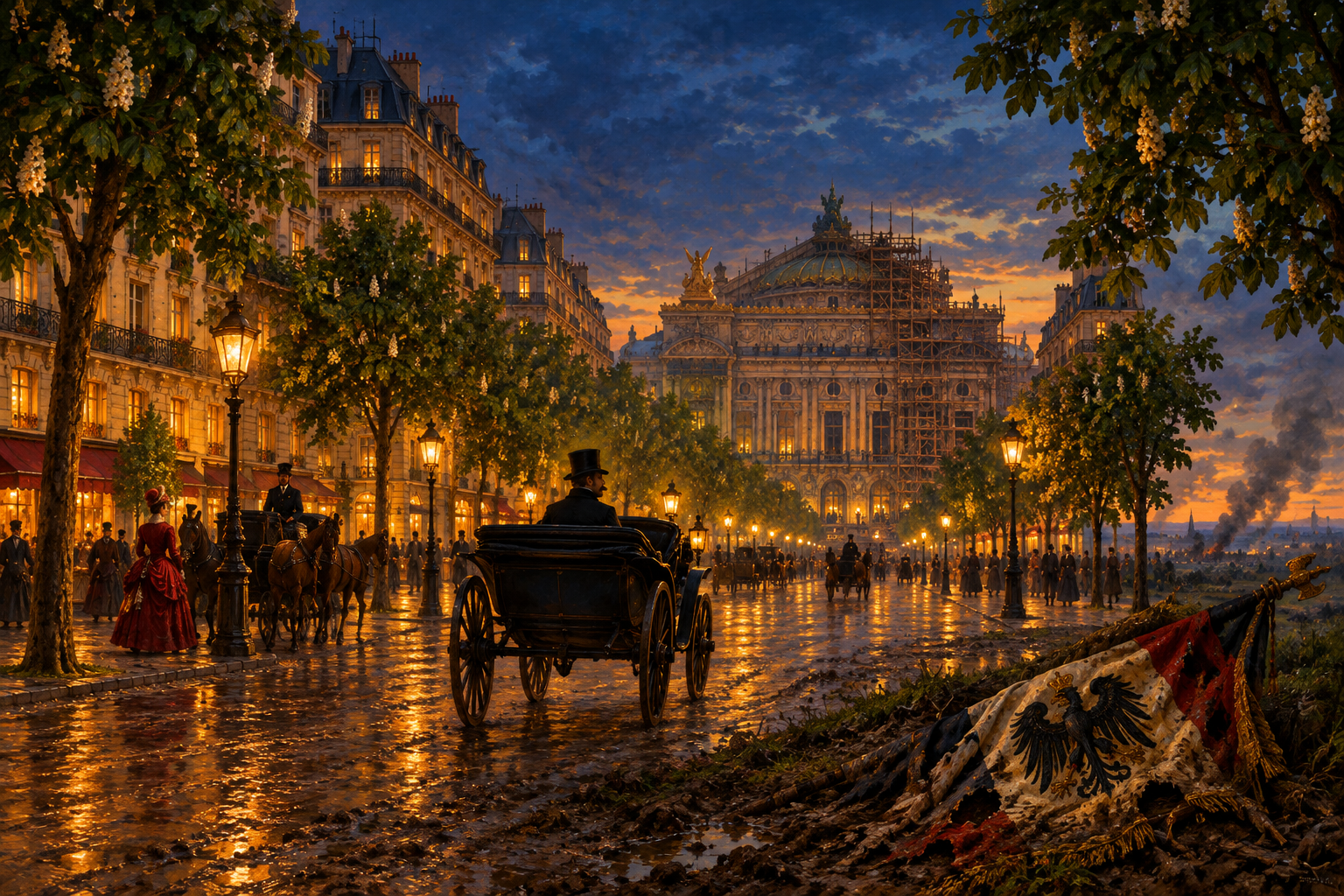
- Paris rebuilt. From 1853 the prefect Georges-Eugène Haussmann cut wide boulevards through the medieval city, built sewers, water supplies and parks, and gave Paris the uniform stone façades we know today. The work displaced many poor residents, and critics called it a way of making rebellion harder, but it also made the city healthier.
- Economy. Railways spread across the country, new investment banks such as the Crédit Mobilier were founded, and the state encouraged industry. The Cobden–Chevalier treaty of 1860 with Britain lowered tariffs.
- Showcase. Paris hosted world's fairs in 1855 and 1867, and the French company that built the Suez Canal opened it in 1869, with Empress Eugénie as guest of honour.
In 1853 he married Eugénie de Montijo, a Spanish noblewoman. Their son Louis, the Prince Imperial, was born in 1856 and was meant to be the next emperor.
Foreign policy: glory and miscalculation
Napoleon III wanted to end the settlement of 1815 and make France a leader again. At first it worked. France fought alongside Britain and the Ottoman Empire against Russia in the Crimean War (1853–1856), and the peace was made at the Congress of Paris, which seemed to put Paris back at the centre of Europe.
In 1859 he helped Piedmont-Sardinia fight Austria. French troops won the bloody battles of Magenta and Solferino, and in return France received Savoy and Nice in 1860. But he stopped the war early, before Italian unification was complete, and angered both Italian nationalists and French Catholics, who wanted the Pope protected.
The worst failure was Mexico. In 1861 France joined Britain and Spain in an intervention over unpaid debts, then stayed on its own and backed the Austrian archduke Maximilian as emperor of Mexico. The scheme drained money and men, the United States objected once its Civil War ended, and French troops withdrew in 1866–1867. Maximilian was executed in June 1867, a blow to the emperor's prestige.
The liberal empire and the road to Sedan
By the 1860s opposition was growing, and the emperor began to loosen his own system. Workers gained a limited right to strike in 1864, the press and public meetings were freed in 1868, and in January 1870 he appointed the moderate Émile Ollivier to lead a more parliamentary government. In May 1870 a plebiscite on these reforms passed by roughly 7.3 million votes to 1.5 million. The empire looked stronger than it had for years.
The danger came from Prussia. Under Otto von Bismarck, Prussia had beaten Denmark, Austria and its German rivals, and a new power was forming on France's border. In 1870 a dispute over a Hohenzollern prince as candidate for the Spanish throne led to the Ems telegram, which Bismarck edited to sound insulting. The French government, under pressure from public opinion, declared war on 19 July 1870.
The Franco-Prussian War and the fall
France was not ready. The German states mobilised faster, moved by railway, and had better artillery. French armies were beaten in August and one was trapped in the fortress of Metz. Napoleon III, ill with bladder stones, travelled with the army of Marshal MacMahon. On 1 September 1870 the Germans surrounded it at Sedan. The next day the emperor surrendered himself and about 100,000 soldiers.
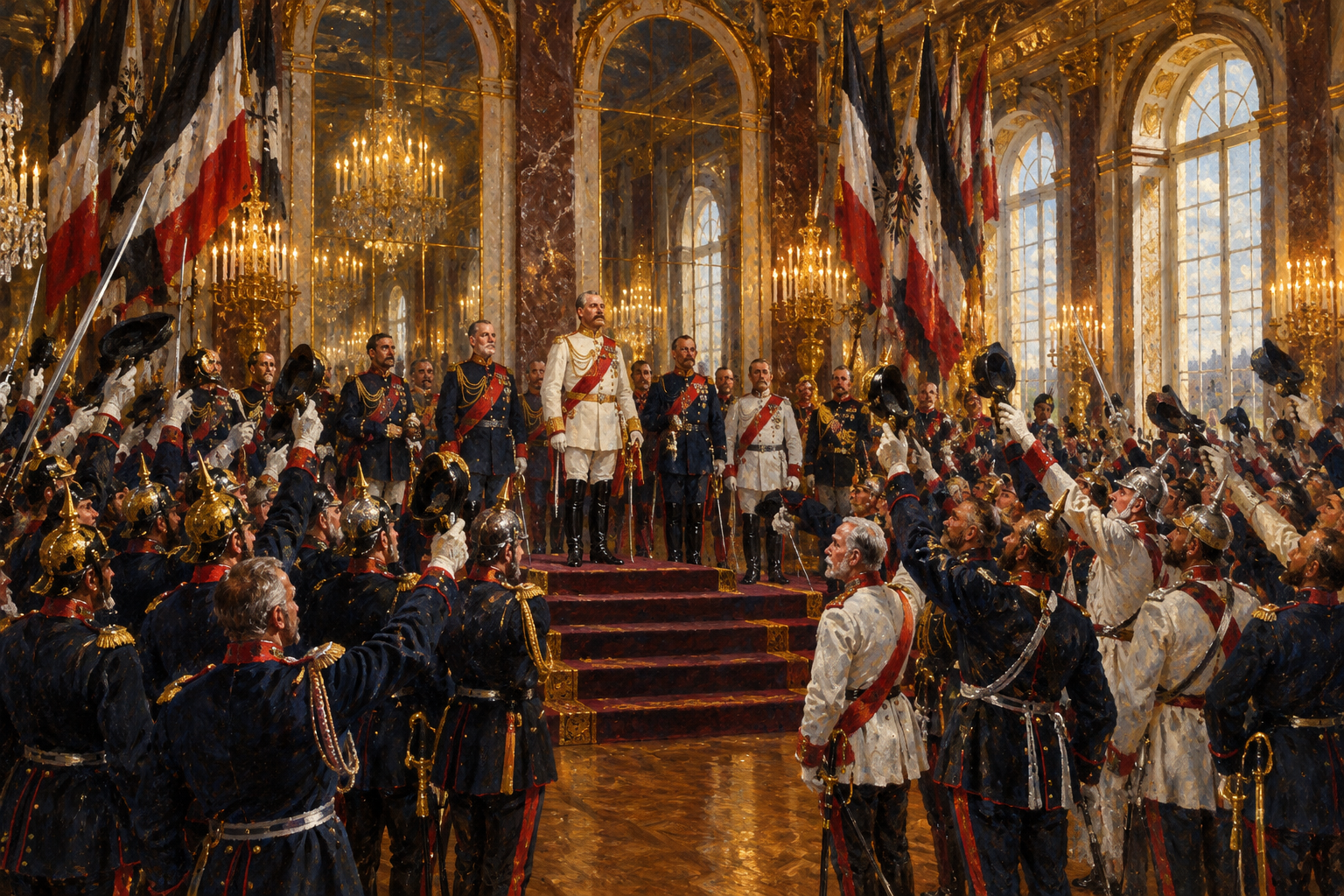
When the news reached Paris, crowds demanded the end of the empire. On 4 September 1870 a republic was proclaimed, the Third Republic. The war went on for months, Paris was besieged, and the German Empire was proclaimed at Versailles in January 1871. In the Treaty of Frankfurt (May 1871) France gave up Alsace and part of Lorraine and paid a large indemnity. The loss of those provinces shaped French politics and European tension for decades.
Exile, death and legacy
Napoleon III was held at Wilhelmshöhe in Germany, freed in March 1871 and joined his family in England, at Chislehurst in Kent. He died there on 9 January 1873 after surgery. His son, the Prince Imperial, was killed fighting for the British in the Zulu War in 1879, and the Bonaparte line lost its realistic hope of a throne.
Historians have not agreed on his legacy. Critics point to the coup of 1851, the censorship and the disastrous war. Others stress that he modernised France, accepted universal male suffrage and slowly liberalised his own regime. Both views are partly right. He was a skilled politician who relied on a famous name, and he was less good at judging military and diplomatic risk.
What exams ask
Questions on Napoleon III usually test the order of events and the link between domestic and foreign policy.
- Sequence: 1848 revolution and presidency, 1851 coup, 1852 empire, 1853–1856 Crimean War, 1859 Italian war, 1861–1867 Mexico, 1870 Franco-Prussian War, Sedan, Third Republic.
- Plebiscites: he used popular votes to give his rule democratic legitimacy, a model sometimes called Bonapartism or Caesarism.
- Significance (AP-style): Napoleon III shows how nationalism, the memory of the French Revolution and authoritarian government could be combined, and how his foreign policy helped create a united Germany that he had hoped to contain.
Read next
- Who Was Napoleon Bonaparte? The uncle whose legend made this reign possible.
- Napoleon II and Napoleon's Descendants What happened to the family after 1815 and why the claim passed to Louis-Napoléon.
- Napoleon's Tomb at Les Invalides How the first emperor's memory was honoured in Paris, in the years that helped his nephew.