Queen Victoria in five minutes
Queen Victoria (1819–1901) was the British monarch from 1837 until her death in 1901. She became queen at 18, married her cousin Prince Albert, raised nine children and reigned for 63 years. That reign was so long that the whole age is named after her: the Victorian era. She held limited political power, because Britain was already a constitutional monarchy, but she shaped how the public saw the crown: a respectable royal family, a queen in black mourning, and finally an empress at the head of the largest empire of her day.
If you remember four things, make them these. She took the throne very young. Her marriage to Albert was close and happy. She mourned him for about forty years. And she ended her life as the "grandmother of Europe".
Who was she before she was queen?
Alexandrina Victoria was born on 24 May 1819 at Kensington Palace in London. Her father, Edward, Duke of Kent, was a son of George III, and he died when she was eight months old. Her mother, Victoria of Saxe-Coburg-Saalfeld, raised her with the help of the household adviser Sir John Conroy, under strict rules known as the Kensington System. The girl was watched constantly and kept away from her uncles' court. You can read the full story in Queen Victoria's Childhood and the Kensington System.
She became heir because none of George III's older sons left a legitimate child who survived. When her uncle William IV grew old without an heir, the throne was waiting for her.
Becoming queen at 18
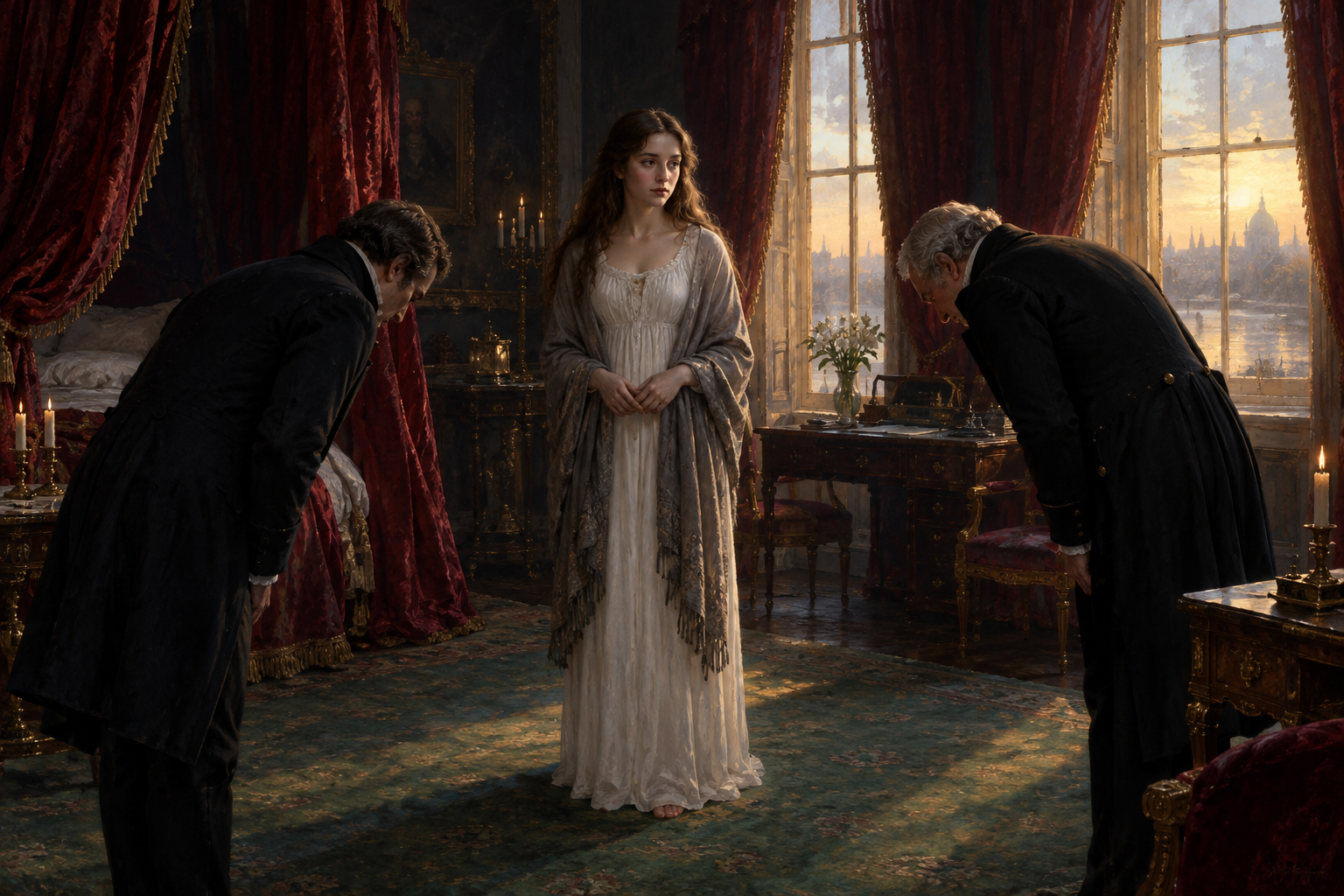
William IV died on 20 June 1837, a month after Victoria's eighteenth birthday. She was woken early at Kensington Palace and told that she was queen. Her coronation followed on 28 June 1838 at Westminster Abbey.
One result of her accession was a split in the crown. The kingdom of Hanover, which had shared a monarch with Britain since 1714, did not allow a woman to inherit, so it passed to her uncle Ernest Augustus.
Her first prime minister, Lord Melbourne, became teacher and close friend, explaining how government worked. The early years were not smooth. In the Bedchamber Crisis of 1839 she refused to replace the ladies of her household when the government changed, and Robert Peel declined to form a ministry. The episode showed how hard it was for a young queen to stay above party politics.
Marriage to Prince Albert
Custom said that a monarch had to propose, so on 15 October 1839 Victoria asked her cousin Prince Albert of Saxe-Coburg and Gotha to marry her. They were married on 10 February 1840. Between 1840 and 1857 they had nine children, among them the eldest daughter Victoria, the future Edward VII, and the youngest, Beatrice.
Albert became her secretary, adviser and the centre of family life. He drove the Great Exhibition of 1851, held in the iron-and-glass Crystal Palace in Hyde Park and visited about six million times, which showed off British industry to the world. In 1857 he received the title Prince Consort. Victoria survived several attempts on her life during her reign, the first by Edward Oxford in 1840, and she kept appearing in public.
A queen who reigned but did not rule
In Victoria's time real power lay with Parliament and the cabinet. The queen could advise, warn and encourage her ministers, and she dealt with prime ministers from Melbourne and Peel to Palmerston, Disraeli and Gladstone. She was close to the Conservative Disraeli and found the Liberal Gladstone hard to work with.
Politics became more democratic during her reign. The Second Reform Act of 1867 gave the vote to many working men in towns. Victoria did not lead these reforms; she accepted what Parliament decided. That model, a monarch as national symbol and elected politicians as rulers, is the basis of the modern British monarchy.
Hard events also happened on her watch, such as the Irish Potato Famine of 1845–1852. Policy was set by the government, not the crown, but the famine is part of the reality behind the "golden" Victorian age.
Albert's death and the years of mourning
Albert died at Windsor Castle on 14 December 1861, aged 42. Victoria was devastated and wore black for the rest of her life. She appeared in public much less, and in some years she did not open Parliament.
In the 1860s and 1870s people complained that the queen had vanished, and a small republican movement gained attention. Her close friendship with the Scottish servant John Brown also fed gossip. Slowly she returned to her duties. Memorials to Albert, such as the Albert Memorial and the Royal Albert Hall in London, kept his name in public view.
Empress of India and the height of empire
After the Indian Rebellion of 1857, the Government of India Act of 1858 ended the East India Company's rule and put India under the crown. In 1876 Parliament passed the Royal Titles Act, backed by Disraeli, and Victoria took the title Empress of India. It was proclaimed at Delhi on 1 January 1877.
The title tied India to the centre of the British Empire, which was then at its greatest extent. The Golden Jubilee of 1887 and the Diamond Jubilee of 1897 brought soldiers and representatives from across the empire to London. For the people ruled by that empire, it meant taxes, control and loss of self-government, which is why historians weigh the Victorian age so carefully today.
Last years and death
In old age she spent most of her time at Windsor Castle, Osborne House on the Isle of Wight and Balmoral in Scotland. The Boer War began in South Africa in 1899 and was still going when she died.
Victoria died at Osborne House on 22 January 1901, aged 81, and was buried at Frogmore near Windsor beside Albert. Her son became Edward VII. Her reign of 63 years and about seven months was the longest of any British monarch until Elizabeth II passed it in 2015.
What was she like?
Victoria was small, about 4 ft 11 in (150 cm) tall. She kept detailed journals nearly all her life, had a strong will and a quick temper, and was deeply attached to her family. Her image as a devoted wife and mother helped to define Victorian ideas of duty, respectability and home life.
The grandmother of Europe
Many of her children and grandchildren married into other royal families. Her eldest daughter Victoria married the future German emperor Frederick III, and their son was Kaiser Wilhelm II. Her grandchildren also include George V of Britain and Alexandra, wife of Tsar Nicholas II of Russia. A haemophilia gene also passed through her daughters into several royal houses. In the First World War, cousins from the same family ended up on opposite sides.
What exams ask
- Dates: queen from 1837 to 1901; coronation 1838; married Albert 1840; Albert died 1861; Empress of India 1876–1877.
- Role: explain why Victoria was a constitutional monarch and how Parliament, not the crown, held power.
- Significance: the Great Exhibition of 1851 as a sign of industrial strength; the Reform Act of 1867 as a step to democracy.
- Empire: 1858 rule of India by the crown, the 1876 Royal Titles Act and Disraeli's part in it.
- Era: describe the Victorian age through industry, empire, reform and ideas of respectability.
Read next
- The Victorian Era (1837–1901): the big picture of the age that carries her name.
- Queen Victoria's Childhood and the Kensington System: how a strictly guarded girl became a queen.
- The British Empire: the world she was empress of.
- The Irish Potato Famine (1845–1852): the crisis that shadows her reign.