The British Empire in five minutes
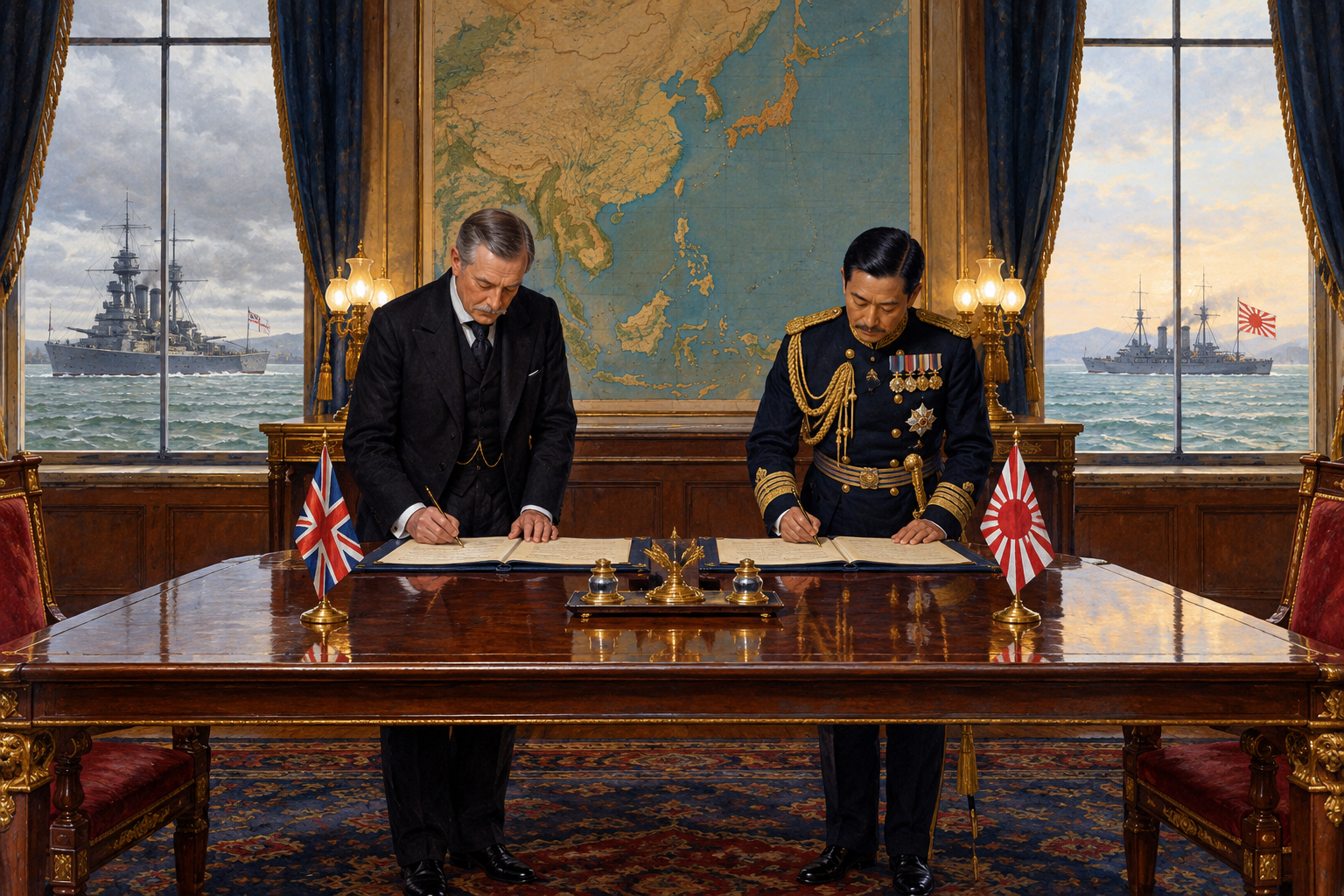
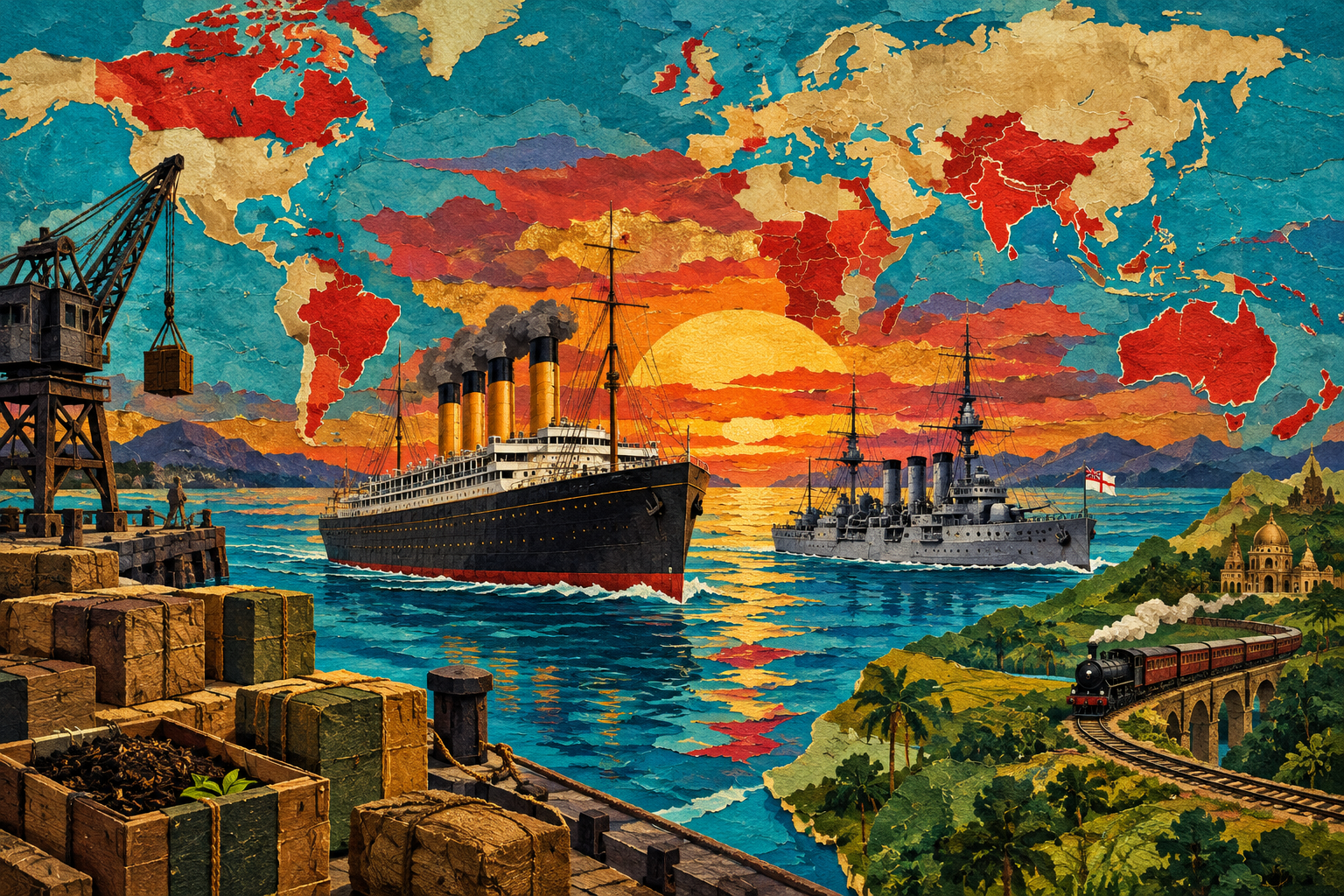
The British Empire was a worldwide system of colonies, protectorates, trading posts and dependent territories ruled or controlled from London. It grew out of English voyages and trading companies in the late 1500s and 1600s, reached its largest extent in the early 1920s, and shrank fast after the Second World War. Hong Kong's return to China on 1 July 1997 is the date most people use for its end.
In between, the empire reshaped the map. It spread the English language, moved millions of people across oceans through trade, slavery and indenture, and drew borders that still matter in South Asia, Africa and the Middle East. It grew fastest during the Victorian era, when Britain was the leading industrial and naval power. This page follows the story in order: how it began, how it worked, what it cost the people it ruled, and why it ended.
How the empire began (1580s–1763)
England was a late starter. Spain and Portugal had overseas empires long before. English interest grew under Elizabeth I: Humphrey Gilbert claimed Newfoundland in 1583, and the East India Company received its royal charter in 1600 to trade in Asia. The first lasting English colony in North America was Jamestown, Virginia, founded in 1607. Colonies in the Caribbean followed, with Barbados settled in 1627, and sugar plantations there became hugely profitable.
Sugar, and later tobacco and cotton, depended on enslaved African labour. British ships carried about three million Africans across the Atlantic in total, making Britain one of the largest slave-trading nations. The state backed this trade. From 1651 the Navigation Acts required colonial goods to travel in English ships, and wars with the Dutch, Spain and France decided who kept which colonies. The Seven Years' War ended with the Treaty of Paris in 1763, which gave Britain Canada, and Robert Clive's victory at Plassey in 1757 had already made the East India Company the strongest force in eastern India.
Losing America, gaining Asia (1763–1837)
The first empire in North America broke up when thirteen colonies declared independence in 1776 and won it in the war that Britain accepted losing in 1783. British attention turned east and south. After James Cook charted Australia's east coast in 1770, the first convict fleet reached Botany Bay in 1788. In India the East India Company changed from a trader into a ruler, taking over large regions through wars and alliances.
Napoleon's defeat in 1815 left Britain with the strongest navy in the world and a chain of useful bases, including Cape Colony, Malta, Ceylon and Mauritius. At home, anger at slavery grew. Parliament banned the slave trade in 1807 and abolished slavery across most of the empire in 1833. The government paid about £20 million in compensation, but it went to the slave owners; the freed people received nothing and were made to work as apprentices for several more years.
The Victorian peak (1837–1914)
Under Queen Victoria, who reigned from 1837 to 1901, the empire grew faster than at any other time. In 1840 the Treaty of Waitangi, signed with Māori chiefs, led to British rule in New Zealand. In 1842 the Treaty of Nanking ended the First Opium War, giving Britain Hong Kong Island and opening Chinese ports to British trade. After the Indian Rebellion of 1857, the Crown took direct control of India from the East India Company in 1858, and in 1877 Victoria was proclaimed Empress of India.
The route to India mattered most. Prime Minister Benjamin Disraeli bought shares in the Suez Canal in 1875, and Britain occupied Egypt in 1882. During the "Scramble for Africa", which the Berlin Conference of 1884–85 helped to organise, Britain took territory stretching from Egypt and Sudan to Nigeria, Kenya and southern Africa. The Boer War of 1899–1902 against the two Boer republics was costly and showed the limits of British power. Meanwhile, settler colonies gained self-government as dominions: Canada in 1867, Australia in 1901, New Zealand in 1907 and South Africa in 1910.
How the empire worked
The empire was never one system. Crown colonies were run by governors sent from London. India was ruled through a viceroy, with hundreds of princely states left under British oversight. Dominions had their own parliaments. Protectorates kept local rulers under British control. There was also an "informal empire": places such as parts of China, Argentina and the Persian Gulf where Britain held influence through trade, loans and gunboats rather than flags.
The Royal Navy guarded the sea lanes, which is why the century after 1815 is often called the Pax Britannica. Steamships, railways and telegraph cables tied the system together, and British capital flowed into mines, plantations and ports. India was the centre: its army fought across Asia and Africa, and its trade surplus helped pay for the whole structure. People spoke of "the empire on which the sun never sets" because some British territory was always in daylight.
The human cost
Imperial rule rested on force and on ideas of racial and cultural superiority, including the claim of a "civilising mission". Alongside railways, schools and courts came violence and exploitation. Britain forced the opium trade on China. Indian labourers worked under indenture contracts on plantations in the Caribbean, Africa and Fiji. India suffered repeated famines under British rule, including the Bengal famine of 1943, in which an estimated two to three million people died. At Amritsar in 1919, troops fired on an unarmed crowd and killed at least 379 people by the official count. Britain also ran detention camps during the Boer War and during the Mau Mau uprising in Kenya in the 1950s.
Borders were often drawn with little regard for the people living there. The partition of India in 1947 caused one of the largest forced migrations in history. How to weigh these facts against railways, law courts and trade links is an argument that historians, and the countries involved, are still having.
Why it ended (1914–1997)
The First World War pulled the whole empire in: more than a million Indian soldiers served overseas. Britain won new League of Nations mandates, including Iraq and Palestine, which is why the empire was largest in the early 1920s. But the war left Britain in debt, and independence movements grew stronger. The Irish Free State appeared in 1922, Egypt gained nominal independence the same year, and Gandhi led mass campaigns in India. The Statute of Westminster in 1931 made the dominions legally equal to Britain.
The Second World War drained Britain further. India and Pakistan became independent in 1947, followed by Burma and Ceylon in 1948. In the Suez Crisis of 1956, Britain and France had to pull back from Egypt under American pressure, which showed how much power Britain had lost. Ghana became independent in 1957, and in 1960 Harold Macmillan spoke in Cape Town of a "wind of change" blowing through Africa. Nigeria (1960), Jamaica (1962) and Kenya (1963) followed. The handover of Hong Kong in 1997 closed the main chapter. Today Britain keeps 14 Overseas Territories, such as Gibraltar and the Falkland Islands, and leads a voluntary Commonwealth of more than fifty countries.
How long did the British Empire last?
It depends on where you start. From the first colonies around 1600 to Hong Kong in 1997 is roughly 400 years. Historians often split this into a "first empire" (to 1783), centred on the Atlantic and slavery, and a "second empire" (after 1783), centred on India, Asia and Africa. At its largest, in the early 1920s, it covered about 35 million square kilometres and held around 450 million people. Most of it vanished in under twenty years, between 1947 and the mid-1960s.
What exams ask
Typical questions ask you to explain why Britain expanded (trade, strategy, and ideas of mission), to compare the first and second empires, to judge the impact on colonised societies, and to explain why decolonisation came when it did. A useful set of anchor dates: 1757 Plassey, 1807 and 1833 on slavery, 1858 Crown rule in India, 1884–85 Berlin Conference, 1931 Statute of Westminster, 1947 Indian independence, 1956 Suez, 1997 Hong Kong. Strong answers give causes and consequences for both Britain and the ruled societies, and avoid describing the empire as simply good or simply bad.
Read next
- Victorian Era Timeline: the dated events of 1837–1901 that sit behind the empire's fastest growth.
- The British Empire at Its Height (Map): see where the empire's territories lay when it was largest.
- Who Was Queen Victoria?: the monarch who became Empress of India and gave her name to the age.