The Emancipation Proclamation in five minutes
The Emancipation Proclamation was an executive order that President Abraham Lincoln signed on January 1, 1863, in the third year of the American Civil War. It declared that enslaved people in areas still in rebellion against the United States were free. It did not abolish slavery across the whole country, and it did not free everyone at once. Slavery ended nationwide only with the Thirteenth Amendment, ratified in December 1865.
Even so, the order changed the war. Before it, the Union fought to bring the Confederate states back. After it, the Union was also fighting against slavery. The proclamation opened the army and navy to Black men, and it made it harder for Britain and France to side with the Confederacy.
The text is short, dry and legal. That was deliberate. Lincoln issued it as a war measure, using his powers as commander in chief, because he did not believe the Constitution clearly let a president end slavery inside the states where it already existed. This page explains why he wrote it, what it said, what it left out and why it still matters. For the wider period, see the hub article 19th-Century America: Expansion, Civil War and the Gilded Age.
Why Lincoln waited
When the war began in April 1861, Lincoln's stated goal was to save the Union, not to end slavery. There were two reasons. First, four slave states, Delaware, Maryland, Kentucky and Missouri, had stayed in the Union, and Lincoln feared that a war against slavery would push them toward the Confederacy. Second, the law was unclear. Slavery was protected by state law, and a president had no obvious power to cancel it.
Events pushed him forward. Enslaved people were escaping to Union lines in growing numbers, and army commanders had to decide what to do with them. Congress passed Confiscation Acts in 1861 and 1862 that allowed the Union to seize property used for the rebellion, including enslaved people. Abolitionists and Black leaders such as Frederick Douglass argued that the Union could not win without striking at slavery.
In July 1862 Lincoln read a draft of an emancipation order to his cabinet. Secretary of State William Seward advised him to wait for a military victory, so that the order would not look like a cry for help from a struggling government. Lincoln agreed and put the draft away. In August he wrote a public letter to the newspaper editor Horace Greeley saying that his main aim was to save the Union, and that he would free none, some or all of the enslaved, whichever best served that aim. Many historians read the letter as a way of preparing the public, since the draft was already written.
The victory came at Antietam, Maryland, on September 17, 1862. It was the bloodiest single day of the war, with about 23,000 soldiers killed, wounded or missing. The Union army stopped Robert E. Lee's advance north, and five days later, on September 22, Lincoln issued the Preliminary Emancipation Proclamation. It warned that unless the rebel states returned by January 1, 1863, enslaved people in them would be declared free. None returned.
What the proclamation said
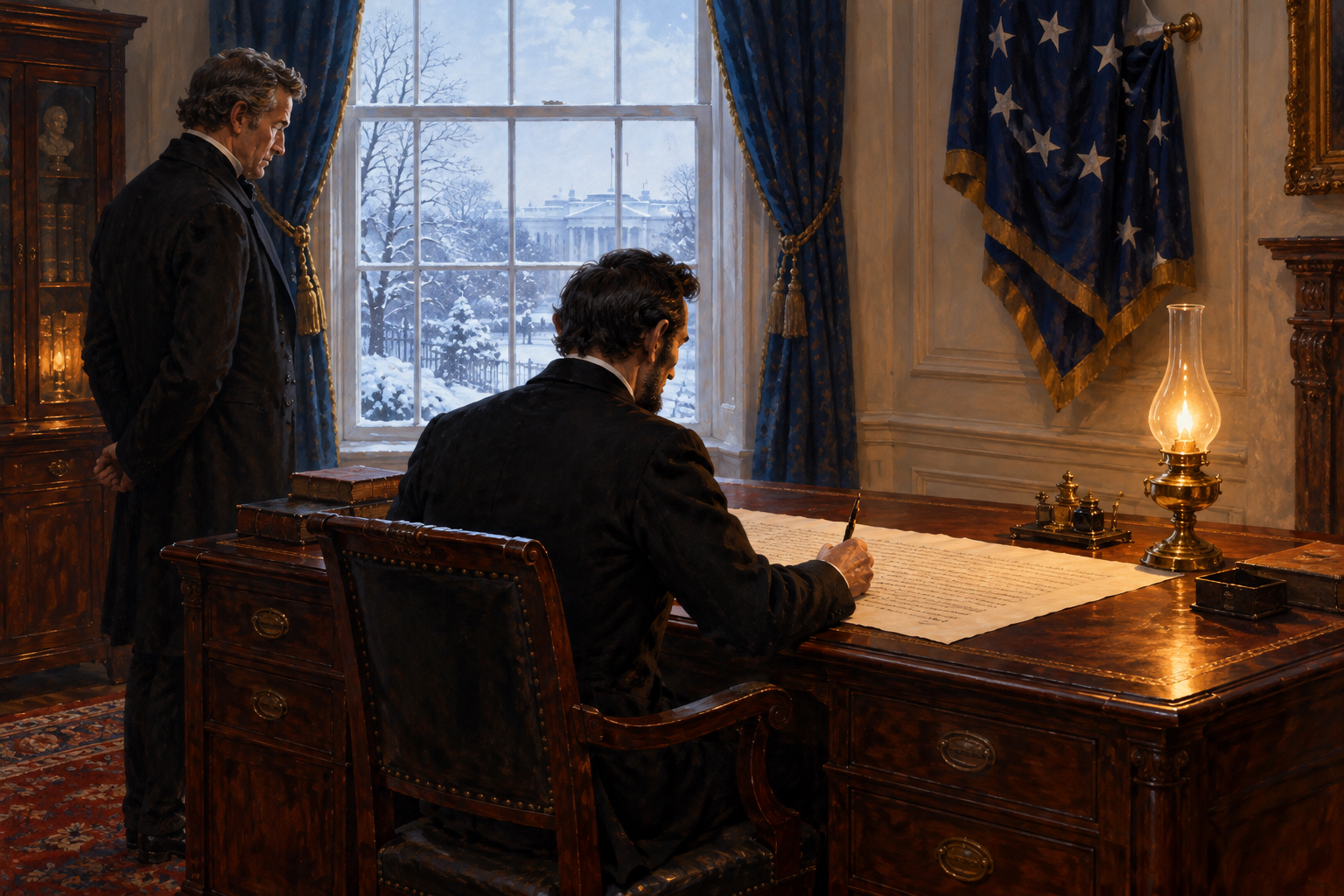
The final proclamation came out on January 1, 1863. Lincoln signed it that afternoon, after a long New Year's reception at the White House, and reportedly remarked that his hand was tired from shaking hands. He did not want a shaky signature to make people think he was hesitating.
The document did four main things.
- It named the areas covered. These were Arkansas, Texas, Louisiana, Mississippi, Alabama, Florida, Georgia, South Carolina, North Carolina and Virginia, with some exceptions.
- It declared the enslaved people there free. The key phrase says they "are, and henceforward shall be free."
- It asked freed people to avoid violence except in self-defence, and to work for fair wages when possible.
- It announced that Black men would be received into the armed forces of the United States.
Lincoln based the order on military necessity. He called it a fit and necessary war measure. That legal reasoning explains the odd limits of the text: a president can use war powers against an enemy, but not against states that are loyal to him.
What it did not do
The proclamation is often remembered as "freeing the slaves." That is only partly true.
- It left out the loyal border states. Delaware, Kentucky, Maryland and Missouri were not covered, and neither was Tennessee, which was largely under Union control.
- It left out some Union-held areas in the Confederacy, including parts of Louisiana and the counties that were becoming West Virginia.
- It could not be enforced where the Confederacy was in control. Confederate leaders ignored it. In practice, freedom came as Union armies advanced and as enslaved people left plantations and reached Union lines.
- It did not give citizenship, voting rights or land. Those questions were fought over during Reconstruction.
Roughly 3 million enslaved people lived in the areas the order named, out of about 4 million in the country in 1860. Many of them gained freedom only in 1864 and 1865, as the Union army moved through the South.
What happened next
The most immediate effect was military. Black men enlisted in large numbers, and close to 200,000 served in the Union army and navy by the end of the war. Their service strengthened the Union and strengthened the argument that Black Americans deserved citizenship.
The proclamation also shifted foreign opinion. After January 1863, Britain and France would have had to support a government fighting to keep slavery, which was politically hard for them to do.
Lincoln knew that a war measure might not survive the end of the war, and courts might later question it. He therefore backed a constitutional amendment. The Senate passed it in April 1864, the House in January 1865, and it was ratified in December 1865 as the Thirteenth Amendment, which abolished slavery across the United States, including the border states. Between those dates, on June 19, 1865, Union General Gordon Granger announced in Galveston, Texas, that all enslaved people there were free. That date is remembered as Juneteenth.
Lincoln spoke about the meaning of the war again that November in the Gettysburg Address, which spoke of a "new birth of freedom."
What exams ask
In AP-style questions, the proclamation is usually tested through these points:
- Date and type: January 1, 1863, issued as a war measure by the president as commander in chief.
- Turning point: it followed Antietam and the Preliminary Proclamation of September 1862, and it shifted Union war aims toward ending slavery.
- Limits: it applied only to Confederate-held areas and excluded the border states.
- Contrast with the Thirteenth Amendment: the proclamation was an executive order; the amendment made abolition permanent and nationwide.
- Effects: Black enlistment, and a harder path for Confederate diplomacy in Europe.
A common mistake is to say it freed all enslaved people. A safe answer says it freed those in areas in rebellion and began a process that the Thirteenth Amendment completed.
Read next
Who Was Abraham Lincoln? tells the story of the president who wrote the order, from the Illinois frontier to the White House.
The Gettysburg Address shows how Lincoln explained the purpose of the war to the public in a speech of only a few minutes.
The Monroe Doctrine (1823) gives the earlier foreign-policy background to American power in the Atlantic world.