In five minutes
Charles Dickens (1812–1870) was an English novelist who turned the poverty, cruelty and hope of Victorian Britain into stories that millions of people read. He wrote Oliver Twist, A Christmas Carol, David Copperfield, Great Expectations and many other novels, most of them published in cheap monthly or weekly instalments. His fiction made readers look at workhouses, debtors' prisons, slum streets and slow law courts, and it helped make the "condition of England" a subject of everyday conversation.
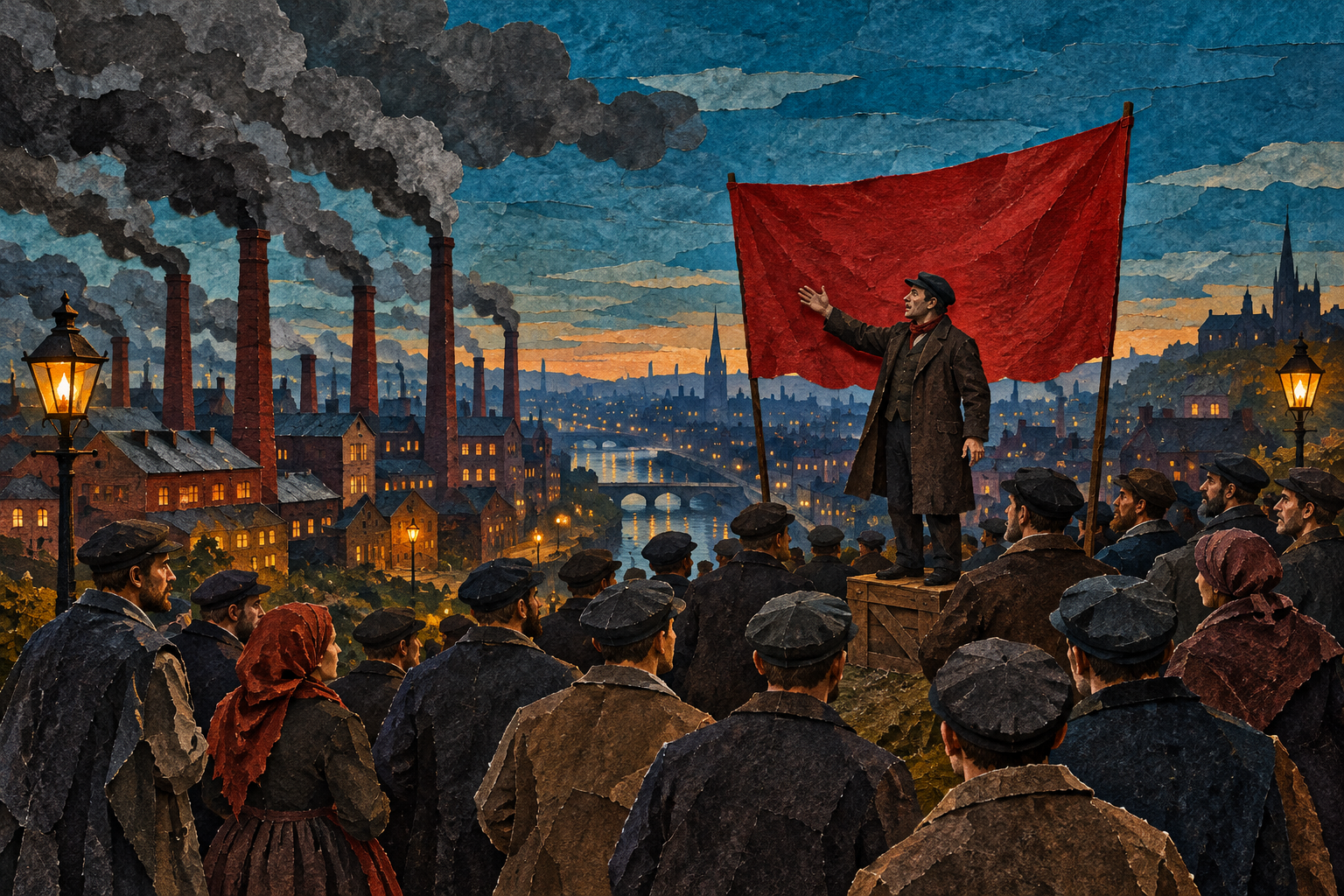
Dickens's career follows the early and middle decades of the era in this hub, The Victorian Era (1837–1901). Queen Victoria came to the throne in 1837, the same year Oliver Twist began to appear. Dickens wrote about a Britain of railways, factories, gas lamps and a fast-growing capital, which you can see in Victorian London.
Childhood: debt and the blacking warehouse
Dickens was born on 7 February 1812 in Portsmouth, the second of eight children of John Dickens, a clerk in the navy pay office, and Elizabeth Dickens. The family moved often and spent more than it earned. In February 1824, when Charles was twelve, his father was arrested for debt and sent to the Marshalsea prison in Southwark, London.
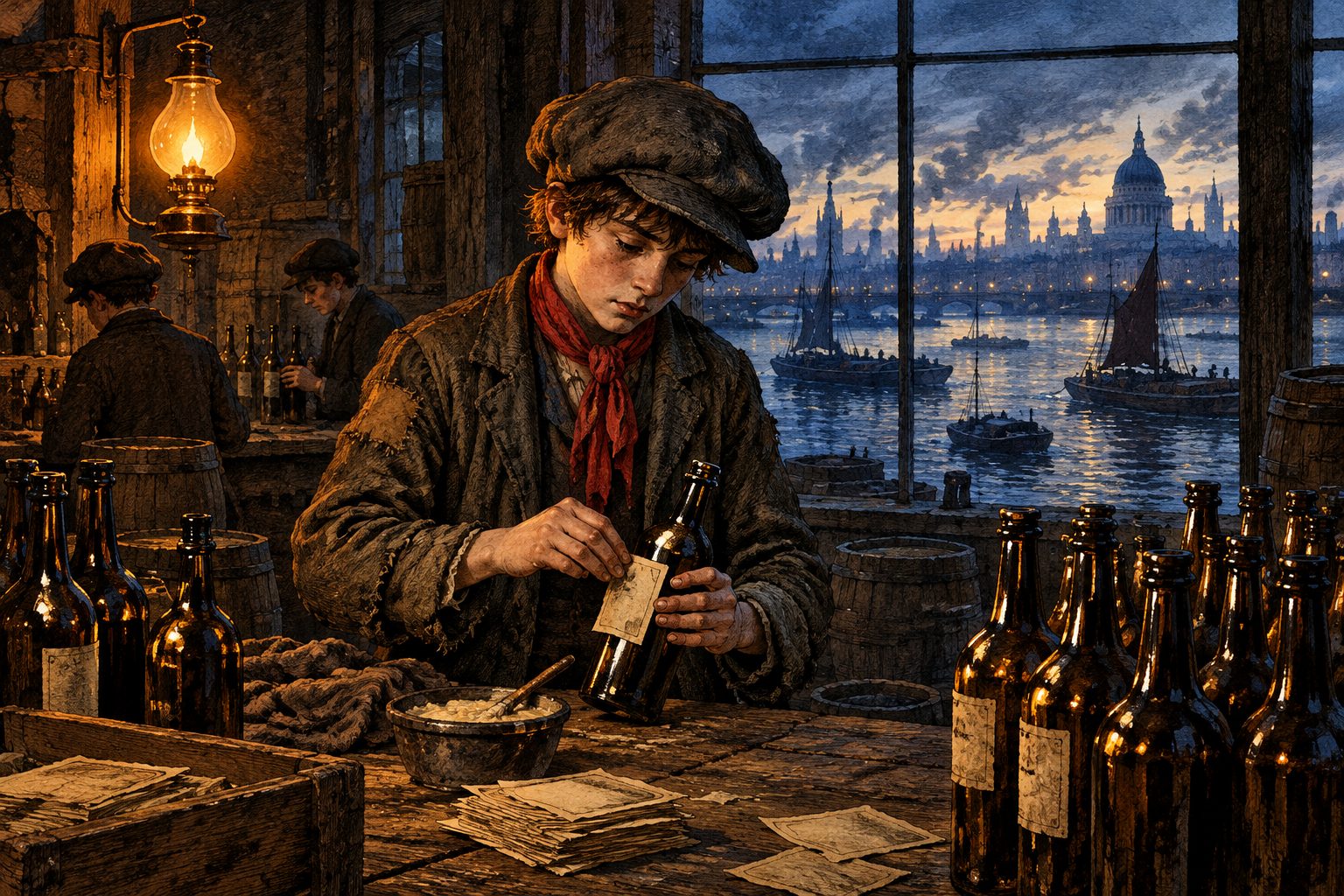
Charles was taken out of school and put to work at Warren's Blacking Warehouse beside the Thames, pasting labels on pots of boot polish for about six shillings a week. The job lasted for months, but the shame stayed with him for life. He told almost nobody. His friend and biographer John Forster revealed the story only after Dickens's death. Many historians see this episode as the emotional source of his lifelong sympathy for neglected children and for families crushed by debt.
After his father was released, Charles went back to school for a few years. At fifteen he became a lawyer's clerk, taught himself shorthand and began work as a court and parliamentary reporter. These jobs gave him a close view of the law, of politicians and of London streets.
From reporter to "Boz"
In the 1830s Dickens began publishing short sketches of London life under the pen name "Boz". They were collected as Sketches by Boz in 1836. In March of that year the first monthly part of The Pickwick Papers appeared, a comic tale of a gentleman and his friends travelling around England. It became a runaway success, and Dickens, still in his twenties, was famous. He married Catherine Hogarth in April 1836, and the couple had ten children.
Oliver Twist followed in 1837–39, then Nicholas Nickleby in 1838–39, which attacked cheap boarding schools in Yorkshire. The Old Curiosity Shop (1840–41) and Barnaby Rudge (1841) kept up the pace. Dickens was already one of the best-known writers in the English-speaking world.
Why serial publication mattered
Dickens did not write for a small, rich audience. Most of his novels first came out in instalments, either in monthly parts costing a shilling or in weekly magazines. A reader could buy one episode at a time, borrow it, or hear it read aloud at home. Each instalment ended with a hook that sent people back for the next one.
This system suited the new Britain: print was cheaper, literacy was rising, and railways carried books and magazines quickly across the country. It also let Dickens respond to his readers' reactions while a story was still running. His novels became shared events, discussed by people of very different classes.
Victorian society in his novels
Dickens wrote about the problems of his own time, and each famous book is tied to one of them.
- Workhouses and poverty. The Poor Law Amendment Act of 1834 made relief harsher, so that only the desperate would enter a workhouse. In Oliver Twist, a hungry boy asks, “Please, sir, I want some more.” (Chapter 2) The scene turned a policy into a human face.
- Child labour. David Copperfield (1849–50) draws on his own warehouse months, through David's job in a bottling firm. In 1843 Dickens read a government report on children working in mines and factories, and he wrote A Christmas Carol that December. Scrooge meets two thin children, Ignorance and Want, under the Ghost of Christmas Present's robe.
- Debt and prison. Little Dorrit (1855–57) is set partly in the Marshalsea, where his own father had been held.
- The law. Bleak House (1852–53) shows the Court of Chancery through the endless case Jarndyce and Jarndyce, which eats up the lives and money of everyone involved.
- Schools and factories. Nicholas Nickleby attacks neglectful private schools. Hard Times (1854) describes the factory town of Coketown and an education that teaches only facts.
- Class and ambition. Great Expectations (1860–61) follows the orphan Pip as he is lifted into the world of gentlemen, and asks what a good life is worth. A Tale of Two Cities (1859) goes back to the French Revolution.
Dickens was a reformer in spirit, but not a political theorist. He asked for kindness, honesty and practical help rather than a new system. Historians still debate how much any single book changed a law. What is clear is that his stories changed how many readers pictured poverty, and the people who suffered it.
Fame, causes and a troubled private life
Dickens toured the United States in 1842 and wrote a travel book about it. He edited magazines of his own, Household Words from 1850 and All the Year Round from 1859, which carried fiction and reports on social issues. In 1847 he helped the philanthropist Angela Burdett-Coutts run Urania Cottage, a home that aimed to retrain women who had been in poverty or in trouble with the law for a new life.
His private life was harder. He worked at great speed, and he and Catherine separated in 1858. From the same year he gave paid public readings of his own work, with dramatic voices, and they drew huge crowds in Britain and later in America. He also formed a long relationship with the young actress Ellen Ternan, which he kept out of public view.
Last years and death
In June 1865 Dickens survived the Staplehurst rail crash in Kent, helping the injured before rescuers arrived. His health declined afterwards, and the reading tours wore him out. On 9 June 1870 he died at his home, Gad's Hill Place, near Rochester, after a stroke, at the age of 58. His last novel, The Mystery of Edwin Drood, was left unfinished, with six of twelve planned parts published. He had asked for a plain funeral, but he was buried in Poets' Corner in Westminster Abbey.
Legacy
Dickens's characters, such as Scrooge, Fagin, Miss Havisham and Mr Micawber, are still known far beyond readers of the books. The word "Dickensian" describes a world of hardship, odd characters and sharp social contrasts. His books have been adapted for stage, film and television countless times, and A Christmas Carol helped shape how many English-speaking families imagine Christmas. For historians, his novels are also a record of how Victorians themselves saw the costs of industrial change.
What exams ask
- Context: link Dickens to the social effects of industrialisation and urban growth: crowded cities, child labour, workhouses under the 1834 New Poor Law.
- Literature as evidence: be ready to say what a novel can show (how people felt, what they feared) and what it cannot (exact statistics; Dickens exaggerates for effect).
- Print culture: explain how cheaper printing, rising literacy, railways and serial publication created a mass readership.
- Reform: compare the roles of writers, government reports and campaigners. The Factory Act of 1833 and the Poor Law of 1834 are the usual reference points.
Read next
- Servants and Maids in Victorian Britain: the household world behind many of Dickens's side characters.
- Florence Nightingale in the Crimean War: another Victorian figure who used facts and public attention to push reform.
- Who Was Queen Victoria?: the monarch whose reign gives the era its name.
- Victorian London: the city that fills his pages.