In five minutes: what Latin America means
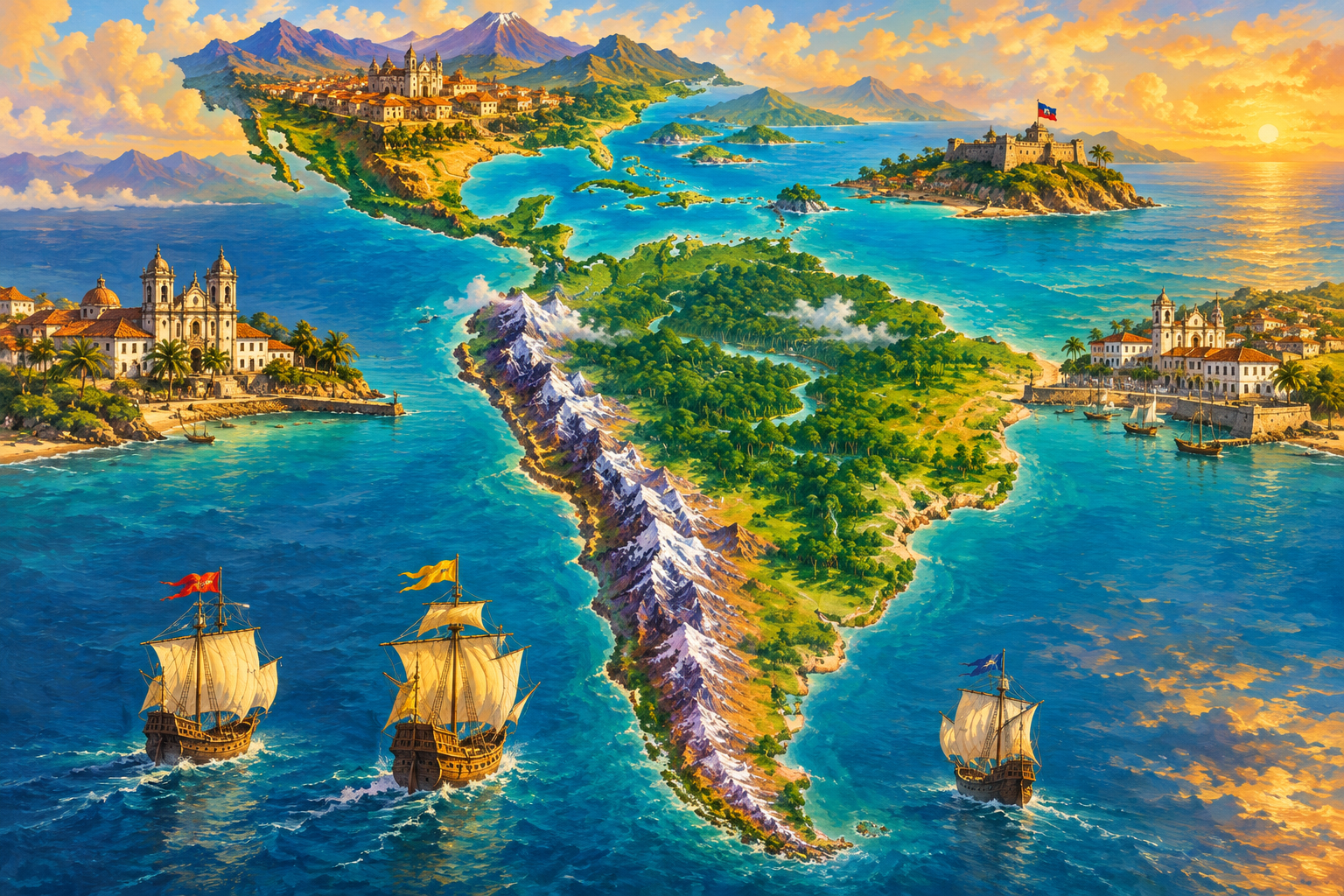
Latin America is the group of countries in the Americas where Spanish, Portuguese or French is the main language. These languages come from Latin, which is where the word “Latin” comes from. The region stretches from Mexico through Central America and the Caribbean to the southern tip of South America, and about 650 million people live there.
The label is a mix of language and history, not a strict geographic term. It says that a country was colonised by Spain, Portugal or France, and that it later won independence in the great wave that began with Haiti in 1804. To see how that wave started, read the hub page Latin American Independence (1791–1826).
Which countries are in Latin America?
Most lists count 20 countries. Eighteen use Spanish: Mexico, Guatemala, Honduras, El Salvador, Nicaragua, Costa Rica, Panama, Cuba, the Dominican Republic, Colombia, Venezuela, Ecuador, Peru, Bolivia, Chile, Argentina, Paraguay and Uruguay. Brazil uses Portuguese, and Haiti uses French (alongside Haitian Creole).
The edges are fuzzy. Puerto Rico is Spanish-speaking but is a US territory. French Guiana is a French overseas department in South America. Belize, Guyana and Suriname are in Central or South America but speak English or Dutch, so they are usually left out. Jamaica and Trinidad are Caribbean but English-speaking, so they are not counted either. Quebec in Canada speaks French, but it is not counted as Latin American.
The region is also not only European in origin. Indigenous languages such as Quechua, Guaraní, Nahuatl and many Maya languages are still spoken by millions of people. Guaraní is an official language of Paraguay, and Quechua is official in Peru alongside Spanish. Millions of people also descend from Africans who were forced across the Atlantic, especially in Brazil, Cuba and Haiti.
How did Latin America get its European languages?
In 1494, the Treaty of Tordesillas, backed by the pope, divided the lands outside Europe between Spain and Portugal along a north–south line in the Atlantic. In practice this gave Spain most of the Americas and Portugal the eastern bulge that became Brazil. France later took Saint-Domingue, the western part of the island of Hispaniola, which became Haiti.
Colonial rule lasted about three centuries. The Spanish crown ran its empire through viceroyalties, such as New Spain (centred on Mexico City) and Peru (centred on Lima). Society was layered by birth: people born in Spain held the top offices, American-born people of Spanish descent (criollos) were wealthy but excluded from the highest posts, and Indigenous, African and mixed-descent people were pushed to the bottom. These tensions are central to the story told in Causes of the Latin American Revolutions.
Why “Latin”? Where the name came from
The people who lived through independence did not call themselves Latin American. In 1810 they spoke of “the Americas”, “Spanish America” or their own new nations. The phrase appears a few decades later and is tied to the rivalry between language families.
In the 1830s the French thinker Michel Chevalier wrote about a “Latin” Europe (France, Spain, Italy) and a “Germanic” and “Anglo-Saxon” one, and he extended the contrast to the Americas. In 1856, writers from the region itself, including Francisco Bilbao of Chile and José María Torres Caicedo of Colombia, used “América latina” in Paris. They were alarmed by US expansion, such as the invasion of Mexico in 1846–1848, and wanted a name that stressed a shared identity apart from the United States.
France then turned the idea into policy. Under Napoleon III, the French government spoke of a “Latin race” and backed an intervention in Mexico from 1861. It installed the Austrian archduke Maximilian as emperor in 1864. The adventure ended in 1867 with Maximilian’s execution, but “Latin America” had become a common phrase. Today it is the standard name in English, Spanish, Portuguese, Japanese and many other languages.
Latin America, South America, Hispanic and Latino: what is the difference?
- Latin America is a cultural and linguistic region, from Mexico to Chile, that includes Brazil and Haiti.
- South America is a continent. It includes Latin American countries such as Peru and Brazil, and also Guyana and Suriname.
- Hispanic means connected to Spanish-speaking countries, including Spain. Brazilians are Latin American but not Hispanic.
- Latino (or Latina, or Latine) is mostly used in the United States for people with roots in Latin America.
- Iberoamerica adds Spain and Portugal themselves to the Spanish- and Portuguese-speaking Americas.
What the countries share, and what they do not
The countries share a colonial past, Catholic traditions, the legacy of the plantation and mining economies, and a similar story of independence in the early 1800s. They also share a long record of migration and mixture: the word mestizo describes people of mixed Indigenous and European descent, and many other mixtures exist.
They differ a great deal, too. Brazil alone has over 200 million people and Mexico about 130 million, while Uruguay has fewer than four million. Argentina and Uruguay received large waves of European immigrants in the late 1800s. Peru, Bolivia and Guatemala have large Indigenous populations. Cuba and Haiti are shaped by the Caribbean plantation world. Treating the region as one block misses these differences.
Why the idea matters for independence
Haiti’s revolution ended in independence in 1804, the first in the region, and the only successful large-scale uprising of enslaved people in modern history. After Napoleon occupied Spain in 1808, most Spanish American colonies began their own struggle, and by 1824 Spain had lost nearly all of its mainland empire. Brazil declared independence from Portugal in 1822. Spain kept Cuba and Puerto Rico until 1898.
The Venezuelan leader Simón Bolívar dreamed of a union of the new states, but it fell apart within a few years. The story of why he failed is told in Who Was Simón Bolívar?. The shared name “Latin America” came later, as a way to describe a unity that politics never produced. Mexico’s own path began with the Cry of Dolores in 1810, which is remembered every year on Mexican Independence Day.
What exams ask
- Know the definition: Latin America is the part of the Americas where Romance languages (from Latin) dominate, mainly Spanish, Portuguese and French.
- Be able to place Brazil (Portuguese) and Haiti (French) in the group, and explain why Guyana and Suriname are usually not.
- Know that the term spread in the mid-1800s, linked to French policy under Napoleon III and the intervention in Mexico.
- Link the region to the independence timeline: Haiti 1804, most Spanish colonies 1810–1825, Brazil 1822.
- In AP-style questions, expect to compare the Haitian and Spanish American revolutions, and to discuss the role of criollos and the Monroe Doctrine of 1823.
Read next
- Latin American Independence (1791–1826): the hub for the whole topic, with every key event in order.
- Causes of the Latin American Revolutions: why a colonial system that lasted three centuries cracked after 1808.
- Who Was Simón Bolívar?: the best-known leader of the independence wars and his failed dream of union.
- Mexican Independence Day (16 September): how the Cry of Dolores is remembered in Mexico today.