In five minutes
Utilitarianism is the moral theory that the right action is the one that produces the most happiness, or the least suffering, for everyone affected. Jeremy Bentham set it out in the late 1700s, and John Stuart Mill refined it in the 1800s. It is one of the ideas that shaped the 19th century, alongside liberalism, socialism and nationalism.
Its core test is simple: look at the results. Tradition, rank and religious authority do not count as reasons on their own. What counts is whether a law or a choice makes people's lives better or worse. That test made utilitarianism a tool for reformers, who used it to attack old laws that caused pain and served no purpose.
Where utilitarianism came from
By the 1700s, many thinkers in Britain and France were asking whether morality needed religion or custom to justify it. David Hume argued that usefulness lies behind much of what we call virtue. Claude Adrien Helvétius in France and Cesare Beccaria in Italy argued that laws should be judged by their effect on public happiness. Beccaria's book on crimes and punishments (1764) used this reasoning against torture and the death penalty.
Britain gave reformers plenty to work on. Its criminal law listed a very long run of offences punishable by death, including minor thefts. The legal system leaned on old custom and confused even lawyers, and Bentham, who trained as one, found it irrational and cruel. Industrial cities were also growing fast, with poverty and dirty water as new problems. Utilitarianism answered them with one message: check the results, then rebuild.
Bentham and the principle of utility
Jeremy Bentham (1748–1832) opened An Introduction to the Principles of Morals and Legislation, printed in 1780 and published in 1789, with a bold claim. Nature, he wrote, has placed humans under two masters, pain and pleasure. They decide what we do, and they should decide what we ought to do. He called the test the principle of utility: approve of an action if it increases the happiness of the people affected, and disapprove if it reduces it.
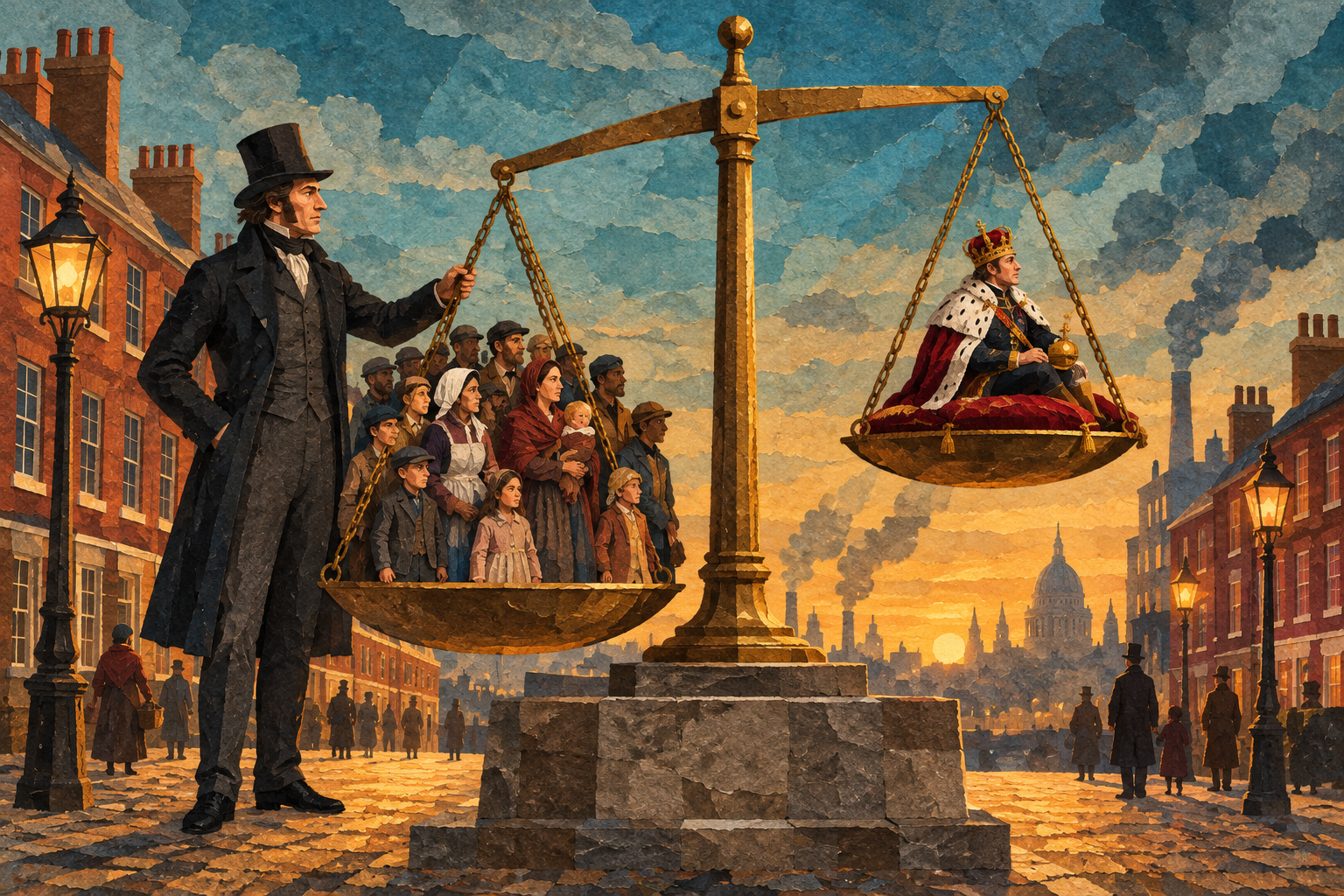
Two features made his version distinctive. First, everyone counts equally, so a king's pleasure weighs no more than a labourer's. Second, he wanted to measure. His “felicific calculus” listed what to weigh in a choice: how intense a pleasure or pain is, how long it lasts, how certain it is, how soon it comes, whether it leads to more of the same, whether its opposite is mixed in, and how many people it reaches. He did not expect anyone to do sums before every decision. It was a guide for lawmakers comparing laws. Because it counts happiness by amount, his view is called quantitative utilitarianism.
Bentham also argued that animals belong in the moral picture because they can suffer. In 1791 he published his plan for the Panopticon, a prison with a central watchtower from which every cell could be seen. It was never built as he drew it, but it shows his habit of designing institutions around results that can be observed.
Reform in practice: the Philosophical Radicals
Bentham's followers turned theory into politics. James Mill, a Scottish writer, and others known as the Philosophical Radicals pressed for wider voting rights, tidier law, education and free trade. Edwin Chadwick, who worked as Bentham's secretary near the end of his life, later helped shape the Poor Law Amendment Act of 1834 and pushed for sanitary reform, which led to the Public Health Act of 1848.
The record has light and shadow. Public health and legal reform improved many lives. The 1834 Poor Law, however, built a harsh workhouse system on the calculation that making relief unpleasant would push people into work. It is still cited as an example of “the greater good” loading heavy costs on the weakest. Bentham died in 1832. His preserved body, the auto-icon, is still kept at University College London.
John Stuart Mill: a more human version
John Stuart Mill (1806–1873) was raised by his father, James Mill, to carry on Bentham's work. By his own account he began Greek at the age of three. In 1826, at twenty, he fell into a deep depression. He had asked himself whether he would be happy if all his reform goals were achieved, and the honest answer was no. Poetry, especially Wordsworth's, helped him recover. He concluded that happiness comes more reliably from aiming at something else than from chasing it directly.
In Utilitarianism (essays in 1861, a book in 1863), Mill answered critics who called the theory a doctrine fit for pigs. He argued that pleasures differ in quality as well as amount. People who know both intellectual and bodily pleasures, he said, prefer the higher ones. Hence his line that it is better to be a human being dissatisfied than a pig satisfied, better Socrates dissatisfied than a fool satisfied. This view is called qualitative utilitarianism.
Mill also grounded justice and rights in utility: rules protecting people's basic interests matter so much to general happiness that they feel like absolute claims. In On Liberty (1859) he added the harm principle, which says society may limit an individual's freedom only to prevent harm to others. In 1867, as a member of Parliament, he moved an amendment to give women the vote. It was defeated, but it matched the argument of his later book The Subjection of Women (1869).
Bentham and Mill compared
- What counts as happiness: Bentham compared amounts of pleasure. Mill held that some pleasures are worth more than others.
- View of people: Bentham pictured people as driven by pleasure and pain. Mill added character, culture and self-development as part of a good life.
- Main interest: Bentham focused on law and institutions. Mill focused on individual liberty and growth.
- Shared ground: both judge actions by results and count every person's happiness equally.
Criticisms and later developments
- Minority rights: if the majority gains, may a minority be sacrificed? A standard example is punishing an innocent person to calm a mob.
- Measuring happiness: can feelings that differ from person to person be compared or added up?
- Integrity: if you must always maximise total happiness, must you give up your own commitments? Bernard Williams pressed this point.
- Separate persons: in A Theory of Justice (1971), John Rawls argued that utilitarianism treats society like one big person and takes the separateness of individuals too lightly.
Defenders responded by reshaping the theory. Henry Sidgwick gave it its most systematic defence in The Methods of Ethics (1874). Act utilitarians judge each action by its results, while rule utilitarians follow the rules that would produce the most happiness if everyone kept them. Peter Singer's Animal Liberation (1975) took Bentham's argument from suffering and applied it to how animals are treated. Today, utilitarian reasoning appears in cost-benefit analysis, welfare economics and health policy.
Utilitarianism in Japan
Mill's ideas reached Meiji Japan early. Nakamura Masanao translated On Liberty in 1872 as Jiyū no Ri, and Nishi Amane translated Mill's Utilitarianism under the title Rigaku in 1877.
What exams ask
- Contrast Bentham (quantity, measurable happiness, legal reform) with Mill (quality, higher pleasures, individual liberty).
- Know the key terms: principle of utility, felicific calculus, harm principle, “the greatest happiness of the greatest number”.
- Key dates: Bentham's Introduction (1789), On Liberty (1859), Mill's Utilitarianism (1863), the Poor Law (1834).
- Link the theory to its setting: Enlightenment reasoning, industrial cities and the push for reform in Britain, including the Reform Act of 1832.
- Typical essay: assess how far utilitarian ideas shaped British reform in the 19th century, and name one benefit and one harm.
- Do not mix up James Mill (the father) and John Stuart Mill (the son).
Read next
- Ideas That Shaped the 19th Century: the hub that places utilitarianism beside liberalism, socialism, nationalism and Darwin.
- John Stuart Mill's On Liberty: the harm principle in full, and how Mill defended individual freedom.
- Malthus and the Population Debate: the argument over poverty and population that set the scene for the 1834 Poor Law.
- What Is Nationalism?: another 19th-century idea, one that put the nation rather than the individual at the centre.