The Mexican War of Independence in five minutes
Mexican independence was a long, uneven struggle that ended three centuries of Spanish rule in New Spain, the colony that covered Mexico and much of what is now the southwestern United States. It began on 16 September 1810, when a parish priest, Miguel Hidalgo, called his neighbours in the town of Dolores to rise against bad government. It ended on 27 September 1821, when an army led by Agustín de Iturbide marched into Mexico City.
The war had three phases. First came a huge, poorly armed popular uprising led by Hidalgo and Ignacio Allende. Then came a more organised movement under José María Morelos, who wanted a new nation with a written constitution. Finally, after years of guerrilla fighting, independence arrived through an unlikely deal between a royalist officer and a rebel commander. It is one chapter in the wider story of Latin American independence.
Why New Spain was ready to break
New Spain was rich and deeply unequal. It had roughly six million people around 1810, and its silver mines made it one of the most valuable colonies in the world. But power was arranged by birth. The top jobs in government, the church and the army went mostly to peninsulares, people born in Spain. Criollos, people of Spanish descent born in Mexico, were often wealthy but were pushed to second place. Indigenous communities, mestizos and people of African descent paid tribute and taxes and had far fewer rights.
Resentment grew in the late 1700s. The Spanish crown raised taxes and demanded loans to pay for its wars in Europe. In 1804 a decree on church debts forced many landowners to repay mortgages quickly, which hurt criollo families badly. The ideas of the Enlightenment and the American and French revolutions also circulated among educated criollos, even though the authorities tried to control them. None of this meant revolution was certain. What it needed was a crisis at the top.
1808: Spain's crisis becomes Mexico's opening
The crisis came in 1808, when Napoleon's troops occupied Spain and forced King Ferdinand VII to give up the throne. Napoleon placed his own brother, Joseph, in charge. Across the Spanish world, a hard question appeared: who now ruled, and in whose name?
In Mexico City, criollos in the city council argued that sovereignty had returned to the people while the king was a prisoner, and that New Spain should govern itself in Ferdinand's name. Viceroy José de Iturrigaray was open to the idea. In September 1808, a group of Spanish-born merchants and officials overthrew him in a coup to protect their own position. The coup showed criollos that legal reform was blocked. Secret meetings began in several towns, including Valladolid (now Morelia) and Querétaro.
1810: The Grito de Dolores
The Querétaro conspiracy included the army captain Ignacio Allende and Josefa Ortiz de Domínguez, the wife of the town's chief magistrate. When the authorities discovered the plot in September 1810, the conspirators had to act or be arrested. Allende and his colleague Juan Aldama rode to the town of Dolores to warn Miguel Hidalgo, a priest well known for helping local people start small industries.
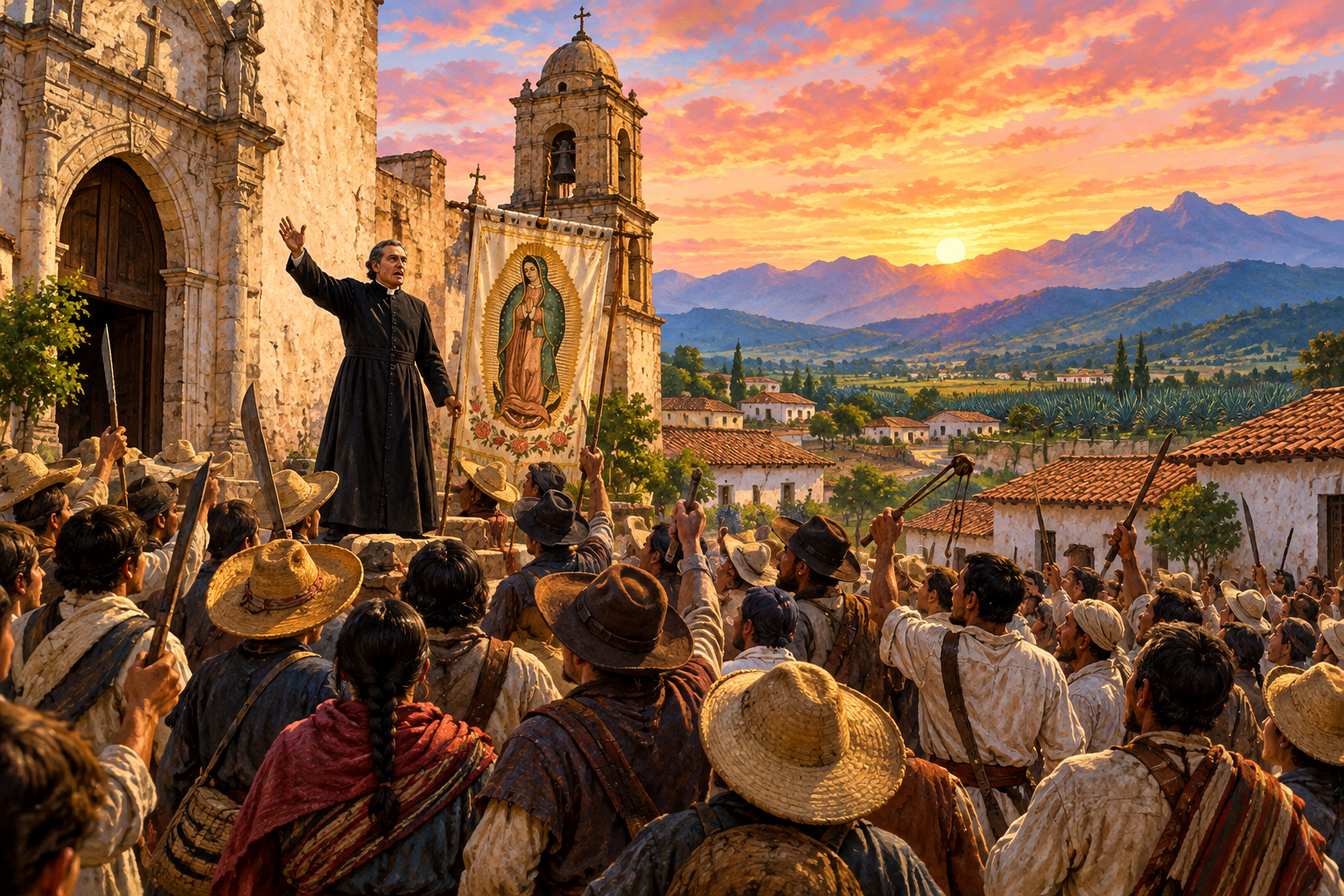
Early on 16 September 1810, Hidalgo rang the church bell and spoke to the crowd. The speech, known as the Grito de Dolores (the Cry of Dolores), called for an end to bad government and, in many accounts, for the removal of the Spaniards who held power. The exact words were never recorded, and versions differ. What is clear is the result: thousands joined him within days. Hidalgo took a banner showing the Virgin of Guadalupe, a symbol that spoke to Indigenous and mestizo villagers as much as to criollos.
The rebel army grew to tens of thousands of farmers, miners and workers, armed with farm tools, slings and a few muskets. On 28 September it stormed the Alhóndiga de Granaditas, a fortified grain store in Guanajuato where Spanish officials and royalist soldiers had taken shelter, and the fighting ended in a massacre. The violence frightened many criollos who had been sympathetic. In December 1810, Hidalgo issued a decree in Guadalajara ending slavery, a bold early step.
On 30 October 1810, at Monte de las Cruces, the rebels beat a royalist force and stood close to Mexico City. Then Hidalgo turned back, for reasons historians still debate, including shortages of ammunition and fear of the royalist army. The chance was lost. On 17 January 1811, a smaller, better-trained royalist force under Félix Calleja defeated the rebels at the Calderón Bridge. Hidalgo, Allende and other leaders were captured in March 1811. Hidalgo was stripped of his priesthood and shot at Chihuahua on 30 July 1811.
1811–1815: Morelos and the idea of a nation
The rebellion did not die. José María Morelos, a priest who worked in the south of Mexico, had joined Hidalgo in late 1810 and then led his own campaign. He was a disciplined organiser. He built a well-run army, held the town of Cuautla through a long siege in 1812, and took Oaxaca.
Morelos also wanted a clear political goal. In September 1813 he opened a congress at Chilpancingo and presented a document called Sentimientos de la Nación (Sentiments of the Nation). It called for full independence, for sovereignty to rest with the people, for the end of slavery and for the removal of legal distinctions based on caste. On 6 November 1813, the congress formally declared independence. In October 1814 it approved the Constitution of Apatzingán, which set out a republican form of government.
The timing was unlucky. In 1814 Napoleon's rule in Spain collapsed and Ferdinand VII returned, cancelled the liberal reforms that had been passed in his absence and sent reinforcements to the colonies. Royalist armies pushed the congress to keep moving. Morelos was captured in November 1815 and executed on 22 December 1815.
1815–1820: The long guerrilla war
After Morelos, there was no single rebel army. Fighters kept going in the mountains and the south. Vicente Guerrero held out in what is now the state of Guerrero, and Guadalupe Victoria in the hills of Veracruz. In 1817 a Spanish liberal, Francisco Xavier Mina, landed with a small expedition to support the cause and was captured and shot within months.
The royalists could not end the fighting, but the rebels could not win. Viceroys offered pardons, and many rebel leaders accepted them. By 1820 the war had settled into a stalemate that exhausted the colony's economy. Independence would not come from a rebel victory. It would come because a political change in Spain altered who wanted independence.
1820–1821: The Plan of Iguala
In 1820 a military revolt in Spain forced Ferdinand VII to restore the liberal Constitution of 1812. In New Spain, conservative groups, including senior churchmen and wealthy landowners, now feared that Madrid's liberals would reduce the privileges of the church and the army. Some of them began to see an independent Mexico, ruled by a monarchy and friendly to the church, as safer than staying with Spain.
Agustín de Iturbide, a criollo royalist officer who had fought rebels for a decade, was sent south in late 1820 to defeat Guerrero. Instead he opened talks. On 24 February 1821 he announced the Plan of Iguala. It set out three guarantees: the Catholic religion would remain the only religion, Mexico would be independent as a constitutional monarchy, and Spaniards and Mexicans would be united with equal rights. Guerrero accepted, and the two armies joined as the Army of the Three Guarantees.
Support spread quickly, and royalist commanders switched sides. In August 1821 the new Spanish representative, Juan O'Donojú, landed at Veracruz and found the colony already lost. On 24 August he signed the Treaty of Córdoba with Iturbide, recognising Mexican independence on the basis of the Plan of Iguala. The Army of the Three Guarantees entered Mexico City on 27 September 1821, and the Act of Independence was signed the next day.
What happened next
Spain's government rejected the Treaty of Córdoba, and no Spanish prince accepted the Mexican throne. In May 1822 Iturbide had himself proclaimed emperor, but his empire collapsed in March 1823 after generals rose against him. Mexico became a federal republic under the Constitution of 1824, with Guadalupe Victoria as its first president. Spain did not recognise Mexico until 1836.
The war left a damaged economy, a weak government and many unsettled questions about who the new nation was for. Slavery, which Hidalgo and Morelos had called to end, was finally abolished across the country under President Vicente Guerrero in 1829. Mexicans now celebrate the Grito on 16 September, the day the uprising started, rather than 27 September, the day independence was won.
What exams ask
- Causes: the criollo–peninsular divide, Bourbon taxes, Enlightenment ideas and Napoleon's invasion of Spain in 1808. In AP-style questions, the key point is that the crisis in Spain acted as a trigger, not the only cause.
- Compare phases: Hidalgo's mass uprising was a social revolt with weak organisation, Morelos's movement aimed at a constitutional republic, and the 1821 settlement was a conservative route to independence.
- Comparison with other cases: Mexico's independence involved popular rebellion from below, unlike many South American movements led by criollo elites, and it ended with a monarchy before becoming a republic.
- Key terms: peninsulares, criollos, Grito de Dolores, Sentimientos de la Nación, Plan of Iguala, Three Guarantees, Treaty of Córdoba.
Read next
- Mexican Independence Day (16 September): how the Grito became Mexico's national holiday.
- Who Was Simón Bolívar?: the leader of the independence struggle in South America, for comparison.
- Bolívar vs San Martín: Two Liberators: how the southern wars of independence were won.
- Latin American Independence (1791–1826): the full overview of the region.