Peter the Great in five minutes
Peter the Great ruled Russia from 1682 (on his own from 1696) until his death in 1725. He is remembered as the ruler who forced a large, inward-looking country to copy Europe's ships, armies, clothes and administration. He fought Sweden for twenty-one years, built a new capital on the Baltic, and ended his reign as the first Russian emperor. This page is part of our hub on The Russian Empire (1721–1917), which begins with the title he took in 1721.
The short answer to "what did Peter the Great do?" has four parts. He modernised the army and built a navy from almost nothing. He won access to the Baltic Sea. He rebuilt the state around service and rank instead of birth and custom. And he pulled the Russian elite toward Western manners and learning. Each of these came with force, taxes and forced labour.
Early life and the fight for power
Peter was born in Moscow in 1672, the son of Tsar Alexis and his second wife, Natalya Naryshkina. When Alexis's heir Feodor died in 1682, the throne was disputed between two families. The Streltsy, Moscow's palace guard regiments, rose up and killed several of Peter's relatives and supporters in front of the ten-year-old boy. The result was a compromise: Peter and his half-brother Ivan V were crowned together, and Ivan's sister Sophia ruled as regent.
Peter grew up mostly outside the Kremlin. He played at war with boys from the court and the village, and he spent time in the foreign quarter of Moscow, where Dutch, German and Scottish craftsmen and officers lived. There he picked up an interest in ships, gunnery and mathematics. In 1689 he turned against Sophia and had her sent to a convent. Ivan stayed co-tsar in name until he died in 1696, and from then Peter ruled alone.
Azov and the Great Embassy
Peter's first big goal was a port on a warm sea. In 1695 he attacked the Ottoman fortress of Azov, near the mouth of the Don, and failed because he had no ships to cut it off. He built a river fleet at Voronezh in a single winter and took Azov in 1696. It was Russia's first real naval success.
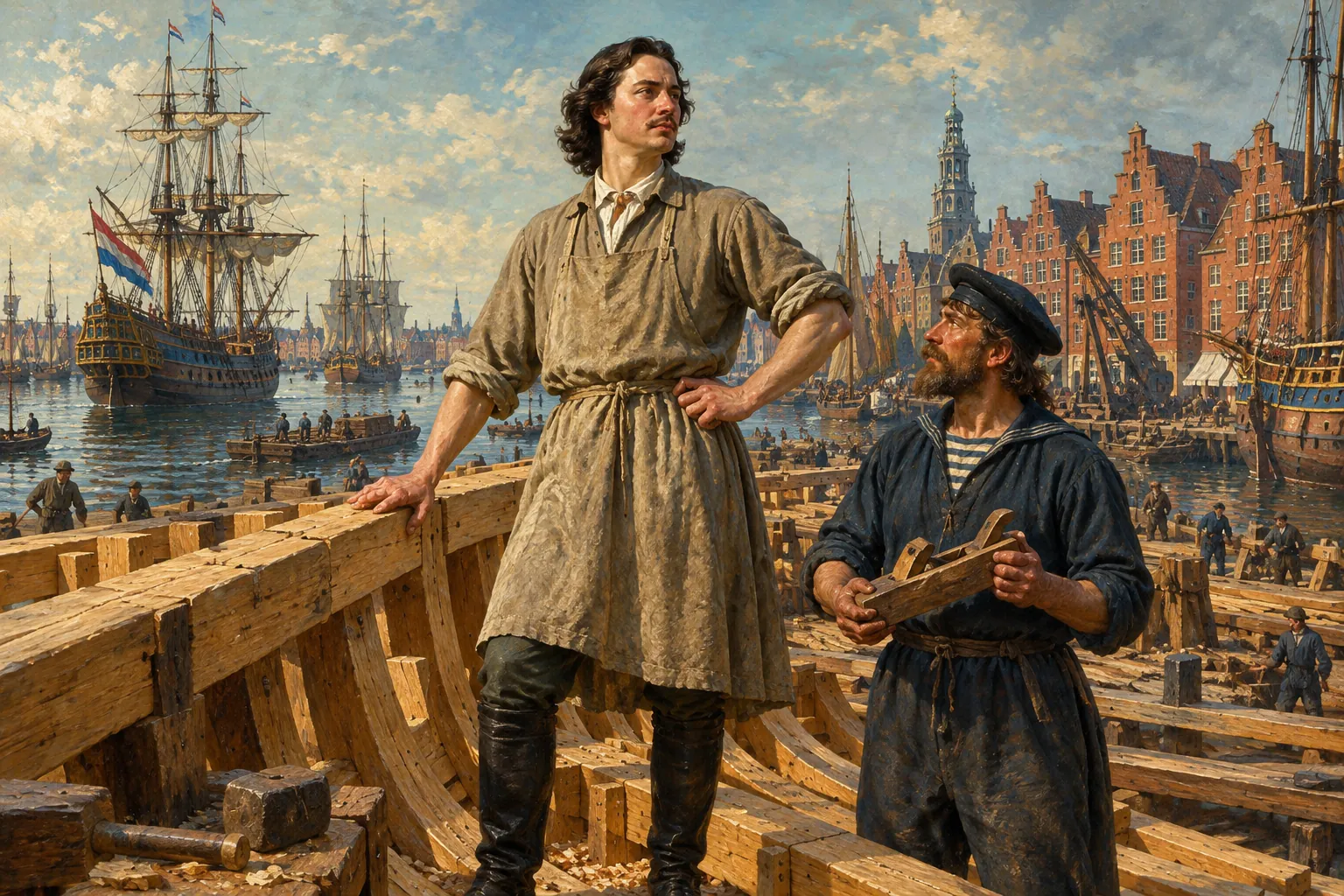
In 1697 he set out on the Great Embassy, a long tour of Europe, travelling under a plain name as a member of the party. He worked in a shipyard in the Dutch Republic, studied shipbuilding in England, and recruited hundreds of engineers, sailors and officers. The trip ended early, in 1698, when he heard that the Streltsy had rebelled again. The revolt was put down, and the regiments were broken up. Hundreds were executed in a brutal inquiry led by Peter himself.
The Great Northern War
Peter had hoped to take a Baltic coast from Sweden, then the leading power of northern Europe. In 1700 he joined Denmark and Poland-Saxony against the young Swedish king Charles XII. Near Narva that November, the Swedes beat a larger but poorly trained Russian army. Peter used the years that followed to rebuild: church bells were melted into cannon, new regiments were drafted, and officers were trained along European lines.
The war turned in Russia's favour. Russian troops captured Swedish forts on the Neva river, and in 1703 Peter laid the Peter and Paul Fortress, the start of St Petersburg. The decisive moment came in 1709 at Poltava, in Ukraine, where Charles XII's army was destroyed. The Russian fleet won at Gangut in 1714. The war ended with the Treaty of Nystad in 1721. Russia kept Livonia, Estonia, Ingria and part of Karelia, and it was now the strongest power around the Baltic. Peter lost one gamble along the way: in 1711 an army sent against the Ottomans was trapped at the Prut river, and he had to hand Azov back.
A new capital and a new state
St Petersburg was built on marshland, mostly by conscripted workers who lived in poor conditions, and many died. The government moved there in 1712. The city was meant to look like a European port, with straight streets, stone buildings and a naval base, and nobles were ordered to build houses there.
Peter changed how the state worked. He set up the Senate in 1711 as the highest government body when he was away on campaign. Around 1717–1718 he replaced the old Moscow offices with colleges, which were departments for foreign affairs, war, the navy, finance and more, modelled on Swedish and German practice. After the patriarch died in 1700 he left the post empty, and in 1721 he created the Holy Synod to govern the church, so the church answered to the ruler. The Table of Ranks of 1722 set out fourteen levels of service in the army, navy and civil government. A man who reached a certain rank could become a noble, so promotion by service became possible for people of lower birth.
In 1718 he introduced a poll tax, charged per male peasant instead of per household, to pay for the army. It pushed up the number of people on the tax rolls and tied peasants more firmly to the land and their owners. Under Peter, serfdom became harsher, not looser (see Serfdom in Russia).
Changing how Russians lived
Peter wanted nobles to look and behave like Europeans. He ordered men at court to shave their beards or pay a tax, and to wear Western-cut clothes. He started the first Russian newspaper in 1702, simplified the alphabet for printed books, and began the Julian calendar year on 1 January from 1700. Nobles were sent abroad to study, and the Academy of Sciences was set up by decree in 1724 and opened after his death. Some of this changed court life quickly. Most villagers hardly noticed.
The cost, and the end of his reign
The price was high. War and construction took money and men from villages, and the army took recruits for life. Peter was suspicious of anyone who resisted. His son Alexei fled abroad, was brought back, and died in prison in 1718 after being tried for treason. Peter had also changed the succession law in 1722, so the ruler could name an heir. Then he died in February 1725 without naming one. His wife Catherine took the throne as Catherine I, backed by the guards regiments and senior officials, and later rulers, including Catherine the Great, built on his legacy.
Why historians still argue about him
Supporters point to the navy, the army, the Baltic coast and the new institutions. Critics say he exaggerated the break with the past, that many reforms were rushed and harsh, and that he strengthened an autocracy that left little room for ordinary people. Both views agree on the main point: after Peter, Russia was a major player in European politics. Many of the pressures that led to the Russian Revolution of 1917 have roots in the state he built.
What exams ask
- Dates: the Great Embassy (1697–1698), Narva (1700), St Petersburg (1703), Poltava (1709), the Treaty of Nystad (1721) and the imperial title (1721).
- Significance (AP-style): Western-style modernisation imposed from above, with state service as the basis for status and serfdom strengthened to pay for it.
- Comparisons: Peter's top-down reforms versus later reformers such as Catherine the Great and Alexander II.
Read next
- Catherine the Great: the empress who expanded the state Peter built.
- Serfdom in Russia: how Peter's taxes and conscription fitted into a system that lasted until 1861.
- The Russian Revolution of 1917: the end of the empire that Peter proclaimed.