This article is part of the hub Qing China, Japan and the West (1793–1912).
In five minutes: the First Sino-Japanese War cartoon
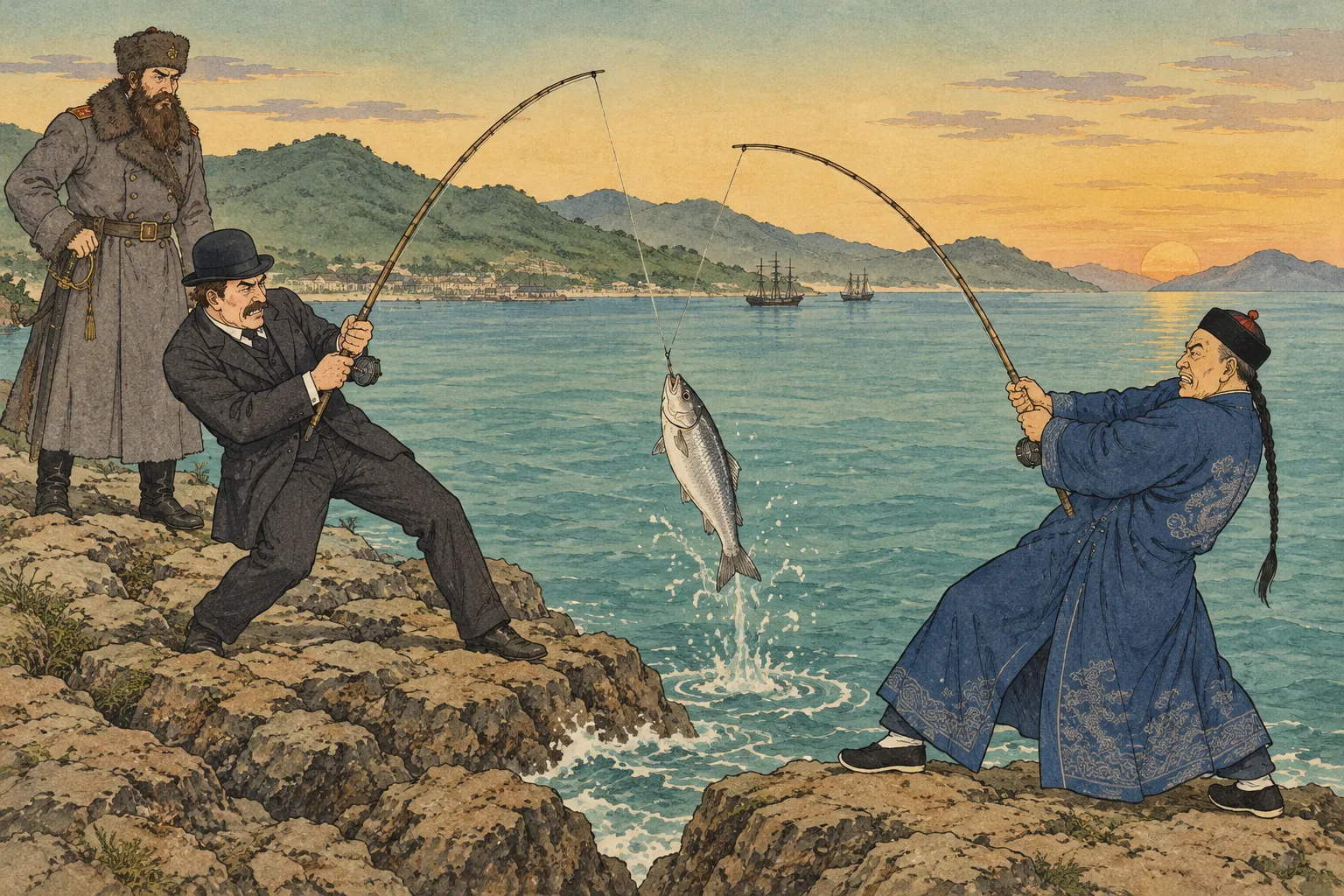
When people search for a cartoon of the First Sino-Japanese War, they usually mean one picture: "Fishing Game" by the French artist Georges Bigot, published in 1887. Two men, one for Japan and one for China, fish for the same fish. The fish stands for Korea. A third figure, standing for Russia, waits behind them and watches the catch.
The key point is the date. The picture was published in 1887, but the war began in 1894. So it does not show a battle. It shows the rivalry that made the war likely: Japan and China both wanted influence over Korea, and Russia was a growing power in the north who might benefit from their quarrel.
That is why textbooks use it. One image lets a student explain the causes of the war, the roles of the three powers and the reason Korea mattered, all in a few sentences.
What the cartoon shows
Read it in the order a teacher would ask you to.
- The two fishermen. The Japanese figure wears Western-style clothes, a sign of Meiji Japan's rapid modernisation. The Chinese figure wears Qing dress and a braided queue, which marks the Qing dynasty.
- The fish. It is Korea, the thing everyone wants. Korea is shown as an object, not a player. That is part of the point: the great powers were deciding Korea's future around it.
- The figure at the back. This is Russia. He is not fishing, but he is ready. Russia was extending its reach in East Asia and had a border with Korea by the 1860s.
A common mistake is to say the cartoon shows Japan winning. It does not. It shows a contest that had not yet been decided, with a third power waiting.
Who was Georges Bigot?
Georges Bigot (1860–1927) was a French artist who came to Japan in 1882 and taught at the Army Academy in Tokyo. He sketched daily life closely and published a satirical magazine, Tobae, from 1887. His cartoons mocked both Japanese society and foreign residents. Because he was an outsider living in Japan, he saw the region's politics from a distance, which makes his work useful as evidence of how international rivalries looked at the time.
Remember the limits as well. A cartoon is an opinion, not a record of facts. It tells you what one observer believed was going on, and exam questions often ask you to say exactly that.
How to analyse a cartoon as a source
Historians do not treat a cartoon as a photograph. They ask a fixed set of questions, and you can use the same set on Bigot's picture.
- Who made it? A French artist living in Japan. He was not a Japanese official, a Chinese statesman or a Korean, so none of the three sides is speaking for itself.
- When and where? 1887, in a magazine printed in Japan. It came out seven years before the fighting, so the artist could not know how events would turn out.
- For whom? Readers of a satirical magazine, many of them foreign residents and educated Japanese. Humour works by exaggeration, so the figures are types, not portraits.
- What does it choose to show? Three powers and one prize. It leaves out the Korean court, Korean opinion and the other Western powers, such as Britain, which also cared about the region.
- What is its message? Korea is the object of a rivalry, and a third power may gain from the quarrel.
This last point is worth a sentence in any answer. The cartoon is good evidence for what an outside observer thought about East Asian tensions. It is weaker evidence for what Korean people wanted, because Korea has no voice in the picture.
Why Korea? The causes behind the picture
Korea sat between China, Japan and Russia. For centuries the Joseon court had a tributary relationship with the Qing. Japan, after its modernisation, wanted Korea to be independent of China, partly for its own security. In 1876 Japan forced Korea to sign the Treaty of Ganghwa, which opened ports and described Korea as an independent state. China, in response, increased its influence over the Korean court.
By the 1880s the two sides were competing in Seoul. Russia's expansion added pressure, especially as it planned the Trans-Siberian Railway, which began construction in 1891. That is the world Bigot drew in 1887.
The spark came in 1894. A peasant movement, the Donghak Peasant Revolution, spread across southern Korea, and the Korean government asked for Qing help. China sent troops. Japan, saying it had not been told in the way the 1885 Tianjin agreement required, sent its own, and a much larger force.
From cartoon to war, 1894–1895
The war that followed went quickly. Fighting began at sea off Pungdo on 25 July 1894, and Japan declared war on 1 August. Japanese forces took Pyongyang in September. The naval battle at the Yalu River, on 17 September, gave Japan control of the sea. Port Arthur fell in November, and Weihaiwei in February 1895.
The war ended with the Treaty of Shimonoseki, signed on 17 April 1895 by Itō Hirobumi and Mutsu Munemitsu for Japan and Li Hongzhang for China. Under it:
- China recognised Korea's full independence.
- China ceded Taiwan, the Penghu Islands and the Liaodong Peninsula.
- China paid an indemnity of 200 million silver taels.
- More Chinese ports and rivers were opened to Japanese trade.
In effect, the Qing had lost the fishing contest, and Japan had become the leading power in East Asia.
Why the war mattered
The war changed the balance of power in East Asia, and it is worth seeing the effects for each side.
- For Japan. It was the first major war fought by the new army and navy built since the Meiji Restoration. The victory raised Japan's standing among the great powers, and it gained its first overseas colony in Taiwan, which it held until 1945.
- For China. The defeat exposed how weak the Qing state had become. It added to calls for reform and, in the years that followed, to pressure from foreign powers seeking ports and special rights.
- For Korea. Independence from China on paper did not mean freedom in practice. Japanese influence in Seoul grew, and Korea was drawn into the next contest between Japan and Russia.
Seen this way, the war was not an isolated event. It was a step between the Qing decline begun in the Opium War and the rivalry that produced the Russo-Japanese War ten years later.
What happened next: Russia steps forward
The figure at the back of Bigot's picture soon moved. Six days after the treaty, on 23 April 1895, Russia, Germany and France advised Japan to give up the Liaodong Peninsula. Japan, unable to resist all three, returned it in exchange for a larger indemnity. This is the Triple Intervention.
Russia then gained influence in Manchuria, which set it on a collision course with Japan and led to the Russo-Japanese War of 1904–1905. Korea, whose king proclaimed the Korean Empire in 1897, was eventually annexed by Japan in 1910. Seen from that distance, Bigot's picture looks like an early map of the next twenty years.
What exams ask
In AP-style or source-based questions, this cartoon tests four skills.
- Identify the symbols: the two fishermen, the fish and the observer represent Japan, China, Korea and Russia.
- Explain the context: competition for influence in Korea, Qing decline and Meiji modernisation.
- Judge the source: a French artist in Japan, published in 1887, a satirical magazine, so it shows opinion and perspective.
- Link to outcomes: the 1894–1895 war, the Treaty of Shimonoseki and the Triple Intervention.
Do not claim that the cartoon depicts the war itself, and do not call Russia a participant in the fighting. Russia did not fight in this war; it acted afterwards.
Read next
- The Donghak Peasant Revolution (1894): the uprising that gave both Qing China and Japan a reason to send troops into Korea.
- The Triple Intervention (1895): how Russia, Germany and France forced Japan to give back the Liaodong Peninsula.
- The First Opium War (1839–1842): the earlier defeat that began the Qing dynasty's long struggle with foreign powers.
- Qing China, Japan and the West (1793–1912): the full topic overview.