The steam engine in five minutes
The steam engine is a machine that uses the pressure of steam to produce motion. Water is boiled, the steam pushes a piston inside a cylinder, and the piston's movement does work: pumping water, turning a wheel or pulling a train. It sits at the heart of the Industrial Revolution because it let people make power wherever they had coal and water, not only beside a fast river.
Who invented it? There is no single answer. Thomas Savery patented a steam water pump in 1698. Thomas Newcomen built the first practical piston engine, which was working at a coal mine near Dudley by 1712. James Watt, a Scottish instrument maker, then redesigned the engine in the 1760s and 1770s so that it wasted far less fuel. Watt is the name most people remember, and he deserves credit for the improvement, but he did not build the first steam engine.
How a steam engine works
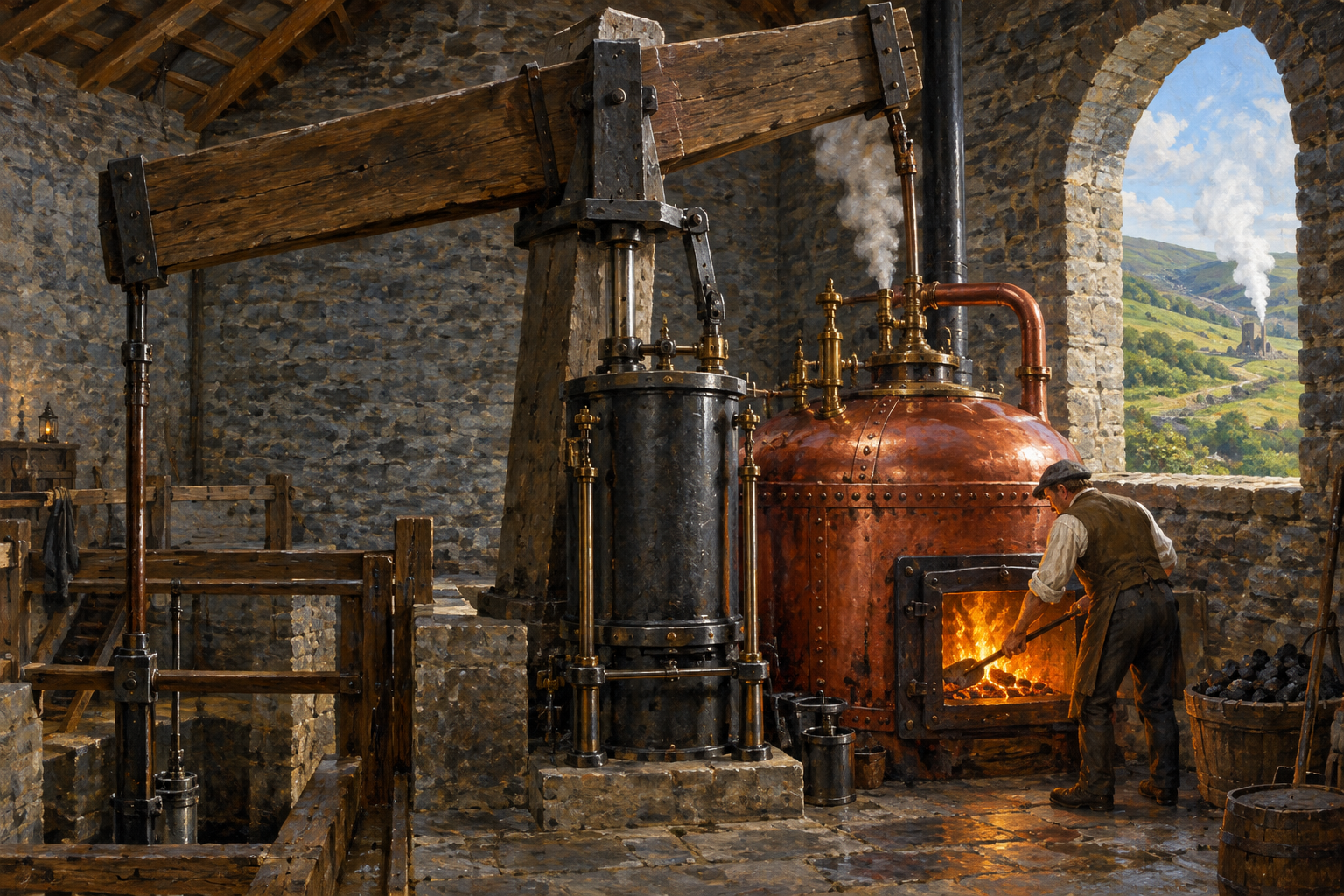
Every early steam engine has the same four parts: a boiler that makes steam, a cylinder, a piston that slides inside the cylinder, and some kind of rod or beam that carries the piston's movement outside. Steam goes into the cylinder, the piston moves, and the rod passes that motion to a pump or a machine.
The clever part is how the steam is used. There are two ways. In the first, the pressure of the steam itself pushes the piston. In the second, the steam is cooled back into water so that the space inside the cylinder becomes a partial vacuum, and the weight of the outside air pushes the piston instead. Newcomen's engine worked mainly in the second way. Watt kept the vacuum idea but also let steam push, and later high-pressure engines made steam pressure the main force.
Before Watt: Hero, Papin and Savery
Steam power is older than most people think. In the first century AD, Hero of Alexandria described a hollow ball that spun when steam jetted out of two bent pipes. It is called an aeolipile. It was a clever demonstration, but nobody used it to do real work.
In the 1670s the French inventor Denis Papin built a steam digester, an early pressure cooker with a safety valve. Later he suggested that steam could push a piston in a cylinder, which was the key idea of the engines to come.
The first machine sold for real work was Thomas Savery's pump. Savery took out a patent in 1698 and called his device the Miner's Friend. It had no piston. Steam filled a closed vessel and was cooled, which sucked water up from below, and fresh steam pressure then forced the water higher. The idea was useful but limited: it could lift water only so far, and high-pressure boilers of the day could burst.
Newcomen: the first practical engine
Thomas Newcomen was an ironmonger and blacksmith from Dartmouth in Devon. Working with John Calley, he built an engine that was running at a coal mine near Dudley Castle in 1712. Mines of the time had a constant problem: water seeped into the shafts, and the deeper miners dug, the more water they had to remove.
Newcomen's engine solved it with a large rocking beam. Steam entered a cylinder under the piston while the weight of the pump rods pulled the piston up. Then a spray of cold water condensed the steam. The vacuum that resulted let the air above the piston push it down, and the beam swung to work the pump. The cycle repeated all day.
The weakness was waste. The cylinder was heated by steam and then cooled by water on every stroke, so a great deal of coal went into reheating metal rather than doing work. At a colliery, where small coal was cheap, that was acceptable. Newcomen engines spread across British mines and then to parts of Europe, and they made deeper mining possible.
Watt: the separate condenser
James Watt was an instrument maker at the University of Glasgow. Around 1763 he was asked to repair a small model of a Newcomen engine. He noticed that the model used a surprising amount of steam and worked out why: the cylinder was being cooled and reheated on every stroke.
His answer, which he developed in 1765, was to condense the steam in a separate vessel, the condenser, so the cylinder could stay hot. He patented the idea in 1769. Money and metalworking were the next obstacles. After a first backer ran into trouble, Watt joined the Birmingham manufacturer Matthew Boulton, and in 1775 they formed a partnership at the Soho works. In the same year Parliament extended Watt's patent to 1800. Accurate cylinders came from the ironmaster John Wilkinson, whose boring machine could cut them far more precisely than earlier methods.
Boulton and Watt often charged customers a share of the coal money the new engine saved them, which tells you how much fuel their design cut. More improvements followed:
- 1781: a patent for turning the piston's back-and-forth motion into rotation, using a sun-and-planet gear, so that engines could drive mill machinery.
- 1782: the double-acting engine, in which steam pushes the piston in both directions.
- About 1788: a centrifugal governor that kept the speed steady.
Watt also measured engine power against the work of horses, which is where horsepower comes from. The unit of electrical power, the watt, is named after him.
From pumps to trains and ships
Watt's engines worked at low pressure and were large and heavy. The next step was to use stronger steam in smaller machines. The Cornish engineer Richard Trevithick built a steam road carriage in 1801 and, on 21 February 1804, ran a locomotive on a tramway at Penydarren in South Wales. It pulled about ten tons of iron and a party of men some nine miles, though the brittle cast-iron rails cracked under the weight and the experiment was not repeated.
Others carried on. In the United States, Robert Fulton's steamboat Clermont began carrying passengers on the Hudson River between New York and Albany in 1807. In England, George Stephenson's locomotive pulled the first trains on the Stockton and Darlington Railway in 1825. His Rocket won the Rainhill trials in 1829, and the Liverpool and Manchester Railway opened in 1830 as the first line run entirely by steam locomotives to a timetable.
Why the steam engine mattered
- Power anywhere. Water wheels need a river. Steam engines need coal and water, so factories could be built in towns, near workers and markets.
- Deeper mines. Engines pumped out floodwater, so more coal and metal could be dug, which fed the engines themselves.
- Faster transport. Railways and steamships cut journey times and moved bulk goods cheaply, linking regions and continents.
- A coal economy. The engine tied industry to fossil fuel and brought smoke and polluted air to growing cities, a legacy that is still with us.
The effects reached Japan too. In 1853 Commodore Matthew Perry arrived off Japan with steam-powered warships, and in 1872 Japan opened its first railway, between Shimbashi and Yokohama.
What exams ask
- Inventor or improver? Strong answers say Watt greatly improved an existing machine. Newcomen built the first practical piston engine.
- Order. Savery (1698), Newcomen (1712), Watt's patent (1769), Trevithick's locomotive (1804), Fulton's Clermont (1807), Stockton and Darlington (1825).
- Significance. A typical AP-style point: steam freed industry from rivers, drove urbanisation, and made railways and steamships possible, which linked world markets.
- Common slip. Spinning and weaving machines mechanised cotton production; the steam engine was the power source that let those machines move away from waterfalls.
Read next
- James Watt: What Did He Invent? follows his life and the details of his patents in more depth.
- Inventions and Inventors of the Industrial Revolution places the engine among the machines that changed textiles, iron and transport.
- Eli Whitney's Cotton Gin shows how another invention reshaped the cotton trade on the other side of the Atlantic.