The Viet Minh and the August Revolution in five minutes
The Viet Minh was founded in 1941 to unite people seeking Vietnamese independence. In August 1945, Japan’s surrender weakened the government it had supported in Vietnam. Viet Minh organizers and local supporters moved quickly, taking control of government offices in Hanoi and other cities. On 2 September, Ho Chi Minh proclaimed the Democratic Republic of Vietnam.
The declaration was a beginning, not a settlement of every question about Vietnam’s future. France sought to restore its authority, and fighting eventually grew into the First Indochina War. The later division of Vietnam and the American war are part of the longer story covered in our Vietnam War guide.
Why did the Viet Minh emerge?
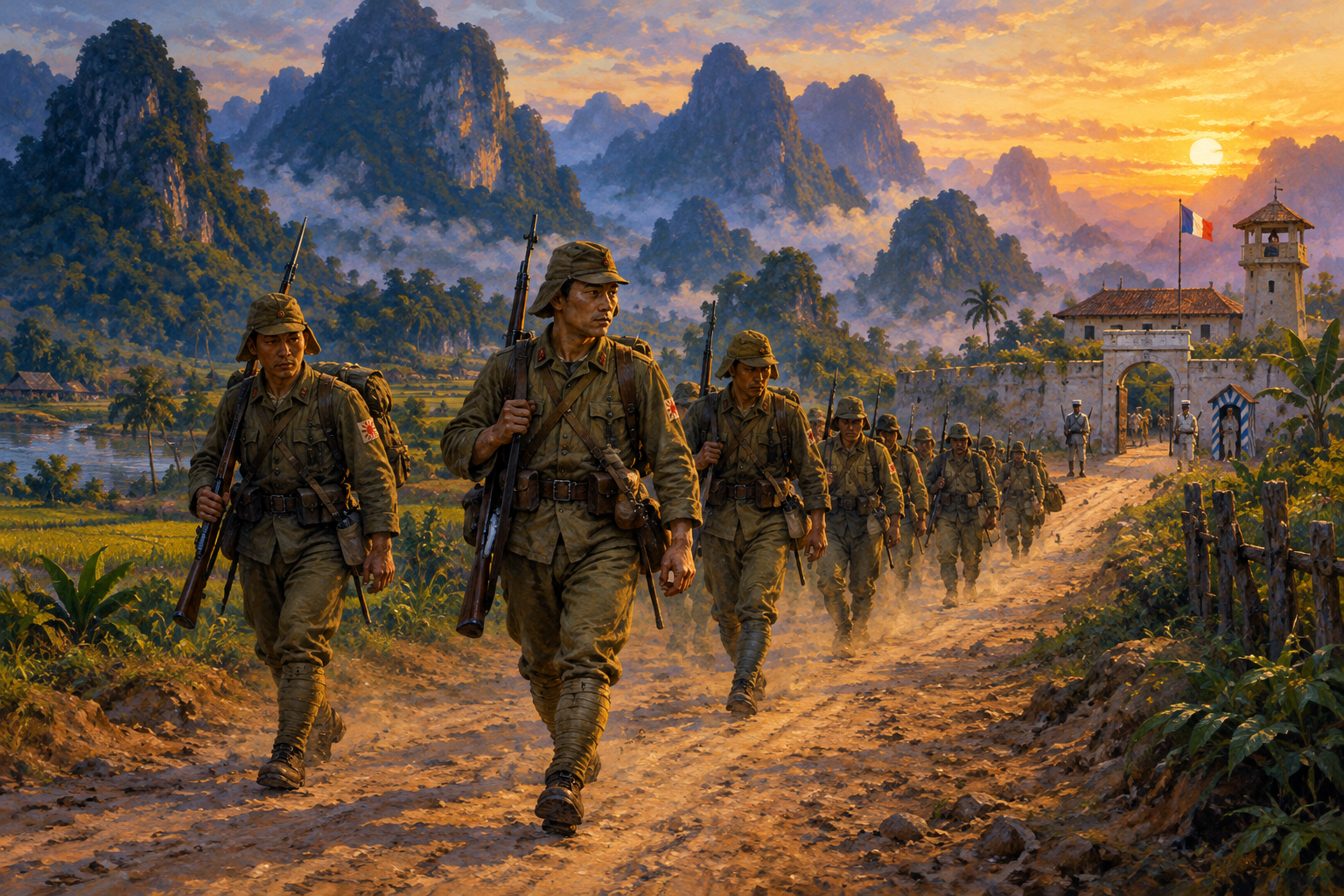
Vietnam had been under French colonial rule for decades. During the Second World War, Japanese forces entered French Indochina, but French colonial officials initially continued to administer it. Vietnamese people therefore lived under a colonial system in which Japanese military power and French administration overlapped.
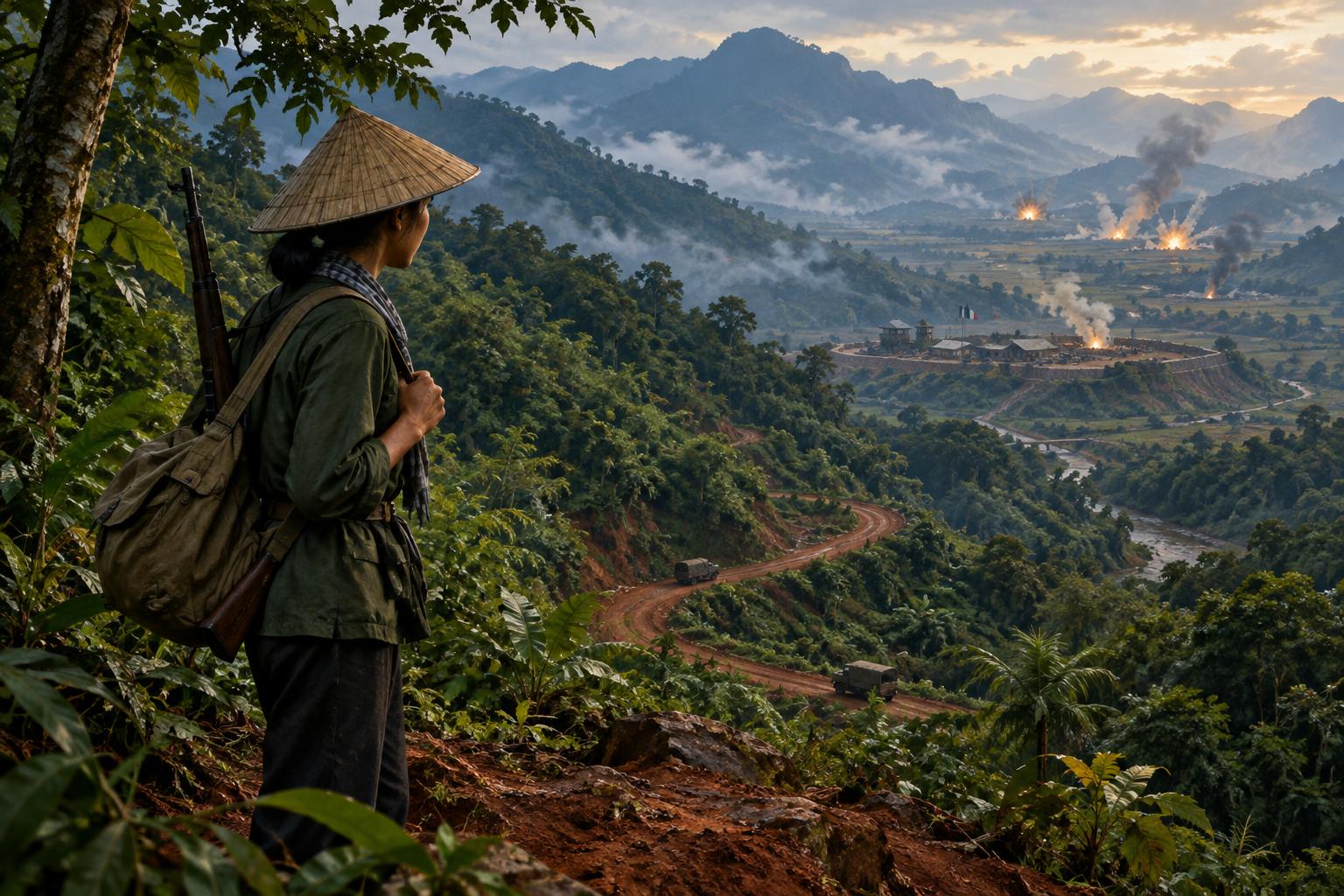
Ho Chi Minh and other activists founded the Viet Minh, short for the League for the Independence of Vietnam, in 1941. The Indochinese Communist Party played a central role in its leadership, but the Viet Minh presented itself as a broad national front for independence. Its members organized supporters, spread their message and built a base in the countryside. It was a political movement as well as an armed one.
The distinction matters. The party was a communist political organization; the Viet Minh was a wider independence front led by people associated with that party. The two were closely connected, but their names do not describe exactly the same organization. For more on the best-known leader, see Who Was Ho Chi Minh?
Colonial rule also shaped the range of demands that the front could bring together. Independence could appeal to people with different social backgrounds and political beliefs, even when they did not share a communist program. That breadth was useful, but it did not mean that all Vietnamese nationalists agreed with the Viet Minh or accepted its leadership.
Building a front required more than choosing a name. Organizers needed trusted local contacts, ways to communicate and people willing to take risks. Such networks gave a national call for action a better chance of being heard outside the leadership's own base. They also connected political aims to the everyday concerns of potential supporters.
Why did the revolution happen in August 1945?
In March 1945, Japan overthrew the French colonial administration in Indochina. A Vietnamese government headed by Emperor Bao Dai operated under Japanese sponsorship. This removed the existing French administrative structure, but it did not give Vietnam freedom from Japanese military power.
At the same time, a devastating famine struck northern Vietnam. Hunger and the disruption of war damaged livelihoods and confidence in those governing. Viet Minh appeals around food and independence helped the movement connect immediate needs with its wider political cause. The guide to Operation Meigō and the famine explains this background in more detail.
Japan’s announcement of surrender in August created the immediate opening. Its forces remained present, but the authority of a government dependent on Japan was badly weakened. The Viet Minh had already built networks that could act in this unstable moment. Both the international shift and years of organizing help explain the speed of events.
The March change and the August surrender should be kept separate. In March, Japan removed French officials while remaining the dominant military power. In August, Japan itself announced defeat. The second change made the position of its Vietnamese allies much less secure and opened a brief opportunity before other foreign powers established their postwar presence.
Food shortages were not the sole cause of the revolution, and they did not affect every region in the same way. They nevertheless help explain why arguments about who governed and who could provide relief had immediate force. Political authority was being judged in the midst of a crisis of survival.
What happened during the August Revolution?
In mid-August, Viet Minh leaders called for a general uprising. A national congress at Tan Trao supported the uprising and selected a national liberation committee headed by Ho Chi Minh. The call reached a country where local conditions and the balance of forces varied considerably.
On 19 August, crowds in Hanoi joined Viet Minh organizers in taking over key government offices. The transfer of authority in the capital gave the movement an important political centre. Uprisings and transfers of power followed in other places, including Hue and Saigon. These events were connected, but they were not identical: local organizers, existing officials and the Japanese presence shaped what happened in each place.
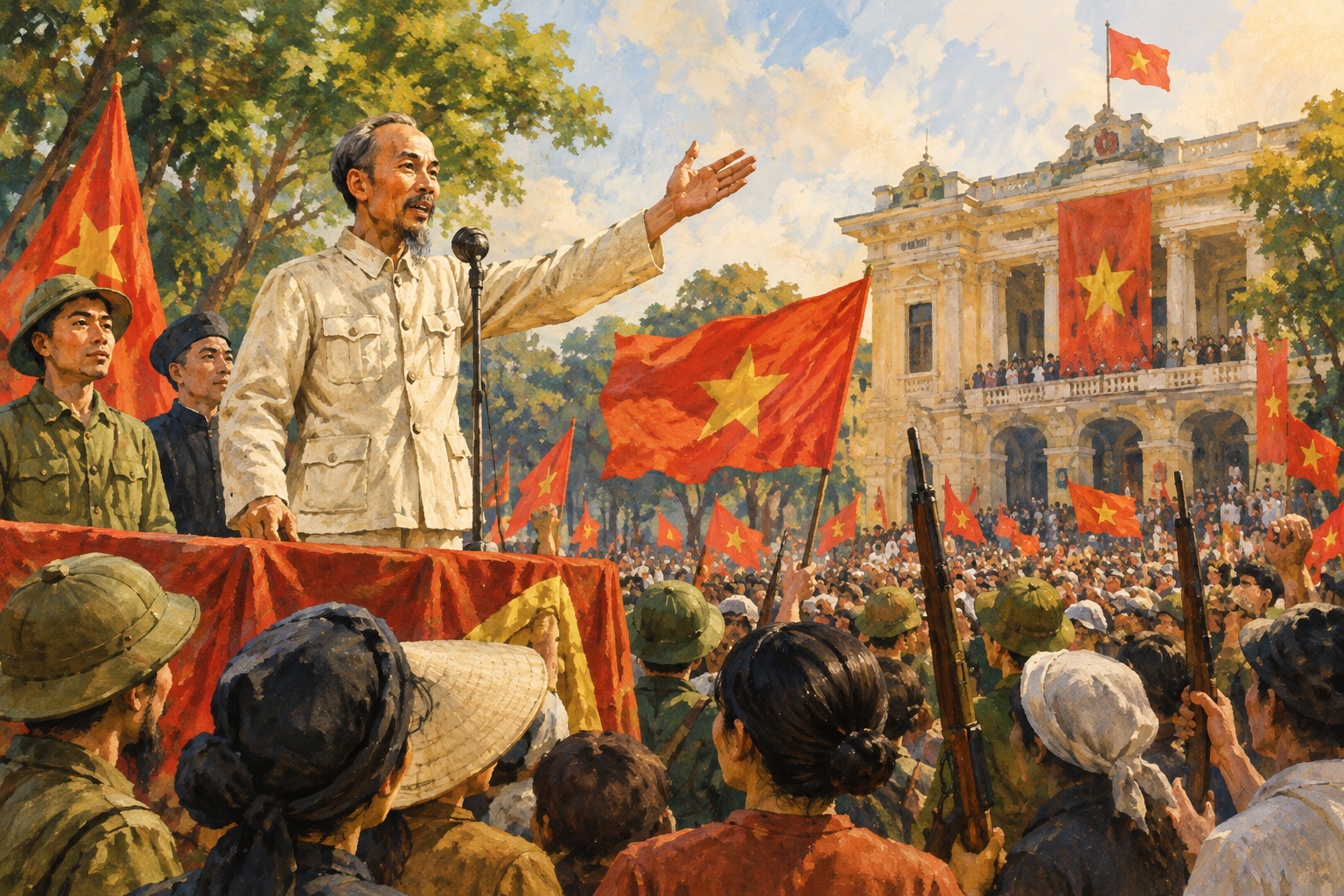
Emperor Bao Dai abdicated at the end of August. On 2 September, Ho Chi Minh read a declaration of independence in Hanoi’s Ba Dinh Square. The new state was called the Democratic Republic of Vietnam. Its declaration appealed to principles of rights and freedom while condemning French colonial rule.
Taking an office was only one part of taking power. A movement also needed people to recognize its authority, maintain order and communicate decisions. Demonstrations made support visible, while negotiations and changes within existing institutions could help transfer control. The balance among these methods differed from place to place.
Events in Hanoi mattered because the capital offered a place from which leaders could claim to speak for the country. Yet a change in the capital did not automatically resolve conflicts elsewhere. The revolution is best understood as a sequence of connected local actions rather than a single ceremony or a uniform military campaign.
What happened after independence was declared?
Japanese surrender brought Allied forces into Indochina to oversee the disarmament of Japanese troops. Chinese Nationalist forces entered the north, while British forces entered the south. France sought to return, and the new Vietnamese government faced both foreign pressure and competing Vietnamese political forces.
Conflict in the south and negotiations over Vietnam’s future showed that a declaration alone could not settle who would govern. Relations between France and the Viet Minh deteriorated, and full-scale war broke out at the end of 1946. The August Revolution therefore belongs both to the end of the Second World War and to the longer history of decolonization in Southeast Asia.
The arrival of Allied troops also shows why the end of one war did not instantly produce a stable peace. Their immediate task was connected to Japan's surrender, but their presence affected the struggle over who would exercise authority. In the south, the return of French power became a focus of armed conflict; in the north, the new government had to navigate a different set of pressures.
For the Vietnamese leadership, diplomacy and mobilization both mattered. The declaration gave the new government a public statement of its claim, while negotiations sought a way to address competing demands. The later outbreak of war shows that these efforts did not produce a lasting agreement.
What exams ask
For a world-history question, connect the organizations, events and dates in sequence: the Viet Minh was founded in 1941; Japan removed French colonial officials in March 1945; Japan announced its surrender in August; and Ho Chi Minh declared independence on 2 September 1945. The declaration created the Democratic Republic of Vietnam, not the later unified Socialist Republic of Vietnam.
An AP-style explanation may ask why the revolution succeeded when it did. A strong answer combines the weakening of Japanese-backed authority with the Viet Minh’s existing political networks. It also distinguishes proclaiming independence from securing it against renewed French claims.
Read next
Who Was Ho Chi Minh? follows the leader whose career connected communist politics with Vietnamese independence.
Operation Meigō, the Famine and the Japanese Soldiers Who Stayed examines the collapse of French colonial authority and the crisis that preceded the revolution.
The First Indochina War explains why independence remained contested after 1945.