In five minutes
Funan was an early Southeast Asian polity that flourished around the lower Mekong during the first millennium CE. Its history is reconstructed from brief accounts in Chinese dynastic records and from archaeology across southern Cambodia and southern Vietnam. Óc Eo, in present-day An Giang Province, is one of the best-known archaeological sites linked with this world. It was a large settlement and manufacturing and trading center, connected to other communities by canals and waterways. This story is part of the wider history of Saigon and Southern Vietnam.
Those connections reached far beyond the delta. Finds at Óc Eo include objects associated with China, India, Persia, and the Mediterranean, as well as objects once described as Roman-era items. The identification of some reported finds as Roman coins is disputed; one scholarly account identifies certain pieces as Indian-made seals modeled on Mediterranean coins. These objects point to long-distance connections, but their exact origin and route require care. They do not prove that foreign merchants or rulers controlled the settlement. Local people built and maintained the communities, workshops, religious places, and routes that made exchange possible.
Funan’s boundaries, political structure, and relationship to individual archaeological sites remain difficult to pin down. “Funan” is the name used in Chinese historical writing, while “Óc Eo” names a modern archaeological site and a wider material culture. Keeping those terms distinct helps us see the evidence clearly: written accounts offer one perspective, while objects, canals, and settlement remains offer another.
Key facts
- When: First millennium CE; the Funan polity is commonly associated with the early centuries through about the seventh century.
- Where: The lower Mekong region, including areas of modern southern Cambodia and southern Vietnam.
- Key site: Óc Eo, in modern An Giang Province, Vietnam.
- Evidence: Chinese historical records, archaeological sites, canals, religious objects, craft remains, and imported goods.
- Why it matters: It shows how local societies in mainland Southeast Asia participated in long-distance trade and adapted outside influences.
How historians know about Funan
There is no surviving Funan chronicle that tells the kingdom’s history from the inside. Much of the written evidence comes from Chinese dynastic histories and reports of diplomatic missions. These texts describe a place and its rulers from the viewpoint of visitors and court officials. They preserve valuable information, but their brief accounts cannot answer every question about the region’s people, languages, or political life.
The name “Funan” itself comes through those Chinese accounts. It should not be treated as a complete description of how people in the region named themselves or understood their political communities. Nor should a single modern border be drawn around the polity as if its territory were fixed. Early states could depend on networks of settlements, routes, and relationships whose reach changed over time.
Archaeology adds a different kind of evidence. Excavations at Óc Eo began in 1944 under French archaeologist Louis Malleret. Finds from the wider landscape include remains of structures, craft production, religious objects, beads, seals, and imported goods. The evidence helps researchers trace activity and connections, but an artifact’s place of manufacture, ownership, and route of travel are not always certain. Archaeologists therefore compare objects with their context and with evidence from other sites.
The strongest account comes from putting the records and material evidence together while remembering what each can and cannot show. A foreign object can point to contact; it cannot by itself explain who carried it, what it meant locally, or how often such journeys took place.
Óc Eo: settlement, workshops, and waterways
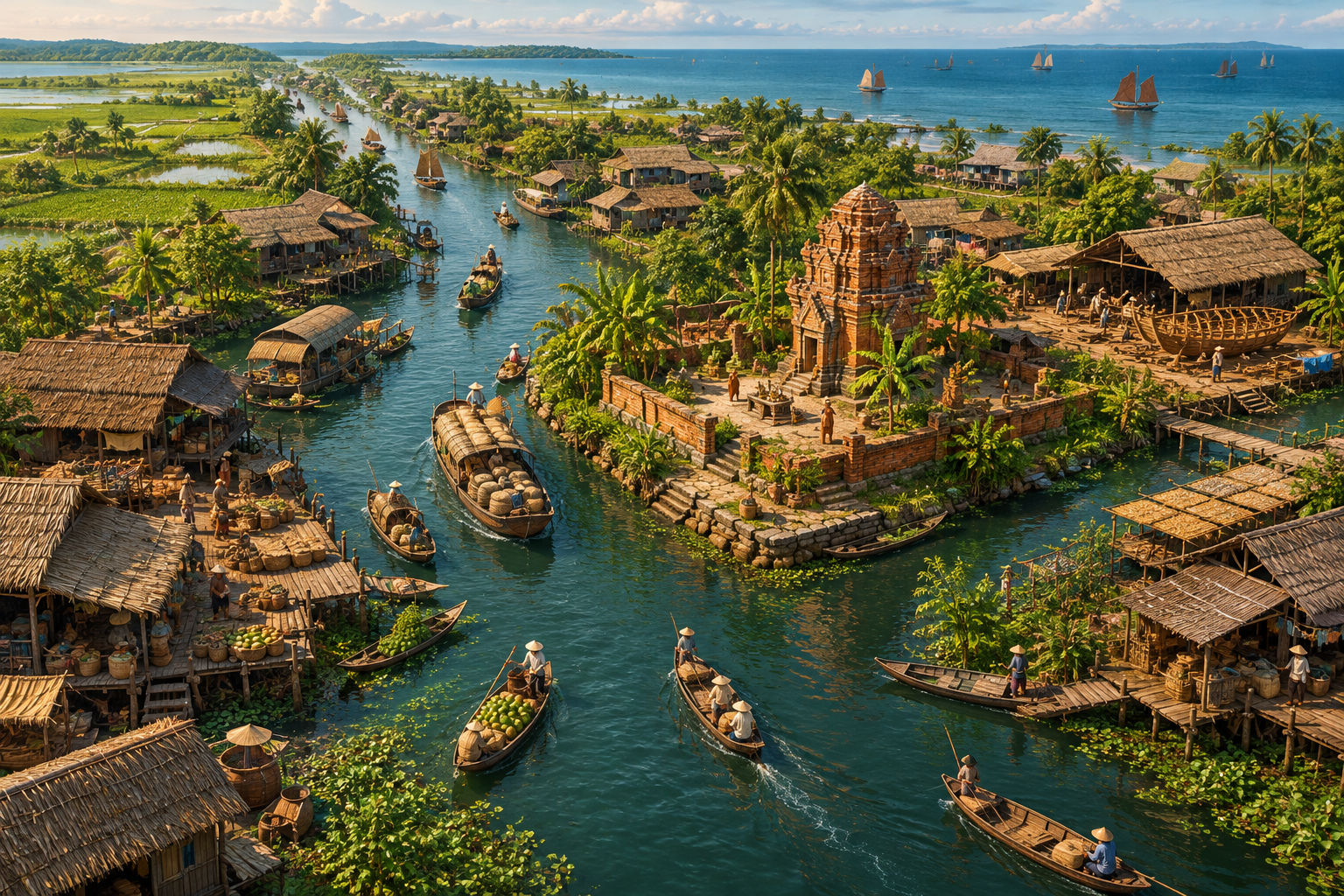
Óc Eo lies in the Mekong Delta, where wetlands, rivers, and seasonal flooding shaped everyday life. Its ancient remains are part of a wider archaeological landscape, not a lone city surrounded by empty countryside. Settlements, raised ground, waterways, and nearby sites formed a connected environment in which people could live, farm, make goods, and travel.
Canals are central to understanding that environment. In a low-lying delta, a water route could move people and cargo between inland settlements and coastal approaches. It could also support local travel and help communities manage a landscape shaped by water. Archaeologists have identified ancient canal traces across the region; studying their dates and connections helps test how settlements related to each other. The routes make it easier to picture an inhabited network than a single isolated port.
Workshops and production remains show that Óc Eo was not simply a place where imported goods changed hands. The archaeological record includes evidence of craft activity, including glass-bead production and work with metals and other materials. Some goods and materials arrived from elsewhere; local makers also shaped objects for use and exchange. A port’s importance rested on the people who supplied, made, repaired, carried, and traded things, as well as on the ships that arrived.
The landscape has changed over many centuries. Sediment, altered waterways, and changes in the coast mean that a port that once related to sea routes may now sit far inland. This shifting geography is a reminder that ancient maps should not be read through today’s shoreline alone. A place’s role depended on the waterways and coastal access of its own period.
Trade across Asia, and local choices
Objects found at Óc Eo point to contacts that reached China, India, and regions farther west. Some objects found at Óc Eo have been described as Roman-era coins or medallions, but the identification of certain finds as Roman coins is disputed. One scholarly account identifies some as Indian-made seals modeled on Mediterranean coins. Such finds point to far-reaching connections, but they do not prove a direct voyage from the Roman Empire to the Mekong Delta; goods could pass through many ports and hands.
Trade was more than a line between two distant empires. It depended on regional routes, local knowledge, and the people who lived along them. Boats moved through rivers and canals; merchants and craft workers met the needs of travelers and neighboring communities. The delta was part of a broader exchange system because its residents participated in it, not merely because foreign objects appeared there.
Religious objects and architectural remains also tell a story of contact and adaptation. Indian traditions influenced religious life across parts of early Southeast Asia, but influence did not mean that local culture disappeared. Communities selected, reshaped, and combined ideas within their own settings. The presence of Buddhist or Hindu imagery, for example, is evidence of religious connections; it is not a full record of what every resident believed.
This is why historians avoid describing Funan as a passive receiver of “Indianization.” That label can make change sound like a one-way transfer from a supposedly more advanced outside world. Óc Eo’s material record instead suggests exchange within a society that had its own skills, priorities, and political relationships. The exact balance varied by place and period, and the surviving evidence does not settle every detail.
Change and the limits of the record
By around the seventh century, the political landscape associated with Funan had changed, and the old role of Óc Eo as a major center declined. This was not necessarily one sudden event that erased a whole society. Political power, trade routes, settlement patterns, and the delta environment all changed over time. The sources do not allow a single cause to explain every part of that transition.
Shifts in maritime routes may have reduced the importance of some ports, while environmental changes affected waterways and farming. These explanations can work together, but the precise timing and weight of each factor are debated. A careful account avoids presenting a neat story of one invasion or one disaster unless evidence supports it.
Nor does a change in a named polity mean that its people vanished. Communities continued to inhabit the region, and cultural practices could endure or change under later political arrangements. Archaeology helps trace continuities, but it cannot always connect a particular object or tradition to a named group across centuries. The record is a pattern of evidence, not a complete census of identities.
What exams ask
For world history and comparative questions, connect Funan and Óc Eo to the growth of maritime exchange in early Southeast Asia. Be ready to explain how the Mekong Delta’s waterways linked local settlements with wider routes. A good answer distinguishes the Chinese-recorded name “Funan” from the archaeological site “Óc Eo,” then uses artifacts and canals as evidence of contact and local production.
Avoid two common shortcuts: treating every imported object as proof of foreign rule, and assuming that outside religious influence replaced local culture. Instead, explain that trade carried objects and ideas, while local communities made choices about how to use and adapt them. Also remember that historians combine written records with archaeological evidence because neither source type gives the whole picture.
Read next
Saigon and Southern Vietnam: A History from Funan to 1975 places Funan within the region’s longer history. Chữ Nôm and Quốc Ngữ follows a much later transformation in Vietnamese writing. The History of Vietnam: Dynasties, Empire and War offers a broader national timeline.