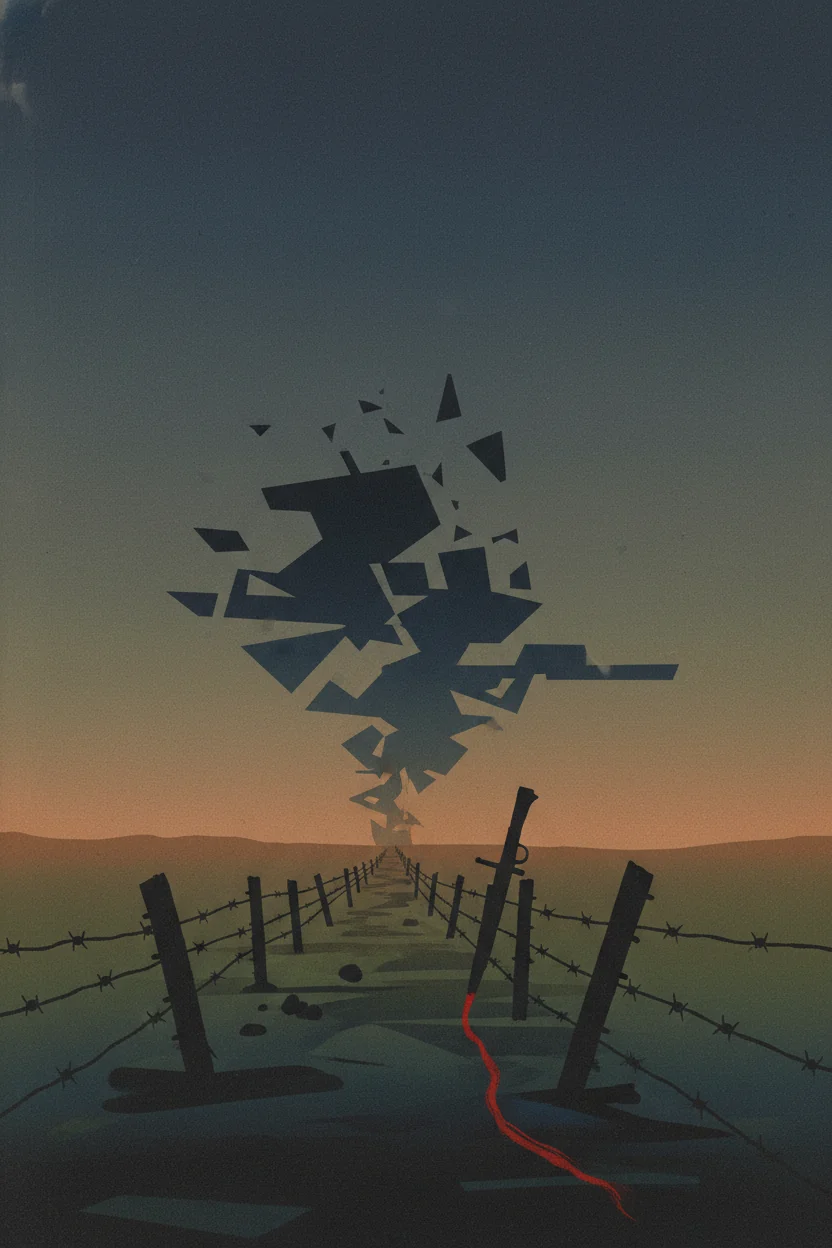
All Quiet on the Western Front by Erich Maria Remarque
by Erich Maria Remarque
A harrowing account of Paul Bäumer and his fellow German soldiers during WWI. It depicts the brutal reality of trench warfare and the profound alienation of young men betrayed by their elders' nationalism.
The Big Idea
"War is a dehumanizing machine that destroys the physical and psychological essence of a generation, rendering the promises of patriotic glory a cruel lie."
Key Insights
The Lost Generation
War creates a permanent psychological rift between those who fought and those who stayed home.
Paul's struggle to communicate with his family during his leave, feeling like a stranger in his own house.
Institutional Betrayal
The youth are manipulated by authority figures using romanticized notions of duty and honor.
The contrast between Kantorek's patriotic speeches and the visceral horror of the trenches.
Universal Humanity
The 'enemy' is an artificial construct created by governments to facilitate mass killing.
Paul's realization while killing the French soldier that they are both victims of the same war.
Survival Instinct
In extreme trauma, human consciousness narrows down to basic animal instincts for food and safety.
The soldiers' obsession with finding food and the expertise of Kat in scavenging.
The Banality of Death
Individual tragedy is ignored by the military bureaucracy in favor of statistical reports.
The irony of Paul's death occurring on a day reported as 'all quiet' on the front.
Chapter Breakdown
The Context of the Great War
Written by Erich Maria Remarque, who served in the German army during World War I, All Quiet on the Western Front is not merely a piece of fiction but a visceral testimony to the horrors of industrial warfare. Published in 1929, the novel emerged during a period when the world was beginning to reckon with the psychological scars of the 'War to End All Wars.' Remarque focuses on the 'lost generation'—young men who were pushed into enlistment by patriotic fervor and schoolroom propaganda, only to find that the romanticized version of glory was a lethal lie. The setting is the Western Front, a desolate landscape of trenches, craters, and barbed wire where the environment itself is as hostile as the enemy.
Plot Overview: The Descent into Attrition
The story follows Paul Bäumer, a young German soldier who, along with his classmates, volunteered for the army after being encouraged by their teacher, Kantorek. The narrative tracks Paul's psychological disintegration as he moves from a naive youth to a hardened survivor. The plot is not driven by a traditional heroic arc but by the repetitive, grinding nature of trench warfare. Paul and his comrades—including the pragmatic Kat and the spirited Kropp—spend their days oscillating between extreme boredom and sheer terror. They face artillery barrages, gas attacks, and the constant threat of death.
As the war progresses, Paul's connection to his former life fades. He returns home on a brief leave, only to find that he can no longer communicate with his family or his old friends; the gap between the civilian world and the front is an unbridgeable chasm. The casualties mount, and one by one, Paul's friends are killed. The climax of the novel is not a grand battle, but the quiet, systemic erasure of a generation. Paul eventually dies in October 1918, just weeks before the armistice. The irony of the title is revealed in the final lines: the army report describes the day of his death as having 'all quiet on the Western Front,' reducing a human life to a negligible statistical detail.
Major Themes: Dehumanization and Disillusionment
The central theme of the novel is the destruction of the individual. Remarque illustrates how war strips away a soldier's identity, replacing it with a primal instinct for survival. The men are no longer students, sons, or citizens; they are 'human animals' reacting to stimuli. This dehumanization is a defense mechanism—if they do not form emotional bonds, the inevitable loss of their comrades becomes bearable.
Another dominant theme is the betrayal of youth. Paul frequently reflects on how the older generation—teachers, politicians, and generals—manipulated the youth into a conflict they did not understand. The 'glory' promised by the authorities is revealed to be a mask for slaughter. This leads to a profound sense of alienation; the soldiers feel they belong neither to the world of the dead nor to the world of the living. The novel also explores the absurdity of nationalism, highlighted in a scene where Paul kills a French soldier in a shell hole and realizes that the 'enemy' is just another man with a family and a life, no different from himself.
Key Scenes and Pivotal Moments
One of the most poignant scenes is Paul's encounter with Gerard Duval, the French soldier he kills in a crater. As Paul watches the man die slowly, he is overcome with guilt and empathy, realizing the shared humanity between combatants. This moment serves as the emotional core of the book, stripping away the political justifications for war. Another critical sequence is Paul's return home on leave. His inability to describe his experiences to his father or his sister highlights the psychological isolation of the veteran. He realizes that the people at home are living in a fantasy, while he is living in a nightmare.
The death of Kat, Paul's mentor and father figure, marks the final collapse of Paul's spirit. Kat was the one who taught Paul how to survive—how to find food and shelter in the ruins. When Kat is killed by a stray piece of shrapnel while bringing food to Paul, the last thread connecting Paul to a sense of security is severed. His death is the catalyst for Paul's final surrender to the inevitability of his own end.
Legacy and Why It Matters Today
All Quiet on the Western Front remains the definitive anti-war novel because it refuses to romanticize combat. It does not focus on strategy or politics, but on the physical and mental agony of the soldier. By centering the narrative on the 'lost generation,' Remarque warns future generations about the dangers of blind obedience and the seductive power of nationalism. In an era of modern conflict, the book serves as a reminder that the cost of war is always paid by those who have the least to gain from it. It challenges the reader to see the soldier not as a hero or a villain, but as a victim of a systemic failure of humanity.
Take Action
Practical steps you can implement today:
-
Question the rhetoric of nationalism and glory when pushed by authority figures.
-
Recognize the importance of psychological support for those returning from high-stress environments.
-
Cultivate empathy for 'the other' to dismantle artificial barriers of enmity.
-
Understand that survival in crisis often depends on practical skills and communal support rather than ideology.
-
Value the human cost of conflict over political or strategic victories.
Notable Quotes
"We are not young any longer."
— Erich Maria Remarque
"Their voices are not the voices of men; they are the voices of animals."
— Erich Maria Remarque
"I am a soldier, and I have a duty to my comrades."
— Erich Maria Remarque
"All quiet on the Western Front."
— Erich Maria Remarque
Who Should Read This
Anyone interested in the psychological impact of war, students of history, and readers who want to understand the deep-seated disillusionment of the early 20th century. It is essential reading for those who wish to see the stark reality of combat stripped of cinematic glamour.
Summary Written By
Software Engineer & Writer
Software engineer with a passion for distilling complex ideas into actionable insights. Writes about finance, investment, entrepreneurship, and technology.
View all summaries →Reviews
No reviews yet. Be the first to share your thoughts!