The Paris Commune in five minutes
The Paris Commune was a self-governing city administration that held Paris for 72 days in 1871, from 18 March to 28 May. It grew out of France's defeat in the Franco-Prussian War, a long and hungry siege, and a bitter quarrel between Parisians who wanted a republic and a conservative national government that many of them did not trust. Workers, artisans and armed National Guardsmen took control of the capital, elected their own council and began to rewrite how a city could be run. The French army, sent from Versailles, retook Paris in the "Bloody Week" of 21 to 28 May and killed thousands of people.
The Commune lasted barely two months, but it became one of the most discussed events of the nineteenth century. For socialists it was the first attempt by working people to govern; for conservatives it was a warning about disorder. It also shaped the Third Republic, which was built in part on the memory of the repression. This page belongs to our overview of 19th-century Europe: revolutions, nationalism and unification.
Why it happened: war, siege and distrust
Defeat in the Franco-Prussian War
France declared war on Prussia on 19 July 1870. The campaign went badly almost at once. On 2 September, after the battle of Sedan, Emperor Napoleon III was captured with a large army. Two days later, on 4 September, a crowd in Paris forced the end of the Second Empire and a Government of National Defence proclaimed a republic. For the rise of Prussia and the man behind it, see Otto von Bismarck: The Iron Chancellor.
The siege of Paris
German armies surrounded Paris from 19 September 1870. The city held out for more than four months. Food ran short, winter was hard, and people ate horses, dogs and even zoo animals. Ordinary men joined the National Guard, which grew to several hundred thousand members and was armed and paid by the city. Many Parisians felt that they, not the generals, had defended France. When an armistice was signed on 28 January 1871, they felt that the government had given up too soon.
An Assembly that Paris did not trust
Elections on 8 February 1871 produced a National Assembly with a large conservative and monarchist majority, because rural France wanted peace above all. Adolphe Thiers became head of the executive. The peace terms were harsh: France would lose Alsace and part of Lorraine and pay an indemnity of five billion francs, confirmed in the Treaty of Frankfurt of 10 May 1871. Republican Paris, which had voted differently, feared that the Assembly would bring back a monarchy. Add unpaid rents, an end to the wartime pay for the Guard, and the poverty of the working districts, and the city was ready to boil over.
Older roots
Paris had a long tradition of revolt, from 1789 to the barricades of 1830 and 1848 (compare July Revolution vs February Revolution). It also had a strong labour movement, with links to the International Workingmen's Association, and a political culture in which "commune" meant the elected city government of the great revolution of the 1790s.
What happened: from the cannon to the Commune
18 March 1871
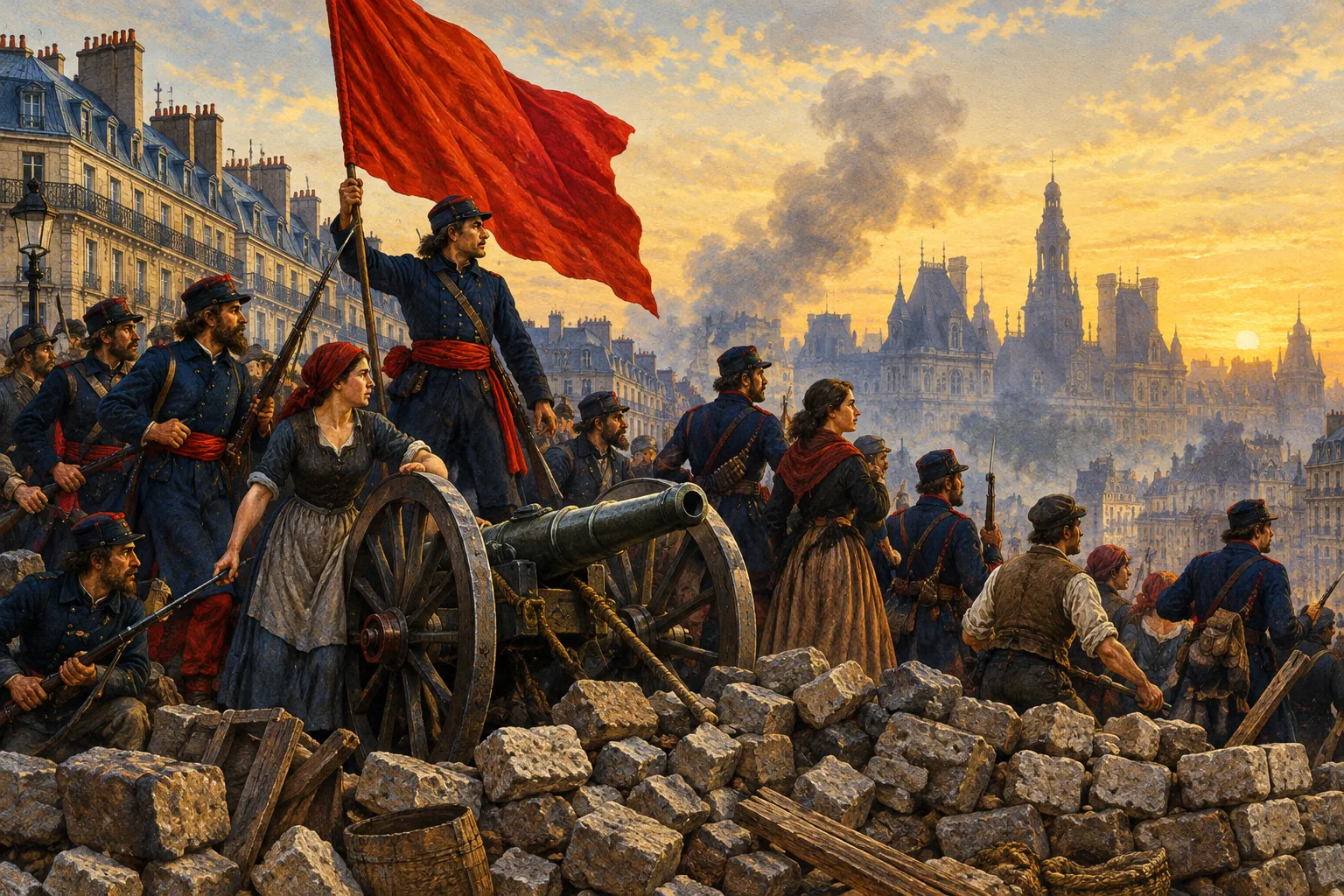
Thiers wanted to disarm Paris. In the early morning of 18 March, soldiers were sent to seize cannon stored on the hill of Montmartre. Local residents, many of them women, gathered and the troops hesitated. Some soldiers refused to fire and joined the crowd. Two generals, Claude Lecomte and Jacques Clément-Thomas, were captured and shot. Thiers ordered the government and the army out of the city and moved to Versailles. The Central Committee of the National Guard was left in charge.
The Commune is elected
Elections were held on 26 March and the Commune was proclaimed at the Hôtel de Ville on 28 March. Its roughly ninety members included workers, clerks, journalists, teachers and doctors. They were divided between several camps: followers of Proudhon who favoured federations and cooperatives, Blanquists who believed in a determined revolutionary minority, and Jacobins who looked back to 1793. The disagreements made decisions slow.
What the Commune did
In a short time it passed a remarkable list of measures:
- Separation of church and state (2 April), with church property taken over.
- A pause on rent and on the sale of pawned goods, and a ban on night work in bakeries (20 April).
- The end of the standing army, with the National Guard as the only armed force.
- Pensions for the widows and children of Guardsmen killed in action.
- A decree of 16 April that let workers form cooperatives in workshops abandoned by their owners.
- Plans for free, secular schooling for both girls and boys.
Women played a visible part. The Union of Women, led by figures such as Élisabeth Dmitrieff and Nathalie Lemel, organised work and support for the defence, and Louise Michel became one of the best known figures of the whole movement. The Commune flew the red flag and used the revolutionary calendar's spirit, though it did not have time to build lasting institutions. Fighting began early in April, when Versailles forces attacked the National Guard's positions outside the city, and the Commune was under siege again for the rest of its life.
The Bloody Week
On 21 May government troops under Marshal Patrice de MacMahon entered Paris through an undefended gate on the western side. For a week they advanced street by street towards the working-class east. The Communards built barricades and set fires, and the Tuileries Palace and the Hôtel de Ville were burned. Hostages were shot too, including Archbishop Georges Darboy on 24 May. But the largest killing was done by the army, which executed prisoners and suspects on the spot. The last stand came in the cemetery of Père Lachaise on 27 and 28 May; the wall where the final prisoners were shot is still known as the Wall of the Federals.
Historians give different totals for the dead. A figure of 6,000 to 7,500 killed in the fighting and executions is often cited, and some studies suggest up to 10,000 or more. About 40,000 people were arrested; many were tried by military courts, and over 4,000 were deported to New Caledonia in the Pacific. Louise Michel was among them. A general amnesty came only in 1880.
Why it mattered
For France
The Commune convinced many conservatives that a republic could be safe for property, and the Assembly turned to building one. The constitutional laws of 1875 created the Third Republic, which lasted until 1940. The state also began building the basilica of Sacré-Cœur on Montmartre in 1875, partly as a gesture of national atonement. For the republic's later crises, including a famous test of its principles, read The Dreyfus Affair.
For socialism
Karl Marx wrote a defence of the Commune, "The Civil War in France", for the International in 1871. He saw in it a working-class government that had smashed the old state machine. Anarchists drew a different lesson, from its federalism. Later revolutionaries, including Lenin, studied the Commune closely, and its memory was kept alive in the song "The Internationale", whose words were written by Eugène Pottier, a Communard, in 1871 (the tune came later).
A caution
The Commune was neither a perfect workers' paradise nor a simple mob. It was a divided, besieged government that made both far-sighted decisions and mistakes, and it was destroyed by overwhelming force. Reading it fairly means keeping all of these facts in view.
What exams ask
- Cause: link the Commune to the defeat at Sedan, the siege of Paris and the conflict between Paris and the monarchist Assembly, not to a single event.
- Key dates: 18 March 1871 (cannon at Montmartre), 28 March (Commune proclaimed), 21 to 28 May (Bloody Week).
- Measures: separation of church and state, cooperatives, the role of women, a pause on rents.
- Significance (AP-style): a model and a warning for later socialist movements; its repression helped define the Third Republic and strengthened the conservative fear of revolution.
- Typical comparison: the Commune with the revolutions of 1789, 1830 and 1848.
Read next
- 19th-Century Europe: Revolutions, Nationalism and Unification gives the overall map of the century.
- July Revolution vs February Revolution shows the earlier Paris uprisings the Commune built on.
- Otto von Bismarck: The Iron Chancellor explains the Prussian side of the war that led to the Commune.
- The Dreyfus Affair shows how the Third Republic handled its next great crisis.