In five minutes: the Reconstruction era amendments
The Reconstruction era amendments are the 13th, 14th and 15th Amendments to the US Constitution, ratified between 1865 and 1870. The 13th abolished slavery. The 14th made everyone born in the United States a citizen and promised every person due process and equal protection of the laws. The 15th said that a citizen's right to vote could not be denied because of race or past enslavement.
They were the first changes to the Constitution since 1804, and the only ones written in the aftermath of a civil war. They are the legal core of the era told in The Reconstruction Era (1865–1877), and they are one of the main threads in our guide to 19th-century America.
The short version: Congress put emancipation, citizenship and the vote into the Constitution itself, so that a later Congress, a hostile president or a single state could not simply undo them. Their weakness was enforcement. After 1877 the federal government largely stopped defending them in the South, and it took until the 1960s for their promises to be backed by strong national action.
Why amendments were needed
When the Civil War ended in 1865, the legal status of freedom was shaky. President Abraham Lincoln's Emancipation Proclamation of 1 January 1863 was a wartime order. It applied to areas in rebellion, not to the border states that had stayed in the Union, and many lawyers doubted what would happen to it once the fighting stopped. A constitutional amendment would settle the question for the whole country.
Citizenship was an open question too. In the Dred Scott decision of 1857, the Supreme Court had said that Black Americans, free or enslaved, could not be citizens. And once slavery ended, there was the matter of political power: formerly enslaved people had never been counted in full for representation, and Southern leaders now stood to gain seats in Congress from a larger population that they still refused to treat as voters. Each amendment answered one of these problems.
The 13th Amendment (1865): ending slavery
The 13th Amendment bans slavery and involuntary servitude anywhere in the United States or in places under its control. It has one exception: punishment for a crime of which a person has been properly convicted. A second section gives Congress the power to enforce the ban with legislation.
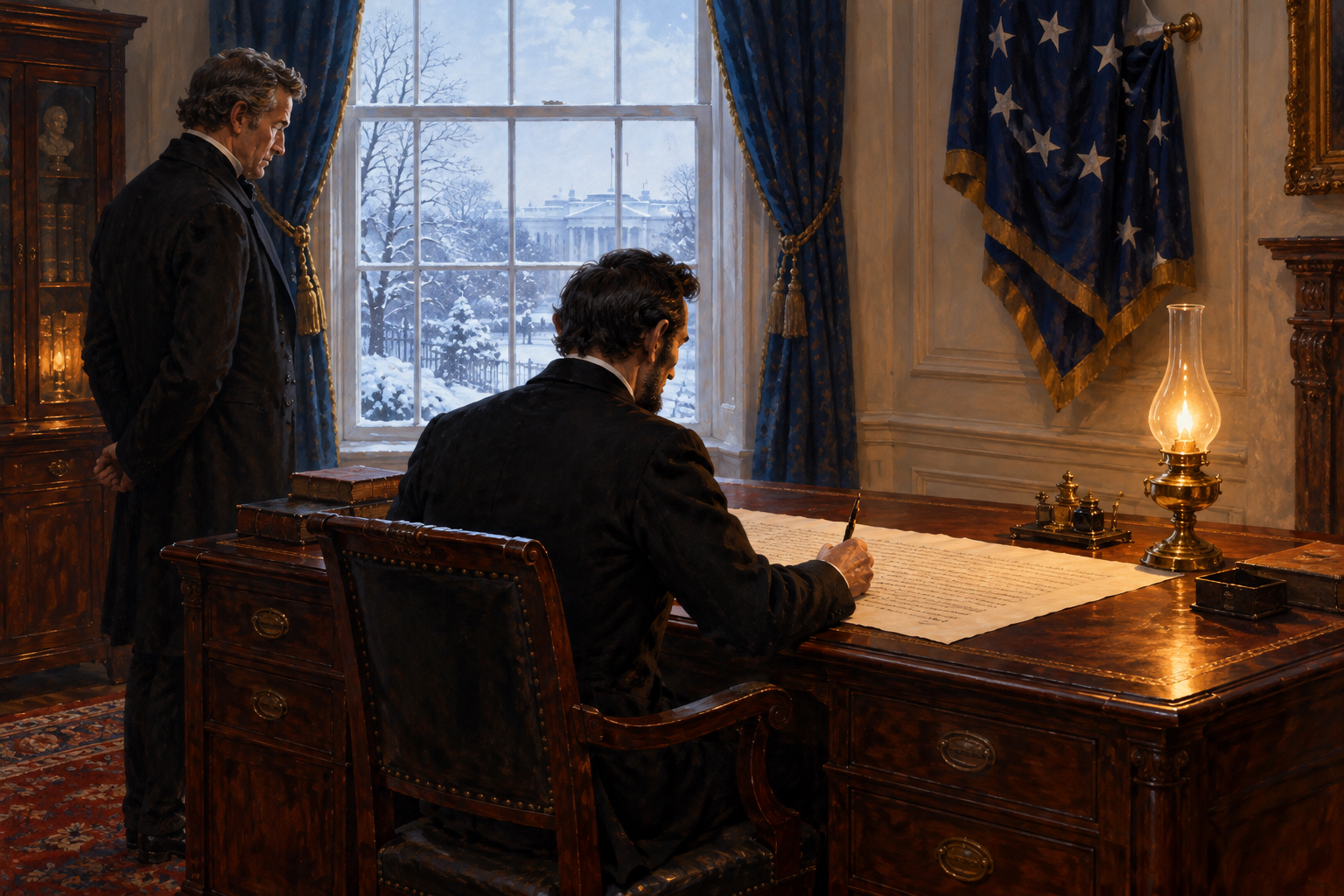
The Senate passed the amendment on 8 April 1864. The House failed to reach the needed two-thirds that June, but after Lincoln's re-election and a hard push by his allies, it passed on 31 January 1865. The states then voted. On 6 December 1865 Georgia became the 27th state of 36 to approve, and Secretary of State William Seward announced the amendment as law on 18 December. Lincoln had been assassinated in April and did not see it become part of the Constitution; you can read more about his role in Who Was Abraham Lincoln?
The exception clause mattered at once. Southern legislatures passed Black Codes in 1865 and 1866 that made things like vagrancy or breaking labour contracts into crimes, and convict leasing later sent many Black men into forced labour for private employers. The amendment ended the legal ownership of people, but it did not by itself deliver equal rights.
The 14th Amendment (1868): citizenship and equal protection
The 14th Amendment was a response to the Black Codes and to President Andrew Johnson's lenient approach to the former Confederate states. Congress passed the Civil Rights Act of 1866 over Johnson's veto in April, declaring Black Americans to be citizens. Worried that a later Congress might repeal the act, or that courts might strike it down, Republicans moved its core ideas into the Constitution. Congress approved the amendment on 13 June 1866.
It has five sections:
- Section 1 says that everyone born or naturalised in the United States, and under its authority, is a citizen. It bars states from taking away life, liberty or property without due process of law, and from denying anyone the equal protection of the laws. This reversed the Dred Scott ruling.
- Section 2 says a state that blocks adult male citizens from voting can lose seats in the House. This penalty was almost never applied.
- Section 3 kept people who had broken an oath to the Constitution by joining the Confederacy from holding office, unless two-thirds of Congress allowed it.
- Section 4 confirmed the Union's war debt and declared Confederate debts void.
- Section 5 lets Congress pass laws to enforce the amendment.
Most Southern states rejected it at first. Congress then made ratification part of the price of readmission in the Reconstruction Acts of 1867. The amendment was ratified on 9 July 1868, and the next weeks saw it proclaimed part of the Constitution. Its first section, with the phrases "due process" and "equal protection", became the most cited part of the Constitution in later American law.
The 15th Amendment (1870): the right to vote
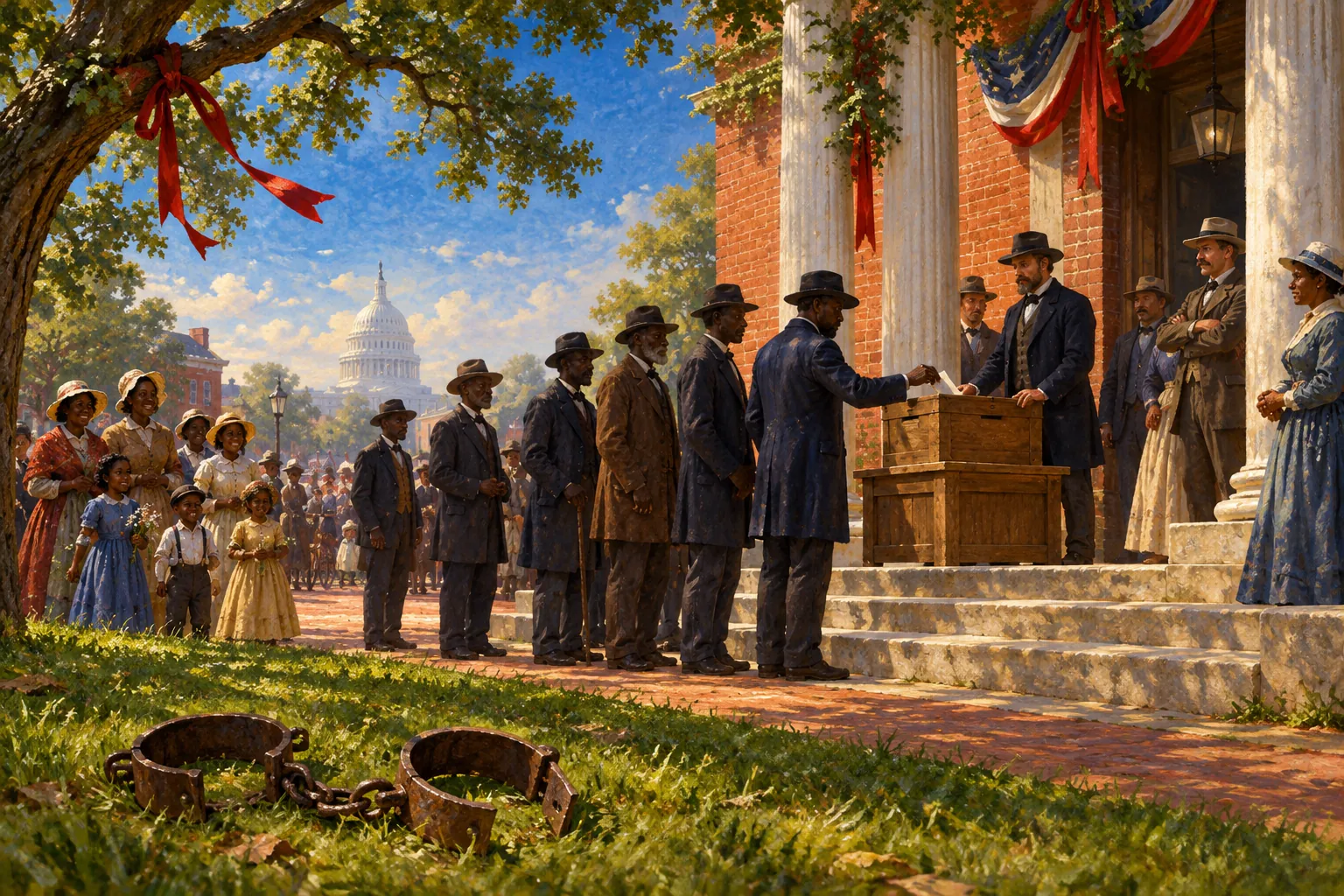
The 15th Amendment says that the right of citizens to vote cannot be denied by the United States or any state because of race, colour or previous condition of servitude. Congress may enforce it by law. Congress approved it on 26 February 1869 and it was ratified on 3 February 1870.
Its supporters saw the vote as the best protection for freed people: if Black men could vote, Southern states would have to take their interests into account. In the first years after 1867, hundreds of thousands of Black men registered. Many were elected to local offices, state legislatures and Congress. In 1870 Hiram Revels of Mississippi became the first Black member of the US Senate.
The amendment had two clear limits. It protected men only, and it split the movement for equal rights, because Elizabeth Cady Stanton and Susan B. Anthony objected that women were left out, while Frederick Douglass and others argued that this was "the Negro's hour" and women should wait. And it was written as a ban on certain reasons for denying the vote, not as a positive guarantee of voting. That left room for states to use literacy tests, poll taxes and similar rules that, in practice, targeted Black voters.
Enforcement, then retreat
For a few years Congress and the federal government tried to enforce the amendments. The Enforcement Acts of 1870 and 1871 made it a federal crime to use violence or threats to stop people from voting, and were aimed at the Ku Klux Klan. The Department of Justice was created in 1870 partly to bring such cases.
The courts and the country soon turned away. In the Slaughter-House Cases (1873), the Supreme Court read the 14th Amendment's protection of citizens' privileges narrowly. In United States v. Cruikshank (1876), it threw out charges against white men involved in the Colfax massacre of 1873, ruling that the federal government could not punish private violence under the amendments. After the disputed election of 1876, federal troops left the last Southern states in 1877, and white Democratic governments took full control.
Over the following decades Southern states built the system known as Jim Crow. Poll taxes, literacy tests and violence cut Black voting to a small fraction in most of the South, and in Plessy v. Ferguson (1896) the Supreme Court accepted racial segregation under the "separate but equal" idea. The amendments stayed in the Constitution, but they were rarely enforced.
Why they still matter
The amendments came back to life in the 20th century. The Supreme Court used the Equal Protection Clause in Brown v. Board of Education (1954) to rule that segregated public schools were unconstitutional. Congress used its enforcement powers to pass the Civil Rights Act of 1964 and the Voting Rights Act of 1965, which finally put strong federal power behind the 15th Amendment. Courts also used the Due Process Clause to apply most of the Bill of Rights to the states. Historians sometimes call the 1950s and 1960s the "Second Reconstruction" for that reason.
What exams ask
- Match the amendment to the year and topic: 13th (1865) abolished slavery; 14th (1868) citizenship, due process, equal protection; 15th (1870) voting rights regardless of race.
- Compare the Emancipation Proclamation and the 13th Amendment. The proclamation was a wartime order covering areas in rebellion; the amendment was permanent and covered the whole country.
- The citizenship clause reversed Dred Scott v. Sandford (1857).
- The 15th Amendment's limits: men only, and no ban on poll taxes or literacy tests, so states found ways around it.
- Significance (AP-style): the amendments created a lasting constitutional basis for civil rights, but the gap between law and enforcement after 1877 allowed Jim Crow to develop.
- Link to later events: the 14th Amendment underpins Brown v. Board; the 15th is the base for the Voting Rights Act.
Read next
- The Reconstruction Era (1865–1877): the political fight over rebuilding the South, in which these amendments were written.
- Jim Crow Laws: how Southern states built a system of segregation and voter suppression after Reconstruction ended.
- Who Was Abraham Lincoln?: the president who pushed the 13th Amendment through Congress.
- 19th-Century America: Expansion, Civil War and the Gilded Age: the larger story of the period.