In five minutes
The Progressive Era was a wave of reform in the United States that ran from the 1890s to about 1920. Its supporters believed that rapid industrial growth had created problems that private markets would not fix on their own: dangerous factories, filthy city slums, rigged politics and companies so large that they could set prices and wages. Their answer was to use public power, honest information and organized citizens to push back.
"Progressive" was never one party or one program. Reformers were Republicans and Democrats, men and women, ministers, professors, factory inspectors, newspaper writers and union members. What they shared was a faith that society could be improved by study, publicity and law. The result was the food inspection system, antitrust enforcement, the Federal Reserve, the income tax, the direct election of senators and the vote for women. For the period before it, see our hub on 19th-century America.
Why reform began: the problems of the Gilded Age
After the Civil War, railroads, steel and oil turned the United States into the world's largest industrial economy. Firms such as Standard Oil and Carnegie Steel grew by buying rivals and forming trusts. Prices, freight rates and wages were often set by a handful of owners. Congress passed the Sherman Antitrust Act in 1890, but courts and presidents used it weakly at first.
Cities swelled as farmers and millions of immigrants arrived (see Immigration to America, 1840–1914). Many families lived in crowded tenements with poor sanitation. Factory days of ten to twelve hours were normal, and children worked in mills, mines and canneries. Political "machines" in big cities traded jobs and favors for votes, and business money flowed into legislatures. Senators were then chosen by state legislatures, which made bribery charges common.
The Panic of 1893 and the long depression that followed made the anger sharper. Farmers had already organized the Populist movement, which demanded regulation of railroads and a fairer money system. Progressives were mostly urban and middle class, but they inherited many of those demands.
Who pushed for change
Journalists did much of the early work. Jacob Riis showed the poverty of New York's tenements in How the Other Half Lives (1890). In 1902–1904 Ida Tarbell published a detailed history of Standard Oil in McClure's magazine, and Lincoln Steffens exposed city corruption in The Shame of the Cities (1904). Upton Sinclair's novel The Jungle (1906) set out to expose how immigrant workers were treated in Chicago's meatpacking plants, but it was the descriptions of unclean meat that shocked the public. President Theodore Roosevelt called such writers "muckrakers", a name they kept.
Settlement houses carried reform into neighborhoods. Jane Addams and Ellen Gates Starr opened Hull House in Chicago in 1889, offering childcare, classes and a place to meet, and gathering facts about local housing and work. Women's clubs, the National Consumers League and the National Child Labor Committee (founded 1904) pushed for safer factories and an end to child labor. After the Triangle Shirtwaist Factory fire in New York in March 1911, which killed 146 workers, many locked in or blocked from exits, New York passed tough fire and safety laws.
What changed: laws and amendments
At the state level, Wisconsin under Robert La Follette and Oregon pioneered direct primaries and the initiative, referendum and recall, which let voters propose laws, approve them and remove officials. Many states added workplace rules, limits on working hours and, in some cases, pensions for mothers.
At the national level the biggest steps were:
- Pure Food and Drug Act and Meat Inspection Act (1906): the first federal checks on food labels and on slaughterhouses.
- Antitrust cases: the government won the Northern Securities case in 1904, and in 1911 the Supreme Court ordered Standard Oil broken up.
- Federal Reserve Act (1913): created a central banking system to steady credit.
- Federal Trade Commission and Clayton Act (1914): new tools against unfair business practices.
- Conservation: Roosevelt protected millions of acres of forest and created the Forest Service under Gifford Pinchot in 1905; the National Park Service followed in 1916.
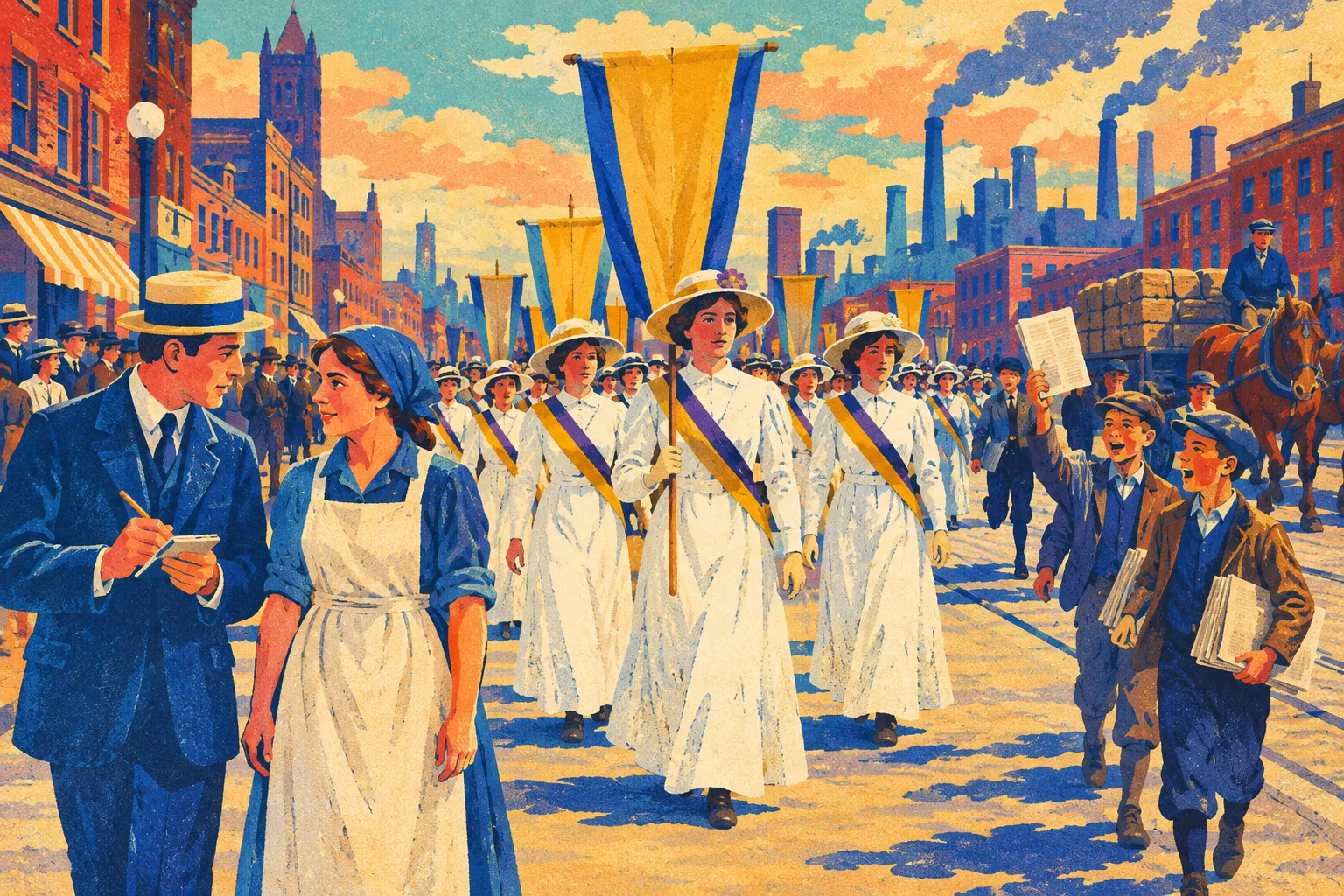
Four constitutional amendments mark the era: the 16th (1913) allowed a federal income tax, the 17th (1913) made senators directly elected, the 18th (ratified 1919, in force 1920) banned the sale of alcohol, and the 19th (1920) guaranteed women the right to vote.
Presidents: Roosevelt, Taft and Wilson
Theodore Roosevelt (president 1901–1909) called his approach the Square Deal. He settled the 1902 coal strike by pressing owners to negotiate, and he used the Sherman Act against selected trusts, arguing that "good" and "bad" trusts must be told apart. William Howard Taft (1909–1913) filed more antitrust suits than Roosevelt, yet he angered reformers by backing high tariffs and conservative Republicans.
In 1912 Roosevelt ran against Taft as the candidate of the new Progressive Party, nicknamed the Bull Moose party, and promised a "New Nationalism" with strong federal oversight. The split in Republican votes helped Democrat Woodrow Wilson win. Wilson's "New Freedom" favored breaking up concentrated power and led to the tariff cut, income tax, Federal Reserve and FTC of 1913–1914.
Limits and critics
Progressivism had real blind spots. Black Americans faced lynching and Jim Crow laws, and the Supreme Court had allowed "separate but equal" in Plessy v. Ferguson (1896). Most white progressives did little about it, and under Wilson segregation spread in federal offices. Black reformers such as W.E.B. Du Bois and Ida B. Wells helped found the NAACP in 1909.
Some reformers backed immigration limits, and many supported eugenics, which later became a source of forced sterilization laws. Prohibition, meant to reduce poverty and violence linked to drink, produced widespread lawbreaking. Courts also struck down some reforms: Lochner v. New York (1905) overturned a limit on bakers' hours, and a federal child labor law of 1916 was struck down in 1918, though Muller v. Oregon (1908) upheld shorter hours for women.
How it ended and why it matters
There was no single end date. American entry into World War I in 1917 shifted attention to the war, and the postwar Red Scare and fatigue with reform helped the Republican Warren Harding win in 1920 with a promise of "normalcy". Yet many progressive ideas survived: the New Deal of the 1930s built on federal regulation, labor protections and a larger role for government that progressives had argued for.
What exams ask
AP U.S. History and similar courses usually test these points: the causes (industrialization, urbanization, immigration, corruption), the role of muckrakers, Roosevelt's Square Deal compared with Wilson's New Freedom, the 16th–19th Amendments, and the movement's limits for African Americans and immigrants. Good answers connect a reform to the problem it answered, for example The Jungle to the 1906 food laws, or the Triangle fire to workplace safety codes. Be ready to explain why historians still debate whether progressivism was mainly democratic or mainly about social control.
Read next
- Immigration to America (1840–1914): the newcomers who filled the cities and factories that reformers set out to fix.
- The Spanish-American War (1898): the overseas expansion that ran alongside reform at home.
- Who Was Abraham Lincoln?: the Republican tradition many progressives, including Roosevelt, claimed to continue.