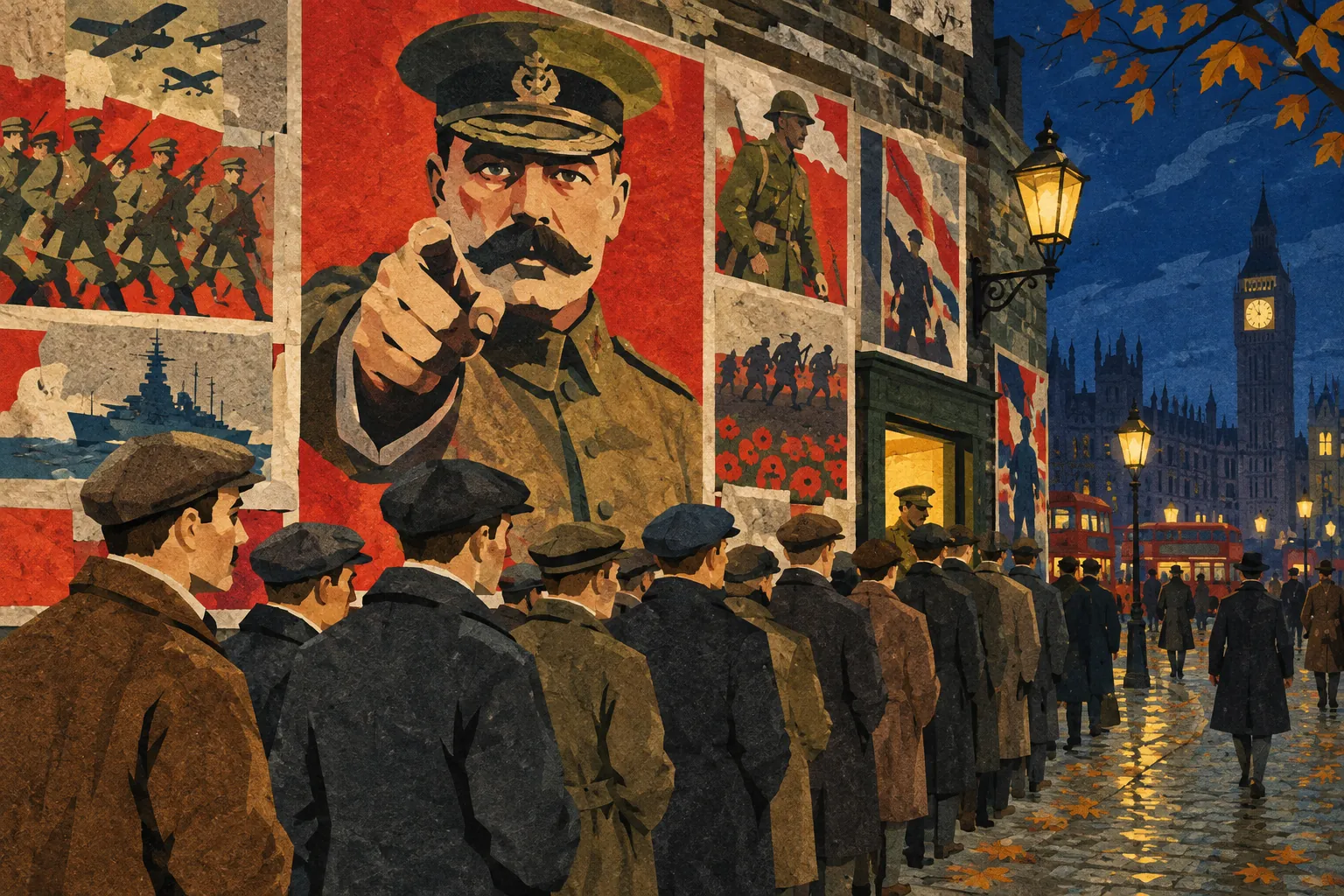
WWI propaganda posters in five minutes
WWI propaganda posters were the cheapest and most visible way for governments to speak to millions of people at once between 1914 and 1918. They asked men to enlist, asked families to lend money through war bonds, asked cooks to waste less bread, and asked everyone to fear and hate the enemy. They are among the best-known images of World War I, and they show that a modern war needed the whole society, not only the army.
- Main goals: recruitment, war loans, food and work campaigns, and hatred of the enemy.
- Most famous examples: Britain's pointing Lord Kitchener, America's "I Want YOU" Uncle Sam, and France's "On les aura!"
- Why posters: printing was cheap, there was no television, and a wall or shop window reached everyone.
- Long-term effect: after the war, many people distrusted government messages, and the same methods were studied and reused later.
Why governments needed posters
Earlier wars were fought mostly by professional armies. World War I was different. Armies grew to millions of men, factories had to make shells day and night, and the cost of the war was far beyond normal tax income. This kind of war is often called a "total war", because it draws in soldiers, workers, farmers, women, children and money alike.
Governments therefore had to persuade ordinary people to give things freely: their sons, their savings and their labour. Newspapers, speeches, films and pamphlets all helped. But the poster had a special strength. Thanks to colour lithography, a design could be printed in huge numbers and pasted on walls, trams, railway stations and shop windows. Even someone who never read a newspaper walked past it every day. A strong poster also needed very few words: one face, one slogan and one demand.
Recruitment in Britain: the pointing finger
Britain entered the war in August 1914 with a small professional army and no conscription. It needed volunteers fast. Lord Kitchener, the Secretary of State for War, called for hundreds of thousands of men, and a cross-party Parliamentary Recruiting Committee began to produce posters in the same month.
The best-known image came from the artist Alfred Leete. His drawing of Kitchener staring and pointing straight at the viewer appeared on the cover of the magazine London Opinion on 5 September 1914 and was soon turned into a recruiting poster with the message that the country needed you. The idea was simple and personal: the man in the street was being addressed directly.
Other British posters used guilt and pressure. One of the most famous, from 1915, shows a father whose child asks what he did in the Great War, while the father sits silent. Others showed women urging their men to go, or marching troops with the words that there was still room in the ranks. More than two million men volunteered between August 1914 and the end of 1915. Recruitment then slowed, and Britain brought in conscription with the Military Service Act in January 1916. Posters had helped, but they were never the only reason men enlisted: friends, local pride, wages and fear of shame all mattered too.
The United States: from neutrality to a poster war
The United States declared war on Germany on 6 April 1917. Many Americans had been unsure about joining a European war, so President Woodrow Wilson created the Committee on Public Information a week later, led by the journalist George Creel. It ran press releases, films, speakers and posters, and it recruited leading illustrators to work for the cause.
The most famous result is James Montgomery Flagg's 1917 poster of Uncle Sam pointing at the viewer with the words "I Want YOU for U.S. Army". Flagg openly borrowed the idea of the pointing figure from Leete's British design. Millions of copies were printed, and the image became so strong that it was used again in World War II and is still copied today.
American posters also pushed Liberty Loan campaigns, which sold government bonds to ordinary citizens, and food campaigns led by Herbert Hoover's Food Administration, which urged families to save wheat and meat for the army and for Europe. Buying a bond or skipping a meal was presented as a form of service, so people at home could feel they were part of the fight.
Images of the enemy
Many posters did not ask for anything. They simply taught people to hate. Allied artists often showed Germans as brutes, monsters or barbarians. A famous American example from 1917 shows a gorilla in a German helmet carrying a club and a frightened woman, under the words "Destroy this mad brute".
This imagery grew out of real events and exaggeration. Germany invaded neutral Belgium in August 1914, and its troops did kill civilians and burn towns, including Leuven. The British government set up a secret propaganda office at Wellington House in 1914, and the Bryce Report of May 1915 collected stories of German cruelty in Belgium. Some stories were true and some were unproven or invented, but together they gave poster artists a powerful theme: "Poor little Belgium" needed to be defended.
Events at sea and in the trenches added to it. The sinking of the liner Lusitania by a German submarine on 7 May 1915, with nearly 1,200 deaths, produced posters that urged people to remember it. Germany's use of chlorine gas at Ypres in April 1915 was also presented as proof of a savage enemy. For the full background, see submarine warfare and poison gas.
The home front: women, food and money
Posters also spoke to people who would never fight. Women were told to send their men to war, to take factory and farm jobs, and to join nursing and auxiliary services. A few posters shamed men who stayed home, and in Britain the "white feather" campaign of 1914 encouraged women to hand a feather to any man not in uniform. It often embarrassed men who were unfit or already doing vital work.
Money was just as important. Britain, France, Germany and the US all sold war bonds, and posters turned a financial request into a moral one. Germany ran nine war loans, and Fritz Erler's 1917 poster for one of them shows the stern face of a soldier in a steel helmet with the call "Help us win". French designers used a similar approach. Jules Abel Faivre's 1916 poster for a national loan shows a tough soldier and the confident words "On les aura!", meaning "We'll get them!"
Differences between countries
The basic tools were similar everywhere, but the style differed. British posters often used personal pressure and humour or guilt. American posters were polished, patriotic and led by professional illustrators. French posters often stressed the defence of the homeland and the suffering of the invaded north. German posters leaned on the image of the determined soldier and the duty to support him with money, though German citizens also faced food shortages caused by the Allied blockade, which weakened messages of confidence late in the war.
Voluntary systems relied more heavily on persuasion. Australia, which recruited its army only by volunteers, used posters heavily, and still rejected conscription in two national referendums in October 1916 and December 1917. That shows the limit of propaganda: a poster could persuade, but not force.
Did the posters work?
Historians agree that posters were one tool among many, and their exact effect is hard to measure. They probably worked best when they matched what people already felt, such as anger at the invasion of Belgium or pride in their country. Bond sales and enlistment numbers rose during big campaigns, but people also joined because of friends, jobs and social pressure.
The longer effect was more complicated. When the war ended on 11 November 1918, many people felt that they had been told simplified or exaggerated stories. In Britain and the US, some atrocity stories were later doubted, and that made some people sceptical of similar reports in later conflicts. At the same time, governments and politicians studied how mass persuasion had been done. Posters from 1914 to 1918 remain valuable sources for historians because they show what each government wanted its people to think, feel and fear.
What exams ask
AP-style questions usually ask for significance and comparison. Useful points to remember:
- Propaganda was a key feature of total war, along with rationing, conscription and control of industry.
- Posters served four main purposes: recruitment, finance, home-front work and food, and demonising the enemy.
- Alfred Leete's Kitchener (Britain, 1914) inspired James Montgomery Flagg's Uncle Sam (US, 1917).
- The Committee on Public Information (1917) and Britain's Wellington House (1914) were the main government propaganda bodies you should know.
- Belgium, the Lusitania and poison gas were the events most used to portray Germany as a threat to civilisation.
- The limits of propaganda: Britain still needed conscription in 1916, and Australians rejected it twice.
Read next
- World War I (1914–1918): Causes, Course and Consequences: the main hub, for the war these posters were selling.
- What Is Militarism? How It Led to WWI: the pre-war culture that made mass support for war easier.
- U-Boats and Unrestricted Submarine Warfare: the Lusitania story and the path to America's entry.
- Poison Gas in World War I: the weapon posters used to portray the enemy as barbaric.