In five minutes: the Spanish-American War
The Spanish-American War was a short conflict between the United States and Spain in 1898, fought mainly over Cuba. The United States won quickly on both sides of the world. Its navy destroyed Spanish fleets at Manila Bay and off Santiago de Cuba, and its army, helped by Cuban rebels, forced Santiago to surrender. In the peace treaty signed in Paris in December 1898, Spain gave up Cuba and handed Puerto Rico, Guam and the Philippines to the United States.
The war ended what was left of Spain's empire in the Americas and turned the United States into a power with territory in the Caribbean and the Pacific. It also opened a harder conflict, because Filipinos who had been fighting Spain refused to accept a new ruler. This page follows the war from the Cuban revolt, through the sinking of the USS Maine, to the treaty and its results. It is part of our hub on 19th-Century America: Expansion, Civil War and the Gilded Age.
Why the war happened
The Cuban revolt
Spain had lost most of its American empire by the 1820s, but it still held Cuba and Puerto Rico. Cuba was rich in sugar and tobacco, and its people had rebelled before. The latest revolt began in February 1895. José Martí, one of its leaders, was killed in action that May, but generals such as Máximo Gómez and Antonio Maceo kept fighting. The rebels burned cane fields and mills to make Spanish rule too expensive to continue, and Spain answered by sending more troops.
Reconcentration
In 1896 Spain sent General Valeriano Weyler to Cuba. He moved country families into fortified towns so the rebels could not find food or shelter. The towns had too little food and almost no sanitation, and hunger and disease killed a very large number of civilians; historians put the toll at well over a hundred thousand. Reports of these camps reached the United States and turned many Americans against Spain.
Newspapers and public opinion
In New York, Joseph Pulitzer's World and William Randolph Hearst's Journal fought for readers with huge headlines about Cuba. This style of sensational reporting is called yellow journalism. Much of the suffering was real, though some stories were exaggerated or wrong. Many Americans also felt that Cubans deserved the independence that the thirteen colonies had won from Britain.
Business and the idea of expansion
There were practical interests as well. American investors had money in Cuban sugar, and the fighting disrupted trade. By the 1890s many Americans also said the western frontier had closed and that the country needed overseas markets. The naval writer Alfred Thayer Mahan argued that great powers needed strong fleets and bases abroad. Theodore Roosevelt, then Assistant Secretary of the Navy, agreed, and the Navy had already drawn up plans to attack the Spanish Philippines if war came.
Presidents Grover Cleveland and William McKinley both tried to avoid war. Spain recalled Weyler at the end of 1897 and offered Cuba limited self-government, but the rebels wanted full independence.
The Maine and the road to war
In January 1898 McKinley sent the warship USS Maine to Havana, officially to protect Americans there. On February 9 a private letter by the Spanish minister in Washington, Enrique Dupuy de Lôme, was published in the Journal. In it he called McKinley weak, and he resigned.
On the night of February 15 the Maine exploded in Havana harbor and sank. About 260 crew members died. A US Navy inquiry in March concluded that a mine outside the ship had set off its magazines, while a Spanish inquiry blamed an accident inside. Later studies, including one led by Admiral Hyman Rickover in 1976, leaned toward an internal coal-bunker fire, though the cause is still debated. No evidence shows that the Spanish government ordered an attack. Even so, the slogan "Remember the Maine!" spread across the country.
On April 11 McKinley asked Congress for authority to use force. On April 19 Congress passed a joint resolution declaring Cuba free and independent, demanding that Spain withdraw and authorising the use of the army and navy. The Teller Amendment added that the United States had no intention of taking over Cuba. Spain broke off relations on April 21, and on April 25 Congress declared war, with the date set back to April 21.
The war in the Pacific and the Caribbean
Manila Bay, May 1
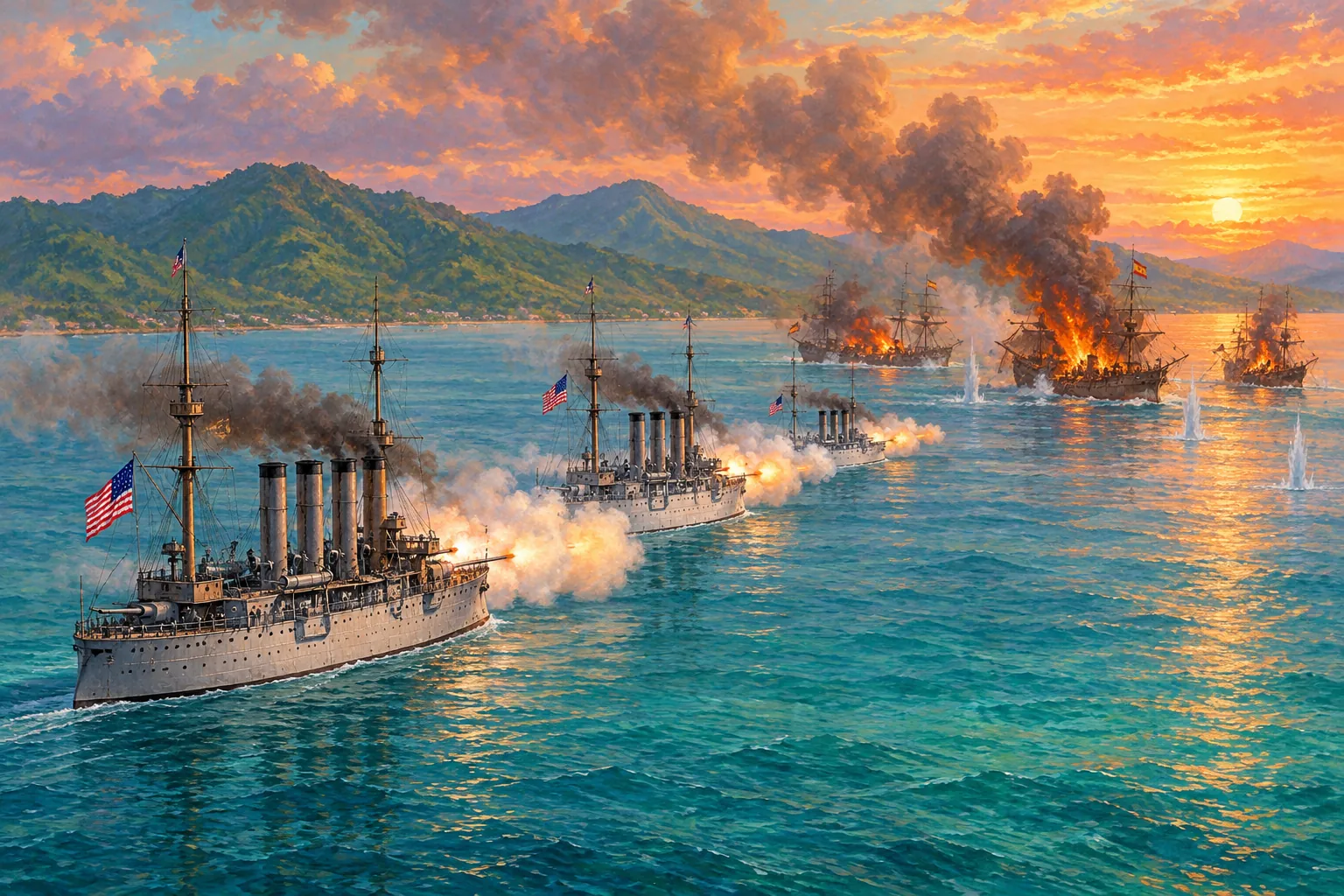
The first blow fell in Asia. Commodore George Dewey's Asiatic Squadron left Hong Kong, entered Manila Bay in the dark, and at dawn on May 1 attacked the older Spanish squadron of Admiral Patricio Montojo. The Spanish ships were destroyed, and very few Americans were killed. But Dewey had no troops to take Manila, so he waited. Meanwhile the exiled Filipino revolutionary Emilio Aguinaldo returned in May, declared independence on June 12, and Filipino forces surrounded the city.
Santiago de Cuba, June and July
The US Army was small and poorly prepared, and it depended on volunteers. Even so, General William Shafter's force landed near Daiquirí in late June and marched toward Santiago de Cuba. On July 1 there were hard fights at El Caney and on the San Juan Heights. Roosevelt's volunteer cavalry, the Rough Riders, charged Kettle Hill alongside regular Black cavalry regiments, the Buffalo Soldiers, while infantry took San Juan Hill. The losses were heavy.
At sea, Admiral Pascual Cervera's squadron was trapped in Santiago harbor by the US blockade. On July 3 it tried to break out and was destroyed in a few hours. With the fleet gone and the city surrounded, Santiago surrendered on July 17.
Puerto Rico and the armistice
On July 25 General Nelson Miles landed at Guánica in southern Puerto Rico and met little resistance. On August 12 the two governments signed an armistice in Washington. News had not yet reached Manila, and on August 13 American and Spanish commanders staged a short, mostly arranged battle there so that the city would surrender to the Americans. Filipino troops were kept outside, which deepened a quarrel that was already growing.
Fewer than 400 Americans died in combat, but about 2,000 died of disease, mainly typhoid, malaria and yellow fever.
The Treaty of Paris
Peace talks opened in Paris in October, and the treaty was signed on December 10, 1898. Spain gave up its claim to Cuba and ceded Puerto Rico and Guam to the United States. The Philippines passed to the United States in exchange for $20 million. The Senate approved the treaty on February 6, 1899, by 57 votes to 27, only just over the two-thirds it needed.
The vote came after a public argument. The Anti-Imperialist League, whose members included Mark Twain and Andrew Carnegie, said that ruling distant peoples without their consent went against American principles. The treaty passed anyway.
What changed afterwards
Cuba became independent in 1902 after a period of US military rule. Under the Platt Amendment of 1901, it had to accept the right of the United States to intervene and to keep a naval base at Guantánamo Bay. Puerto Rico came under US rule, and the Foraker Act of 1900 set up its civil government.
The Philippines saw fighting between American and Filipino forces begin near Manila on February 4, 1899. The Philippine-American War officially ended in 1902, though resistance continued afterwards, and many civilians died.
Spain called the defeat the "Disaster of 1898". A group of writers and thinkers, the Generation of '98, asked why the country had fallen behind.
The United States expanded its navy, annexed Hawaii in the same year, and in 1899 sent the Open Door notes to the great powers about trade with China. Roosevelt's war record helped him become vice president in 1900 and president in 1901. John Hay called it a "splendid little war" in a letter to Roosevelt, but the Philippines turned out to be a long and costly commitment.
What exams ask
- Causes: the Cuban independence revolt, Weyler's reconcentration policy, yellow journalism, economic interests, the new expansionist thinking, and the Maine.
- Key dates: April 1898 (declaration of war), May 1 (Manila Bay), July 1–3 (San Juan Heights and Santiago), December 10 (Treaty of Paris).
- Documents: the Teller Amendment (no annexation of Cuba) and the Platt Amendment (limits on Cuban independence).
- Significance, AP style: the United States emerged as an imperial power with colonies, and the country debated whether that fitted its founding ideals. Link it to Hawaii, the Open Door and the Progressive Era.
A common essay question asks you to compare American motives, humanitarian, economic and strategic. A strong answer shows that all three played a part and explains which mattered most at each stage.
Read next
- The Annexation of Hawaii (1898): the same year's other step into the Pacific, and a good test of how far the expansion argument reached.
- The Progressive Era (1890s–1920): the reform movement that grew up alongside American power, and Roosevelt's presidency.
- Who Was Abraham Lincoln?: the Union leader whose victory made the later rise of the United States possible.