In five minutes
The transcontinental railroad was the first rail line to link the eastern United States with the Pacific coast. Two companies built it toward each other. The Central Pacific laid track east from Sacramento, California, and the Union Pacific laid track west from the Missouri River near Omaha, Nebraska. They met at Promontory Summit, Utah Territory, on May 10, 1869, and a ceremonial last spike joined the two lines.
Before the railroad, crossing the continent meant months in a wagon train or a long sea voyage around South America or across Panama. Afterwards the trip took about a week. People, mail, machinery and cattle could move at a scale that had not been possible before. The cost was just as large: lost land and food sources for the Native peoples of the Plains, dangerous work for thousands of immigrants, and a financing system that enriched insiders.
The story sits at the centre of 19th-century America: territorial expansion, the Civil War and the economic boom that followed.
Why was the railroad built?
By the 1850s the United States reached the Pacific. The Gold Rush of 1849 pulled hundreds of thousands of people to California, and California became a state in 1850. Yet it was almost cut off from the rest of the country by thousands of miles of plains, deserts and mountains. Letters and goods travelled by ship, by wagon, or by short-lived services such as the Pony Express (1860–1861), which the telegraph quickly made obsolete.
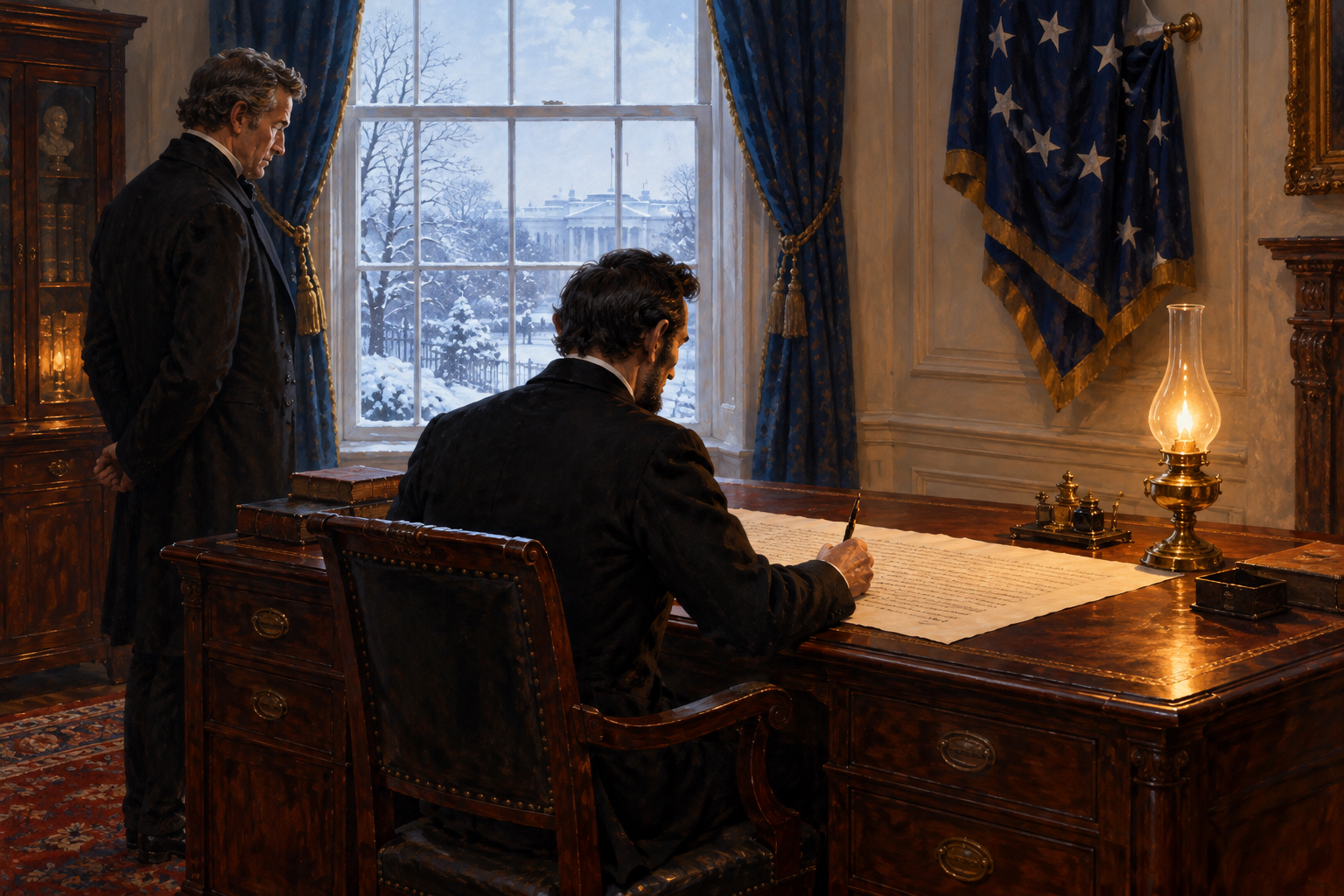
Supporters argued that a Pacific railroad would bind the nation together, speed trade with Asia and open land to farmers. Before 1861 the plan stalled on a sectional question: should the route run through the North or the South? Slavery and its expansion made every western decision a fight. When Southern states left the Union and their representatives left Congress, the deadlock broke. Abraham Lincoln, who had once worked as a railroad lawyer, signed the Pacific Railway Act on July 1, 1862, in the middle of the war.
The act worked through private companies. The Union Pacific was chartered to build west, and the California-based Central Pacific was authorised to build east. The government paid in bonds for each mile of track finished, with higher payments for harder terrain, and it granted public land along the route. An 1864 amendment doubled the land grants to attract investors. In short, private firms built the line with public money and public land.
Two companies, one race
The Central Pacific was run by four Sacramento merchants, Leland Stanford, Collis Huntington, Mark Hopkins and Charles Crocker, known as the Big Four. The engineer Theodore Judah surveyed a route over the Sierra Nevada, but he died in 1863 before construction got far. Work began at Sacramento in January 1863. Granite cliffs, tunnels and deep winter snow made progress slow for years.
The Union Pacific started from the Omaha area. Money and labour were short during the war, but after 1865 the pace picked up. Chief engineer Grenville Dodge chose the route, and the brothers Jack and Dan Casement organised the track-laying crews. On the flat plains the crews could lay a mile or more in a day. Temporary towns followed the end of the track, and their rough reputation earned them the nickname “Hell on Wheels”.
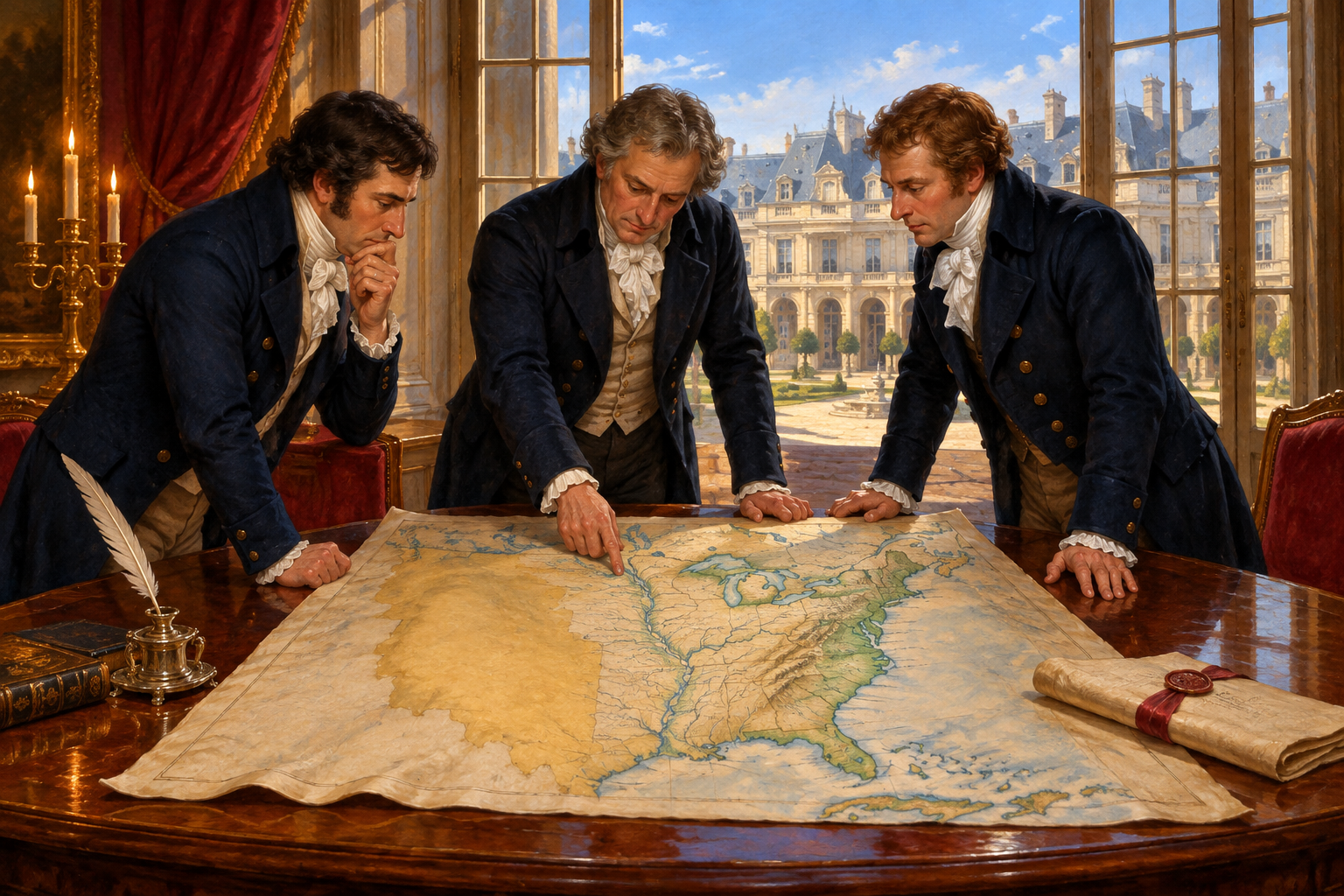
Because the law rewarded every mile built, the two companies raced, and in Utah they ended up grading parallel roadbeds past each other. In April 1869 Congress settled the matter by naming Promontory Summit as the meeting point.
Who laid the track?
The Central Pacific struggled to keep workers, many of whom left for the mines. From 1865 Crocker began hiring Chinese labourers, first a few dozen and then thousands. They became a large majority of the workforce, with higher estimates reaching about 12,000 at the peak. They drilled and blasted tunnels with black powder, worked from baskets hung on cliff faces, and endured camps buried in snow. Many died in avalanches and accidents, but no reliable count exists. They were treated worse than white workers in pay and conditions, and in June 1867 thousands went on strike for higher pay and shorter shifts. The company cut off their food supplies, and the strike ended after about a week.
On the Union Pacific side, much of the workforce was made up of Irish immigrants and veterans of both armies in the Civil War. In Utah, Mormon contractors graded much of the roadbed for both companies.
The land was not empty. The Lakota, Cheyenne and Arapaho lived on the Plains, and the Shoshone, Paiute and Ute peoples lived in the Great Basin. Surveyors and work crews were sometimes attacked, and the army built forts to protect the line. The railroad also cut through hunting grounds. In the 1870s hunters, with trains carrying hides east, killed buffalo herds almost to extinction, and the Plains nations lost a main source of food and trade.
May 10, 1869: Promontory Summit
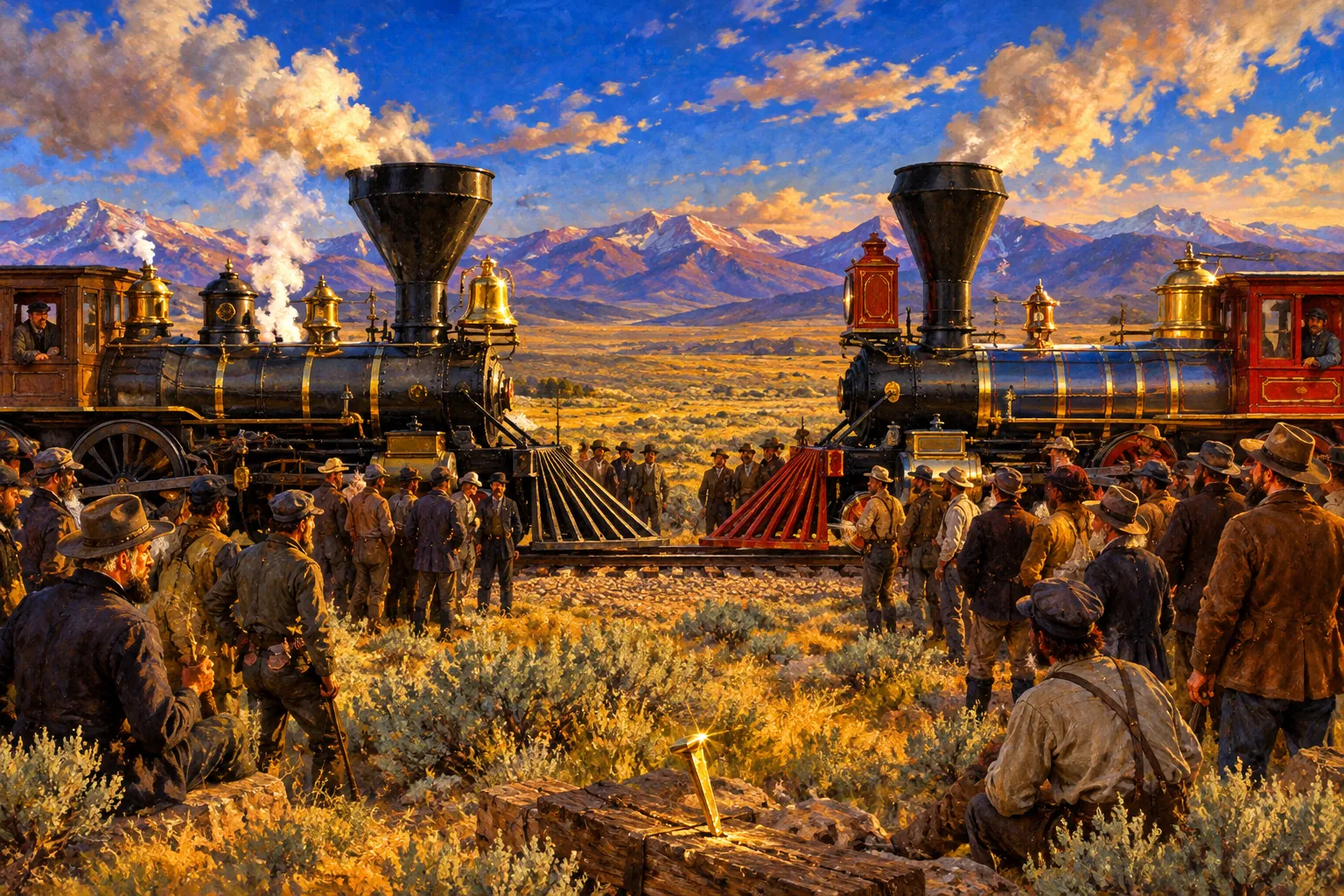
The ceremony was planned for May 8 but was delayed two days by a washed-out bridge and a pay dispute with workers. On May 10, several hundred people gathered on a high Utah plain. The Central Pacific engine Jupiter faced the Union Pacific No. 119. A laurel-wood tie was laid, and a golden spike was set in place. Stanford and the Union Pacific's Thomas Durant were both said to have missed their first swings. Telegraph wires were attached so the blows could be sent as signals, and the word “Done” went out across the country. Church bells rang and cannons fired in cities from San Francisco to the East Coast.
The best-known photograph, Andrew J. Russell's “East and West Shaking Hands”, does not clearly show the Chinese workers who built much of the Central Pacific. It is often used to ask whose work is remembered.
The golden spike was removed after the ceremony and replaced with an ordinary iron one. When the Lucin Cutoff opened across the Great Salt Lake in 1904, Promontory dropped off the main line. Today the site is preserved as a national historic park.
What changed after 1869
- Travel and trade: A coast-to-coast trip took about a week instead of months. Wheat, cattle and ore moved east, manufactured goods moved west, and cities such as Chicago grew into hubs of a national market. In 1883 railroads adopted standard time zones to run their timetables.
- Settlement: Together with the Homestead Act of 1862 and railroad land sales, the line carried settlers onto the Plains and beyond.
- Native nations: Easier military movement, the loss of the buffalo and new settlement pushed the Plains peoples toward reservations and war.
- Corruption: In the Crédit Mobilier scandal, exposed in 1872, Union Pacific insiders paid a construction company they owned inflated prices and gave shares to members of Congress. It became a symbol of the corruption of the age.
- Chinese exclusion: The workers who built the Central Pacific became targets of hostility, and the Chinese Exclusion Act of 1882 was the first major federal law to bar immigration on the basis of nationality.
- Boom and bust: Railroad speculation helped trigger the Panic of 1873, and railroad fortunes became a central feature of what historians call the Gilded Age.
Other transcontinental lines followed in the 1880s and 1890s, but the 1869 line remained the model, and the symbol, of what railroads could do.
What exams ask
AP U.S. History questions usually ask about causes and effects. Be ready to explain:
- The Pacific Railway Act of 1862 and its support: bonds for every mile and grants of public land.
- Why the Civil War made the law possible, since Southern opposition to a northern route had gone.
- Which company built which way: the Central Pacific east from Sacramento, the Union Pacific west from Omaha, meeting at Promontory Summit, Utah, in 1869.
- The labour force: Chinese workers on the Central Pacific, Irish immigrants and veterans on the Union Pacific, and the later Chinese Exclusion Act.
- The effects on Native nations, the buffalo and the reservation system, and the link to the closing of the frontier in the 1890 census.
- The Crédit Mobilier scandal as an example of Gilded Age corruption.
Read next
- What Was the Gilded Age? shows how railroad fortunes, speculation and corruption shaped the decades after 1869.
- Who Was Abraham Lincoln? explains the president who signed the Pacific Railway Act during the Civil War.
- Jim Crow Laws covers segregation, including the 1896 Plessy case about a railroad passenger car.