In five minutes
Pax Britannica, Latin for “British peace,” is the name historians give to the long stretch from about 1815 to 1914 when Britain was the strongest power in the world. The Royal Navy controlled the sea lanes, London was the centre of global finance, and British factories sold goods almost everywhere. Great powers fought each other less often than before, and Britain itself fought no war against another European great power between 1856 and 1914.
The phrase copies Pax Romana, the stable age of the Roman Empire. Most of this period overlaps with Queen Victoria’s reign (1837–1901), so it is a key idea for the whole Victorian era. In short: one country’s power kept trade routes open and the biggest wars away, and it did so on its own terms.
- When: about 1815 (Waterloo and the Congress of Vienna) to 1914 (the First World War).
- What held it up: the Royal Navy, free trade, the City of London and the empire.
- The catch: the “peace” was between great powers. In Asia, Africa and elsewhere, Britain fought many wars.
Where the term comes from
“Pax” is Latin for peace. The model was Pax Romana, the long period from 27 BC to about AD 180 when Rome kept order around the Mediterranean. The idea is the same in both cases: one strong state sets the rules, guards the routes, and the largest rivals find it too costly to fight. Historians also speak of “Pax Americana” for the United States after 1945.
The word “peace” needs care. It does not mean there were no wars. It means that the biggest powers rarely fought one another, and that Britain had the strength to keep sea trade safe. Whether a person saw this as peace often depended on where they stood.
Causes: how Britain got there
Victory over Napoleon
The Royal Navy beat the French and Spanish fleets at Trafalgar in 1805, and Napoleon was defeated on land at Waterloo in 1815. At the Congress of Vienna (1814–15) the European powers tried to keep a balance so that no single country could dominate the continent again. That suited Britain, which had no huge army to match those of its neighbours but wanted to be free to focus on the sea and on trade.
The first industrial nation
Britain was the first country to industrialise, with coal, iron, steam engines, railways and cotton mills. Around 1860, common estimates put its share of the world’s manufacturing output at roughly a fifth, which is why people called it “the workshop of the world.” British cloth, iron and machines found buyers across the globe.
Navy and money
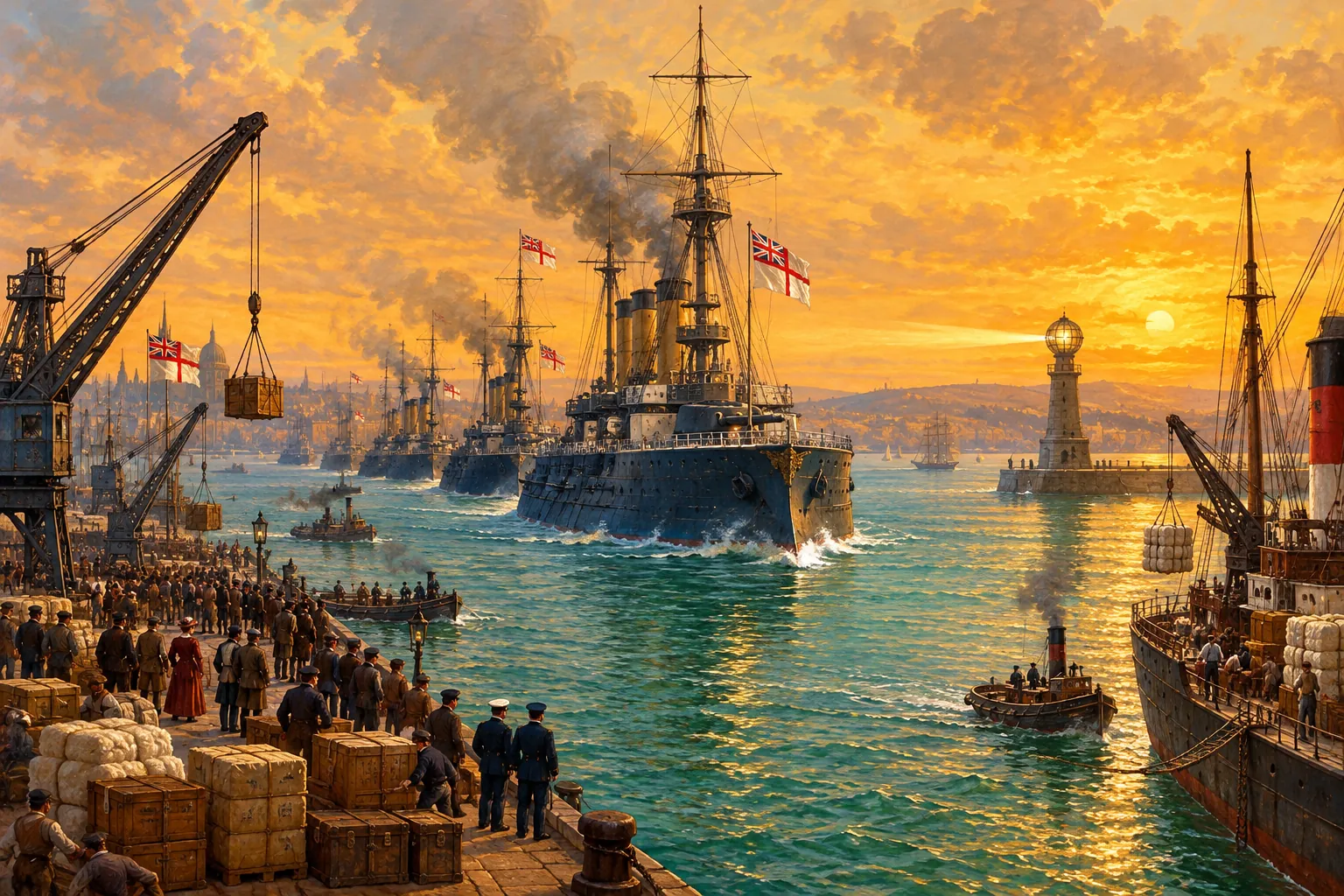
The Royal Navy was larger than any other. The Naval Defence Act of 1889 is linked to the “two-power standard”: keep a fleet as big as the next two navies combined. Meanwhile the City of London became the place where the world borrowed, insured and shipped goods, and the pound, tied to gold, was the most trusted currency in trade.
What happened: the system at work
Free trade
Britain argued that trade without tariffs would make everyone richer, and it had the industry to gain most from it. The Corn Laws, which taxed imported grain, were repealed in 1846, and the Navigation Acts, which had favoured British ships, ended in 1849. The Great Exhibition of 1851, held in the Crystal Palace in London, showed the result: British machines at the centre of a world fair.
Policing the seas
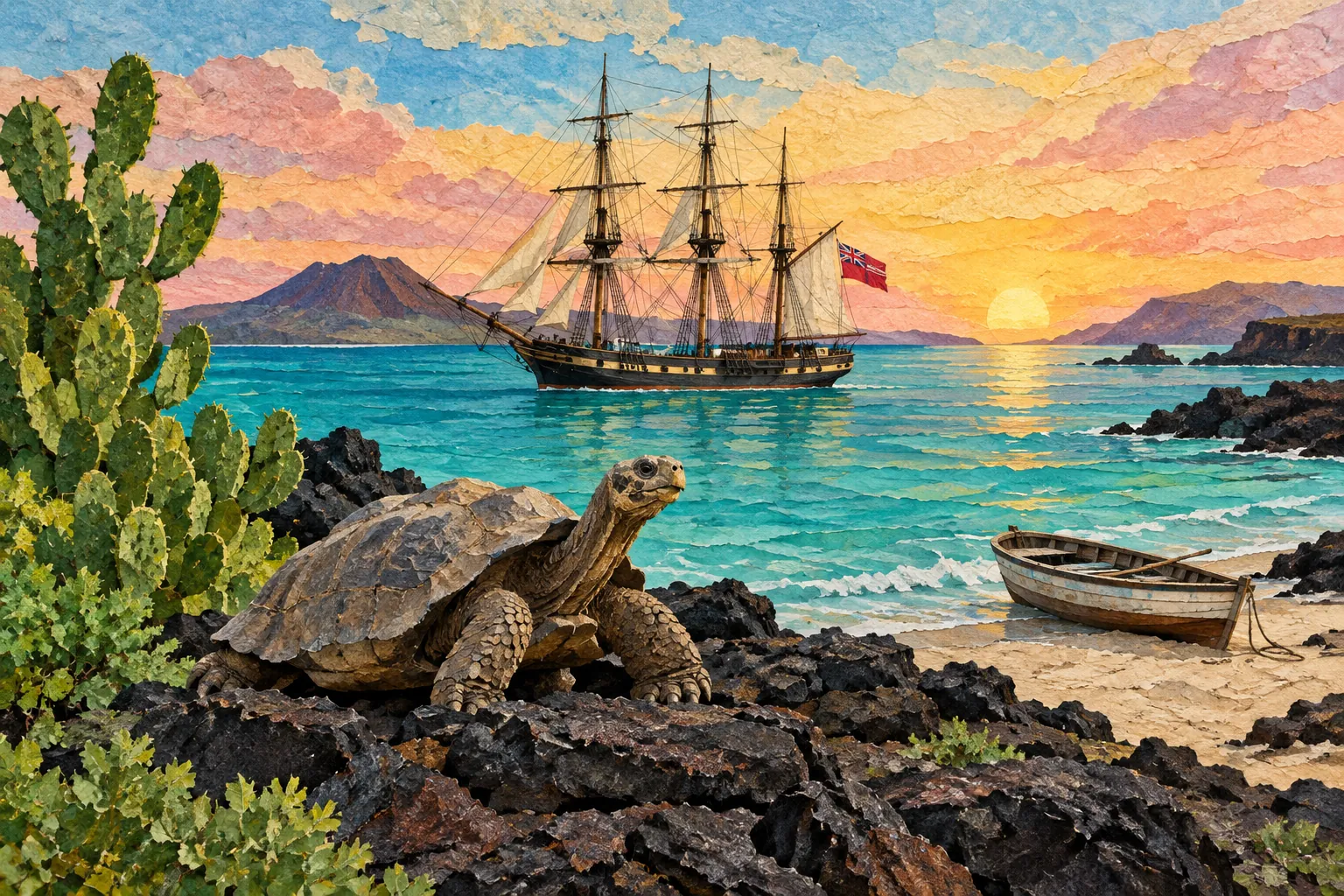
Britain banned the slave trade in 1807 and, with the Slavery Abolition Act of 1833, ended slavery in most of its empire. The Royal Navy’s West Africa Squadron then patrolled the Atlantic and seized slave ships, and the navy also fought piracy. This gave Britain a name as the guardian of the sea. It also showed how far a navy that could stop ships almost anywhere could shape world affairs.
Opening markets by force
When states would not open their markets, gunboats were sometimes used. In the First Opium War (1839–42) Britain defeated Qing China. By the Treaty of Nanjing (1842) it took Hong Kong Island and opened five ports to trade. A second war (1856–60) pushed this further. In 1953 the historians John Gallagher and Ronald Robinson called this pattern the “imperialism of free trade”: gain influence through trade and pressure where possible, and take direct control only where needed.
Formal empire
Where control was wanted, Britain took it. After the Indian Rebellion of 1857, the Crown took over from the East India Company in 1858, and Queen Victoria was proclaimed Empress of India in 1877. The Suez Canal opened in 1869 and shortened the sea road to India. Britain bought Egypt’s shares in the canal company in 1875 and occupied Egypt in 1882. From the 1880s European powers divided most of Africa in the “Scramble for Africa,” and the Berlin Conference of 1884–85 set some of the ground rules. At its peak the empire covered about a quarter of the world’s land and people. See The British Empire for the full story.
How peaceful was it?
Britain’s one big European war in this period was the Crimean War (1853–56), fought with France and the Ottomans against Russia. It is also where Florence Nightingale made her name. After 1856 Britain fought no European great power until 1914.
Outside Europe, the picture was different. Britain fought in Afghanistan, China, South Africa, Sudan and many other places. Severe famines struck British India, for example in 1876–78 and 1896–97, and historians still debate how much British policy made them worse. Critics say the Pax Britannica was a peace for Britain and its rivals, bought with force on the edges of the empire.
Why it faded
- New rivals. By about 1900 the United States had passed Britain in industrial output and Germany was close behind. British factories were no longer far ahead.
- Strain in the empire. The Boer War (1899–1902) was costly, and Britain struggled to defeat the Boer republics. It showed that Britain could not rely on strength alone.
- New friends. Britain ended its “splendid isolation” with the Anglo-Japanese Alliance of 1902 and the Entente Cordiale with France in 1904.
- Naval race. HMS Dreadnought (1906) set off a building race with Germany that Britain won at great cost.
- War. The First World War began in 1914. Britain won, but it ended heavily in debt, and the United States became the leading financial power.
What exams ask (AP-style significance)
- Define Pax Britannica and give the usual dates, 1815–1914.
- Name its pillars: naval supremacy, free trade, financial leadership and empire.
- Explain “imperialism of free trade” and give an example, such as the Opium Wars.
- Compare it with Pax Romana, and with the later Pax Americana.
- Link its decline to the rise of Germany and the United States, the Boer War and the road to 1914.
Read next
- The Victorian Era (1837–1901): the wider hub for politics, industry and daily life under Victoria.
- The British Empire: how the colonies were won, run and lost.
- Who Was Queen Victoria?: the monarch whose reign gave the age its name.
- Florence Nightingale in the Crimean War: a human story from Britain’s one big European war of the era.