In five minutes
Charles Darwin was an English naturalist who worked out that all living things are related and that species change over many generations. He explained how with natural selection: individuals that happen to suit their surroundings leave more offspring, and over a very long time those small advantages add up. He published the case in On the Origin of Species on 24 November 1859. If you have searched "what did Charles Darwin do", this is the short answer: he gave biology its central idea, and he backed it with decades of patient observation.
Darwin is one of the big thinkers covered in Ideas That Shaped the 19th Century, alongside liberalism, socialism and nationalism.
Early life and education
Darwin was born on 12 February 1809 in Shrewsbury, in western England. His father, Robert, was a doctor, and his mother, Susannah, came from the Wedgwood pottery family. His grandfather Erasmus Darwin, also a doctor, had written about ideas of change in living things. The family was comfortable, and that later let Darwin spend his life on research without needing a regular job.
As a boy he loved collecting beetles and stones, and he was not a keen schoolboy. In 1825, aged 16, he went to Edinburgh to study medicine, but he could not bear watching surgery in the days before anaesthetic, and he gave it up. His father then steered him toward becoming a clergyman, and in 1828 he entered Christ's College, Cambridge. He graduated in 1831, though he spent much of his time collecting insects. At Cambridge he became friends with the botanist John Stevens Henslow, who later recommended him for the voyage that changed his life.
The Beagle voyage (1831–1836)
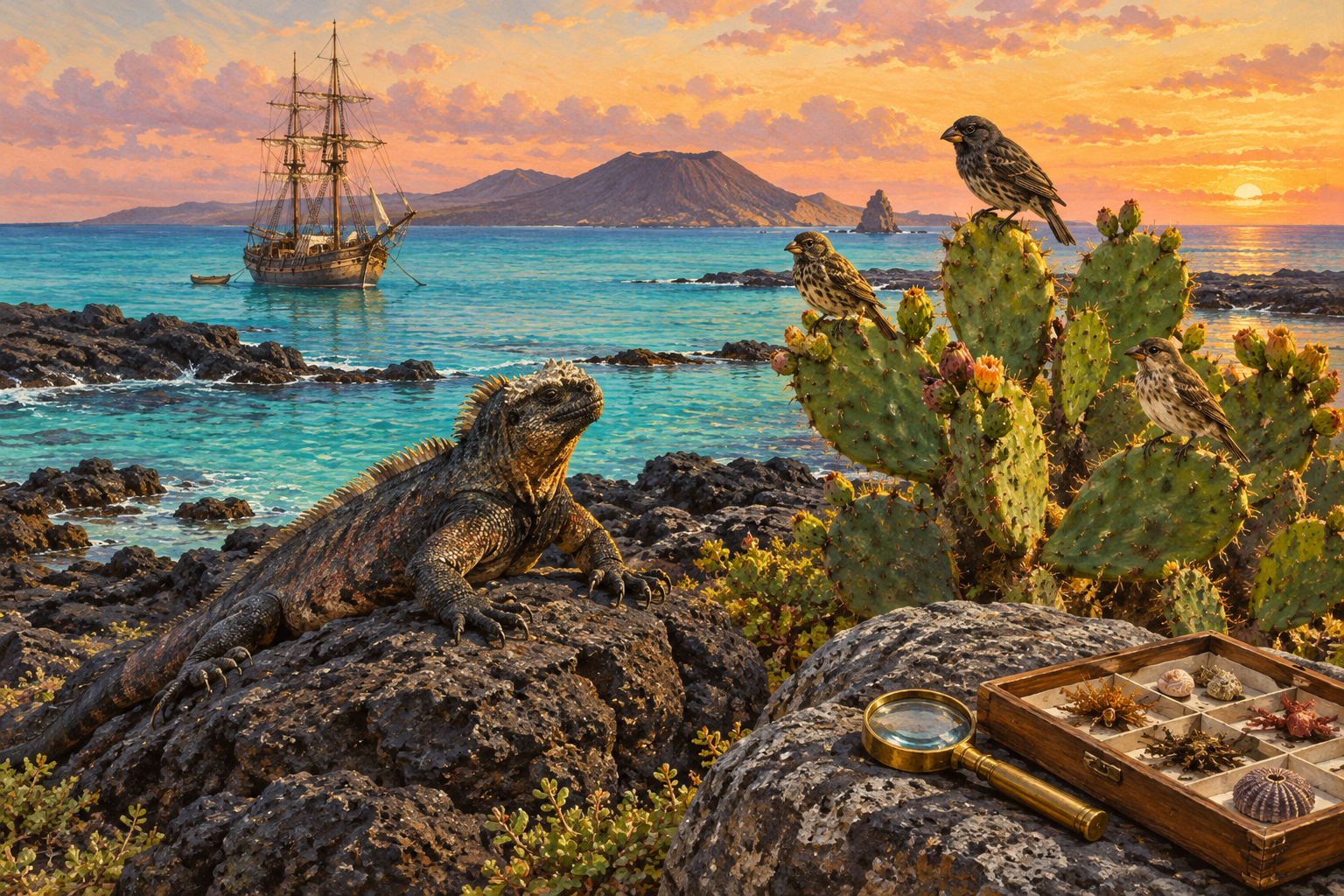
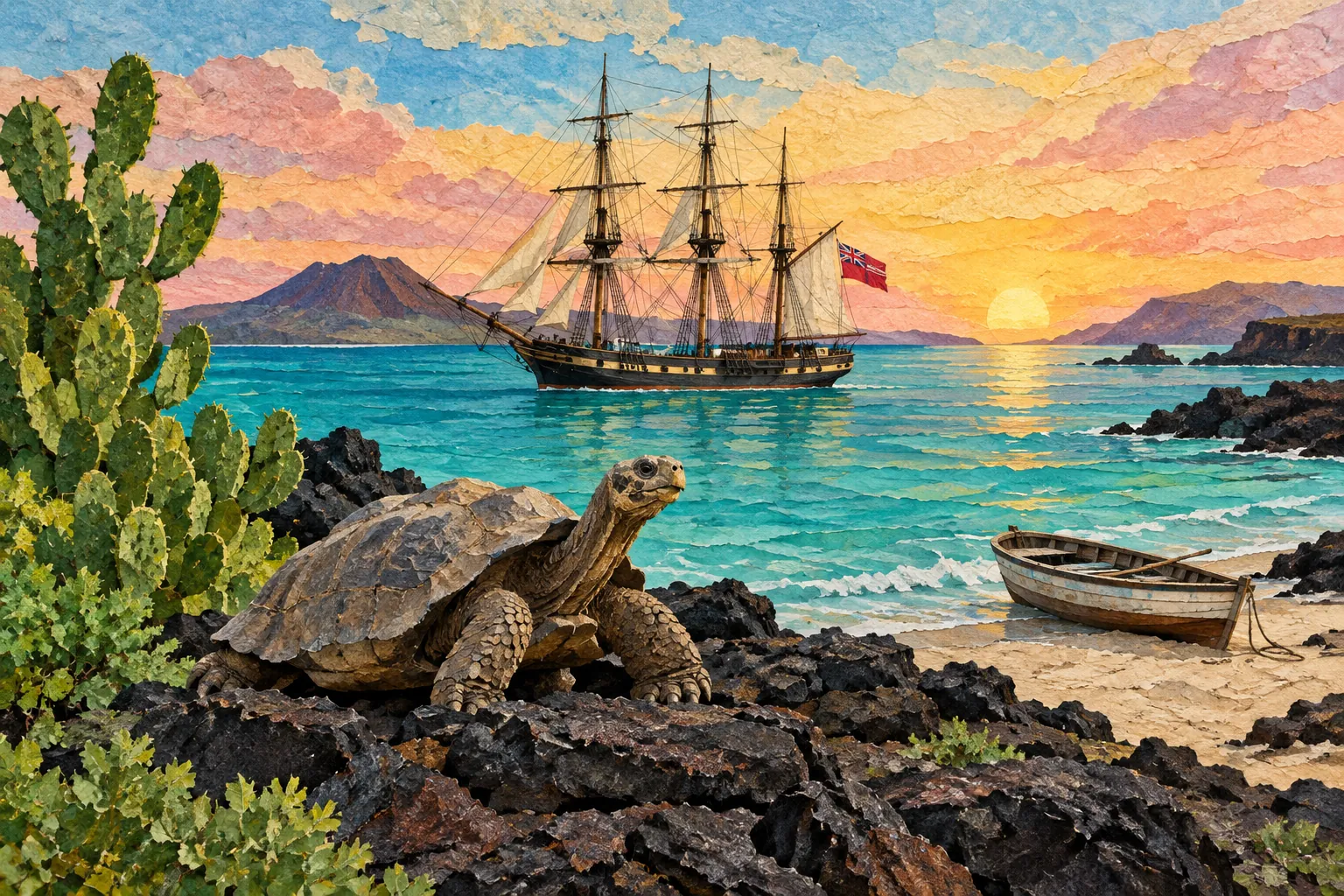
HMS Beagle, a Royal Navy survey ship under Captain Robert FitzRoy, left Plymouth on 27 December 1831. Darwin was 22 and went as a naturalist and a companion for the captain. The voyage lasted almost five years, ending at Falmouth on 2 October 1836. The ship worked along the coasts of South America and also called at the Galápagos Islands, Tahiti, New Zealand and Australia.
Everywhere he landed, Darwin collected and recorded plants, animals, rocks and fossils. In Argentina and Patagonia he found fossils of large mammals that no longer existed, yet looked related to living South American animals. In 1835 he experienced a great earthquake in Chile and saw that the land had been lifted. This fitted the geologist Charles Lyell's Principles of Geology, which he had brought along and which argued that the Earth changes slowly through small steps.
He visited the Galápagos in September and October 1835. He noticed that the giant tortoises and mockingbirds differed from island to island. A popular story says the finches gave him his idea in a flash. That is a myth. Darwin had not labelled where his birds came from, and he only understood them after returning home, when the ornithologist John Gould told him they were a group of closely related finches.
Twenty years of building the case (1836–1858)
Back in England, Darwin began private notebooks on how species change in 1837. In September 1838 he read Thomas Malthus's essay on population. Malthus argued that populations grow faster than their food supply. Darwin saw that the same must be true of animals and plants: more young are born than can survive, so some variations help and others do not. That was the core of natural selection.
On 29 January 1839 he married his cousin Emma Wedgwood, and they had ten children. In 1842 the family moved to Down House in Kent, where Darwin lived and worked for the rest of his life, often troubled by stomach illness and tiredness whose cause is still not settled. He wrote a short sketch of his theory in 1842 and a longer essay in 1844, but he did not publish. He wanted far more evidence and he feared the reaction.
He used the years to build his authority. From 1846 he spent about eight years on a detailed study of barnacles, which made him a respected expert on classification. He also bred pigeons to show how much a species can change under selection. In 1842 he published a theory of how coral reefs form, and in 1851 his daughter Annie died aged ten.
1858: Wallace and the push to publish
In June 1858 Darwin received a letter from the naturalist Alfred Russel Wallace, who was working in the Malay Archipelago. Wallace's enclosed essay described almost the same mechanism. Darwin's friends Charles Lyell and Joseph Hooker arranged for extracts from Darwin's writings and Wallace's essay to be read together at the Linnean Society in London on 1 July 1858. Neither man was there. Darwin had just lost his baby son Charles Waring to scarlet fever, on 28 June.
The shock pushed Darwin to write a book at last. He planned a short "abstract" of his larger work and finished it in a little over a year. Wallace is honoured today as a co-discoverer of natural selection.
On the Origin of Species (1859)
The publisher John Murray released On the Origin of Species on 24 November 1859. The first printing of 1,250 copies sold out to the trade very quickly. The argument is simple and can be put in four steps:
- Individuals of the same species vary.
- Some of that variation is inherited.
- More young are born than can survive, so there is a struggle to live and breed.
- Individuals whose traits suit their surroundings leave more offspring. This is natural selection.
Over very long periods this can produce new species. All life, Darwin argued, descends from common ancestors and is joined like the branches of a tree. He supported this with fossils, the spread of species across islands and continents, similar bone structures in different animals, similarities in embryos and the changes bred into pigeons and farm animals.
The first edition said almost nothing about humans, only that light would be thrown on the origin of man. Darwin also did not know how inheritance works. The work of Gregor Mendel was unknown to him, and genetics and natural selection were joined only in the 20th century.
Reaction and later work
Reactions were mixed. The biologist Thomas Henry Huxley defended the book so fiercely that he was called "Darwin's bulldog". At a British Association meeting in Oxford in 1860, Huxley and Bishop Samuel Wilberforce clashed over the theory; Darwin did not attend. Within a few years most scientists accepted that species evolve, although natural selection as the main cause was still argued over into the early 1900s.
In The Descent of Man (1871) Darwin argued that humans are part of the same story, and in 1872 he published The Expression of the Emotions in Man and Animals. His last book (1881) was about earthworms and soil. He died at Down House on 19 April 1882, aged 73, and was buried in Westminster Abbey, near the grave of Isaac Newton.
Common misunderstandings
- "Humans came from monkeys." Darwin argued that humans and apes share an ancient common ancestor.
- "Survival of the fittest." The phrase was coined by the philosopher Herbert Spencer, and Darwin adopted it in later editions. "Fit" means suited to the surroundings, not strongest.
- Evolution means progress. It does not. It favours what works in a particular place and time.
- Social Darwinism. Some people twisted the theory to defend ruthless competition, racism and empire. This was a social ideology, not Darwin's science, which describes nature and does not say how society should behave.
When Karl Marx died in 1883, his friend Friedrich Engels compared him to Darwin: Darwin had found the law of development of living nature, Marx the law of development of human history.
What exams ask
- Key facts: Beagle voyage 1831–1836; Galápagos 1835; On the Origin of Species 1859; The Descent of Man 1871; death 1882.
- Significance: Darwin challenged the belief that species were fixed and separately created. The theory sparked a major clash between science and religious authority and strengthened the 19th-century faith in science and progress.
- Misuse: Social Darwinism applied "survival of the fittest" to societies and was used to justify racism and imperialism.
- Compare: Darwin's theory of natural selection and Wallace's independent discovery; Darwin and Mendel as two separate parts of what later became modern genetics.
Read next
- Darwin's Theory of Evolution by Natural Selection: the idea itself, step by step, with more on the evidence.
- Friedrich Engels: the thinker who linked Darwin's science to Marx's view of history.
- What Is Nationalism?: another powerful 19th-century idea, and one that was also tangled up with ideas of race and competition.
- Ideas That Shaped the 19th Century: the hub that places Darwin beside liberalism, socialism and nationalism.