In five minutes: Napoleon II and his family
Napoleon II (1811–1832) was the only legitimate child of the French emperor Napoleon I. His mother was Marie-Louise, daughter of the Austrian emperor Francis I. He was called the King of Rome at birth, but after his father fell from power he was raised in Vienna as an Austrian prince. He died of tuberculosis on 22 July 1832, at the age of 21.
He never governed and he had no children. That is why the question "does Napoleon have descendants?" has two answers. The line from Napoleon and his wife ended with Napoleon II. But the Bonaparte family did not disappear: it continued through Napoleon's brothers, and through children Napoleon had outside his marriages. This page follows both stories. For the wider period, see the hub article The Napoleonic Era (1799–1815).
Why Napoleon needed an heir
Napoleon became emperor in 1804, but his first wife, Joséphine, had no child with him. An emperor without a son had a weak dynasty, and Napoleon wanted his rule to outlive him. At the end of 1809 he agreed to divorce Joséphine. You can read about that relationship in Joséphine and Napoleon.
In April 1810 he married Marie-Louise of Austria. The match was also diplomatic. Napoleon had fought Austria several times, and marrying a Habsburg princess tied him to one of Europe's oldest royal families. Marie-Louise was a great-niece of Marie Antoinette, the French queen executed during the Revolution.
On 20 March 1811 their son was born in the Tuileries Palace in Paris. He was named Napoleon François Joseph Charles and given the title King of Rome, a name that showed he was meant to inherit an empire reaching deep into Italy.
From King of Rome to Austrian prince
The boy's world collapsed before he was three. In 1814 the allied armies entered Paris. Marie-Louise left the city with her son at the end of March, and on 6 April Napoleon gave up the throne. He was sent to the island of Elba. Marie-Louise was given the duchies of Parma, Piacenza and Guastalla in northern Italy, and she took her son to her father's court in Austria.
In 1815 Napoleon escaped from Elba and re-entered Paris on 20 March, his son's fourth birthday. This was the Hundred Days. After his defeat at Waterloo he abdicated again on 22 June 1815, this time in favour of his son. The French chambers recognised "Napoleon II", but the allied armies were already marching on Paris, and Louis XVIII returned to the throne in July. In these two weeks Napoleon II was emperor on paper only. He was a four-year-old child in Austria and had no power at all.
The peacemakers at the Congress of Vienna did not want a Bonaparte to hold any land. Parma was given to Marie-Louise for her lifetime, and it was agreed that it would not pass to her son. In 1818 Emperor Francis gave his grandson the title Duke of Reichstadt, and the boy was known in Vienna by the German form of his name, Franz.
Life in Vienna
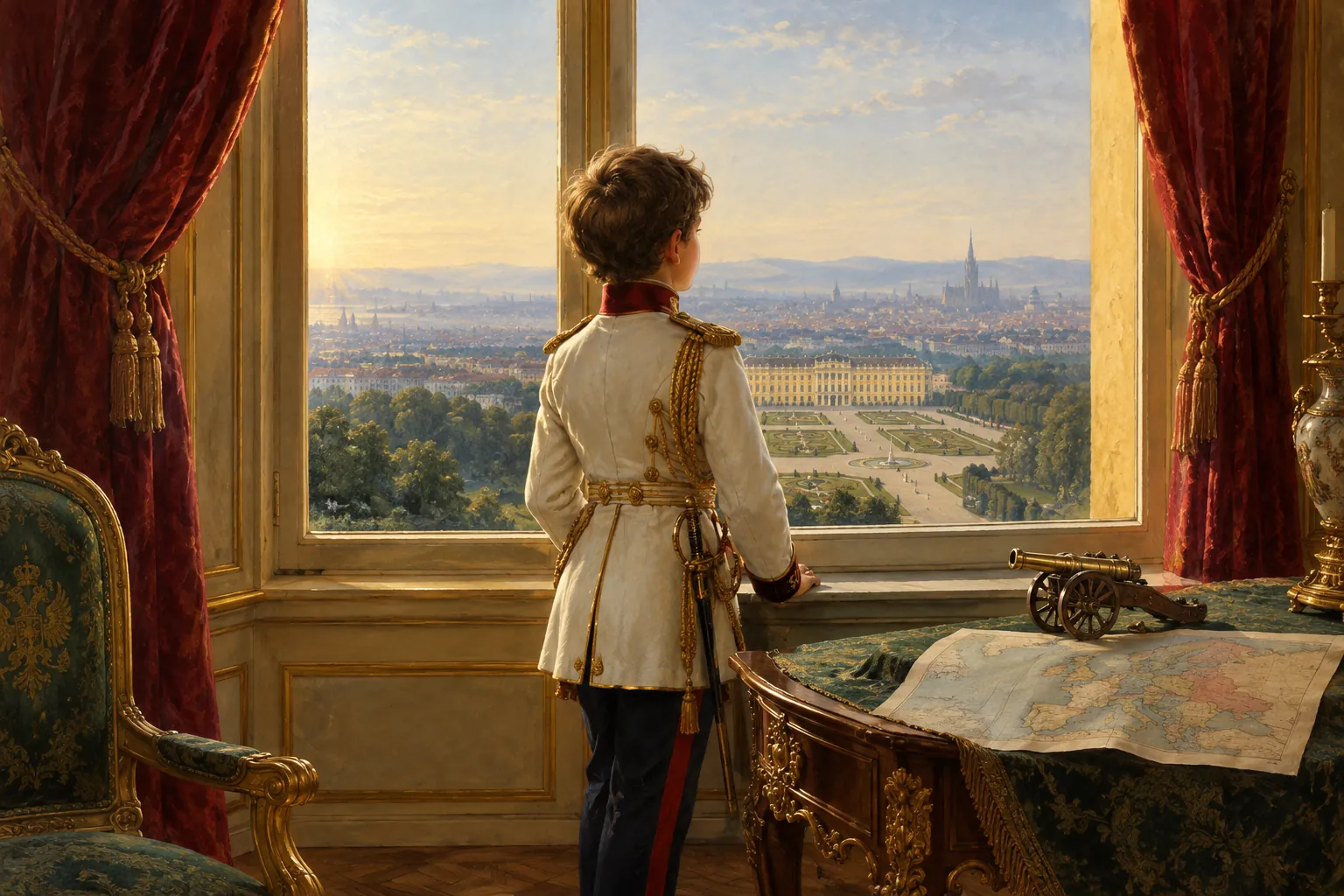
Napoleon II grew up at the Habsburg court. He had Austrian tutors, led by Count Moritz Dietrichstein, and he was trained for an army career. The Austrian chancellor Metternich watched him closely, because a Bonaparte in Europe could still be a rallying point. The boy was curious about his father, studied his campaigns, and kept a deep interest in French history. He was said to be gifted and serious, but he was often in poor health.
His father died on 5 May 1821 on the island of St Helena, where the British had held him since 1815. After that, Bonapartists in France began to speak of the young duke as the heir to the legend. Hopes rose again after the July Revolution of 1830, but the French chose Louis-Philippe as king, not a Bonaparte. Napoleon II's lungs were weakening, and he died at Schönbrunn Palace on 22 July 1832.
His mother, Marie-Louise, ruled Parma. She later married Count Adam Albrecht von Neipperg, who died in 1829, and then Count Charles de Bombelles. She died in 1847.
After 1832: L'Aiglon and the return to Paris
The young man became a figure of romance. He was called L'Aiglon, "the Eaglet", and the name was made famous by Edmond Rostand's play of 1900. In 1940, during the German occupation, Adolf Hitler had his remains moved from the Capuchin Crypt in Vienna to Les Invalides in Paris, where his father's tomb stands. The date, 15 December, was chosen to match the anniversary of the return of Napoleon's own remains in 1840.
Napoleon's descendants today
Napoleon had no legitimate descendants after Napoleon II. Descendants of Napoleon himself exist only through children born outside his marriages. Two are well known:
- Alexandre Walewski (1810–1868), son of the Polish noblewoman Marie Walewska. He became a French diplomat and served as foreign minister under Napoleon III. He has descendants.
- Charles Léon (1806–1881), son of Éléonore Denuelle de La Plaigne.
The Bonaparte name continued through Napoleon's brothers. Louis Bonaparte's son became Napoleon III, emperor of the French from 1852 to 1870. Napoleon III's only son, the Prince Imperial, was killed fighting in the Zulu War in 1879, which ended that branch.
The claim then passed to the line of Napoleon's youngest brother, Jérôme, and it continues today. Charles, Prince Napoléon (born 1950), is the great-great-grandson of Jérôme, and his son Jean-Christophe (born 1986) is the next in line. These people are descendants of Napoleon's brother, not of Napoleon himself.
Jérôme also had a short American marriage to Elizabeth Patterson of Baltimore in 1803, which Napoleon forced him to end. Their descendants include Charles Joseph Bonaparte, who was US Attorney General in 1906–1909 and set up the Bureau of Investigation, the forerunner of the FBI.
What exams ask
In AP European History and similar courses, Napoleon II matters for three reasons. First, he shows how the Napoleonic regime depended on one dynasty. Second, his exclusion from Parma and from France shows how the powers at the Congress of Vienna tried to remove Bonaparte influence. Third, the Bonapartist legacy led to Napoleon III's Second Empire. A typical question asks why the allies refused to accept Napoleon's abdication in favour of his son in 1815. The answer is that they wanted to end Bonaparte rule entirely.
Read next
- Who Was Napoleon Bonaparte? The father's life, from Corsica to St Helena.
- Joséphine and Napoleon Why the childless first marriage ended.
- Napoleon III: The Second Empire How the Bonaparte name returned to power.