In five minutes
Famous portraits of Napoleon are paintings made between 1796 and 1812 that turned a young general into a hero, an emperor and a lawmaker. The best known are Jacques-Louis David's The Coronation of Napoleon, David's Napoleon Crossing the Alps, Ingres's Napoleon on His Imperial Throne and Antoine-Jean Gros's Bonaparte at the Arcole Bridge.
The key point is that these are not snapshots. Each was made to send a message, and Napoleon and his circle shaped what that message was. Think of them as the posters of their age: they told the French, and the rest of Europe, what kind of ruler to expect. This page walks through the main works in order, so you can see what each one shows, what it leaves out and why. For the wider story, see the hub article The Napoleonic Era (1799–1815): Empire, War and the Congress of Vienna.
Why Napoleon needed portraits
Napoleon was a Corsican officer who rose during the French Revolution and took power in a coup in 1799. In 1804 he became emperor. He had no royal blood, so he could not rely on tradition to explain why he should rule. Images helped fill that gap.
There was no photography and no television. A big painting hung at the Salon, the official art exhibition in Paris, could be seen by crowds. Engravings carried it further, and copies went to offices and foreign courts. Painters gained money and rank from imperial favour, and the regime gained a face. David was named First Painter to the emperor in 1804.
Napoleon rarely gave painters long sittings, so artists often worked from quick sketches, costumes and studio models, then built the grand scene around them. That is one reason these images feel staged: they were.
Bonaparte at the Arcole Bridge (Gros, 1796)
In November 1796, during the Italian campaign, French troops fought near the village of Arcole. The story that spread afterwards showed the 27-year-old general seizing a flag and leading his men onto the bridge. Gros, then a young painter in Italy, made a portrait that fixed this image in people's minds.
The picture is not calm. Napoleon's hair streams behind him, he holds the tricolour flag and he turns to look back at the troops, urging them on. The message is youth, courage and a personal bond with his soldiers. Napoleon was still a general, not yet a ruler, so the portrait sells energy rather than majesty.
Napoleon Visiting the Plague Victims at Jaffa (Gros, 1804)
In 1799, during the Egyptian campaign, plague broke out among French troops at Jaffa. Gros painted Napoleon in an eastern courtyard, touching a sick soldier while aides cover their faces. It was shown at the Salon in 1804, the year Napoleon became emperor.
The scene recalls the old idea of kings who healed by touch, and it answered criticism of how Napoleon had treated the sick. A ruler who risks infection is a ruler who cares. That is a very political thing for a painting to say.
Napoleon Crossing the Alps (David, 1801–1805)
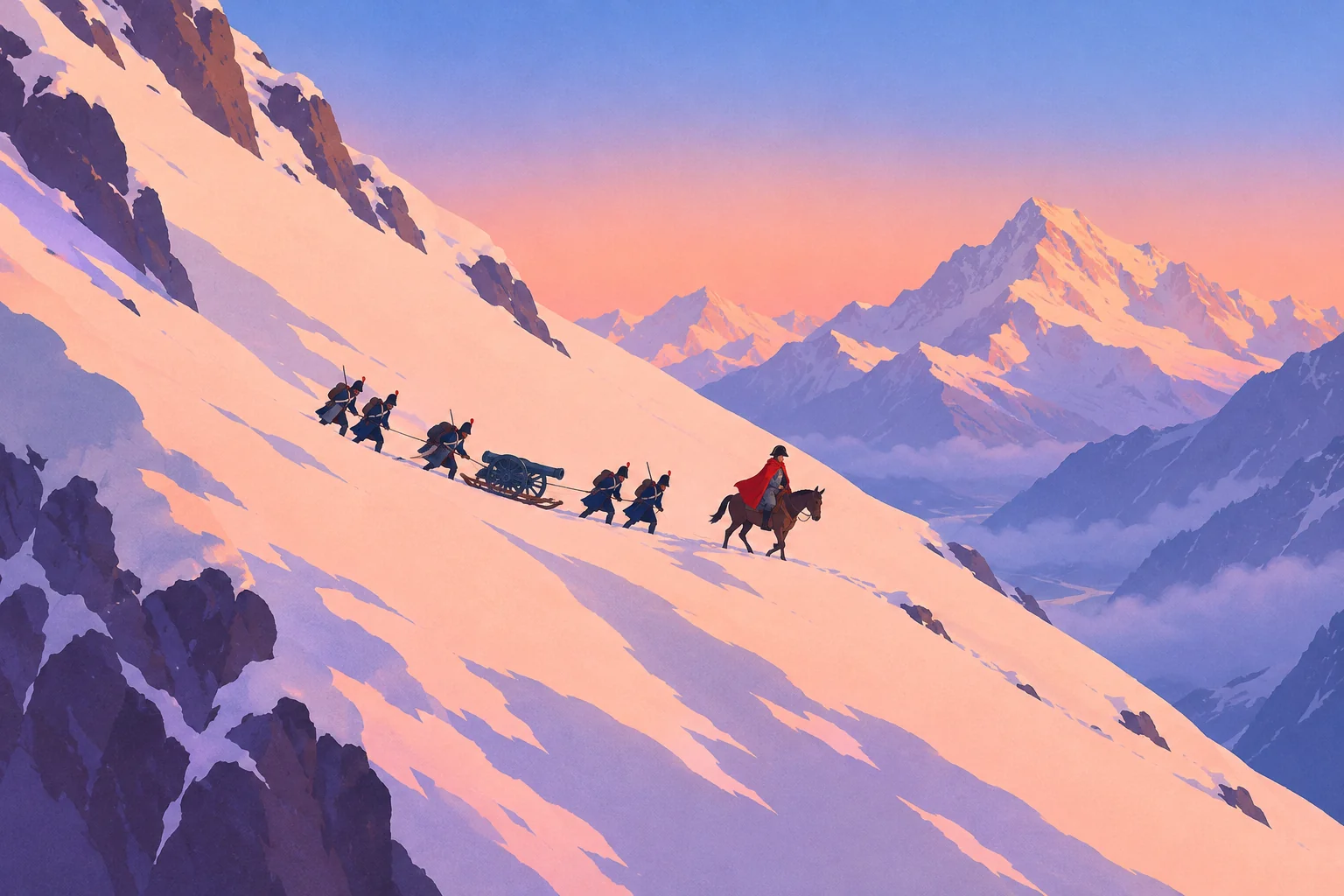
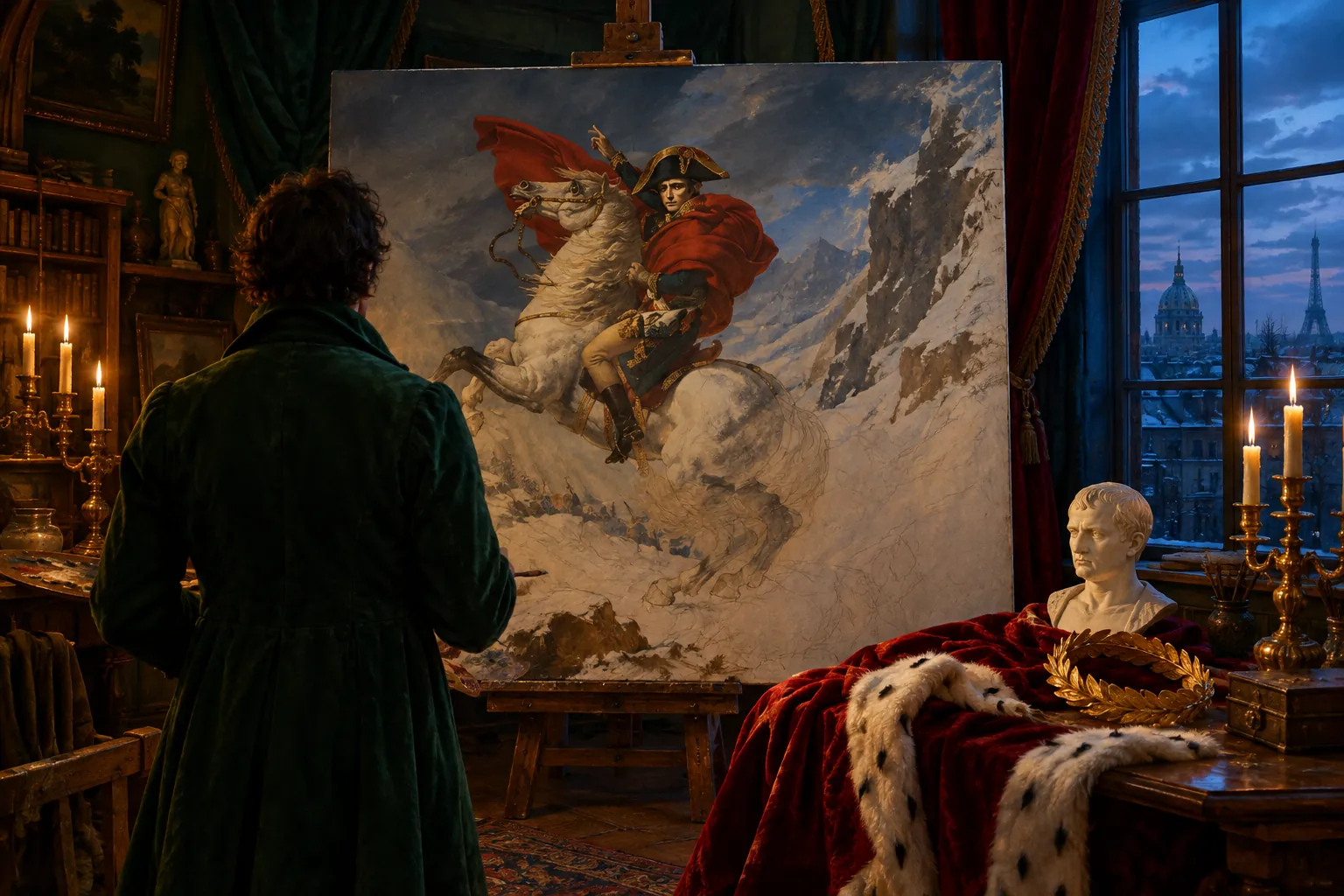
In May 1800 Napoleon, then First Consul, led an army over the Great St Bernard Pass to surprise the Austrians in Italy. King Charles IV of Spain asked David for a portrait of the event, and David painted five versions of it between 1801 and 1805.
Napoleon sits on a rearing horse, his cloak blown by the wind, and points up toward the summit. On the rocks in the foreground are carved the names Bonaparte, Hannibal and Karolus Magnus, which is Charlemagne. The line is clear: Napoleon is the next great crosser of the Alps, after Hannibal and Charlemagne.
Reality was plainer. Accounts say Napoleon crossed on a sure-footed mule led by a guide. David chose the stallion because he wanted a hero, not a record. For a full reading of this canvas, see Napoleon Crossing the Alps: The Painting Explained.
The Coronation of Napoleon (David, 1805–1807)
The crowning of Napoleon painting is the largest and most famous of them all. It shows the ceremony held at Notre-Dame in Paris on 2 December 1804, when Napoleon became Emperor of the French. The canvas is about 9.8 metres wide and 6.2 metres high and hangs in the Louvre. David began work in 1805, and the painting was shown to the public in 1808.
David did not paint the moment when Napoleon put the crown on his own head, which he had done earlier in the ceremony while Pope Pius VII watched. Instead he chose the next moment, when Napoleon holds a crown above the kneeling Joséphine. The pope sits behind, one hand raised in blessing, and looks more like a guest than the man giving the crown. The choice keeps the emperor's independence and still shows him as gracious.
The picture is also crowded with people: officials, marshals, family members and clergy, many of them recognisable portraits. Napoleon's mother is placed in a seat of honour although she did not attend the ceremony. Reality was edited to build a picture of unity and consent.
Napoleon on His Imperial Throne (Ingres, 1806)
Ingres was only 25 when he painted this. It shows Napoleon seated and facing the viewer, in a red robe trimmed with ermine and a laurel wreath, holding a sceptre and a staff topped with a hand, known as the hand of justice, with a sword at his side. These objects echo old royal power, and the stiff frontal pose gives the figure an almost holy look.
It did not go down well. Critics at the 1806 Salon found it cold and old-fashioned, and some compared it to medieval icons. Today it hangs in the Musée de l'Armée in Paris and is admired for its sharp detail and its strangeness. It is the clearest case of the emperor shown as an almost untouchable ruler.
Napoleon at Eylau (Gros, 1808)
The battle of Eylau, fought in East Prussia in February 1807, was a bloody and indecisive winter fight. Gros won a competition to paint its aftermath. The picture shows Napoleon on a snowy field the day after, surrounded by the dead and wounded, raising a hand in pity. It presents the emperor as a man who feels the cost of war, a message the regime wanted at a moment when the campaign had been costly.
The Emperor in His Study at the Tuileries (David, 1812)
This portrait shows Napoleon in a very different light. Painted in 1812 for a Scottish nobleman, the Marquess of Douglas, it shows the emperor standing in his study, in uniform, with a hand tucked into his waistcoat. The candles have burned low and the clock reads about 4:13. The message is plain: the emperor has been up all night working for his people.
Look at the details. A sword lies on a chair, ready but set aside. Papers on the desk point to the Civil Code, his most lasting reform (see The Napoleonic Code (1804)). The painting is now in the National Gallery of Art in Washington. It shows a lawgiver as well as a conqueror.
How to read a Napoleon portrait
Four questions unlock almost any of these pictures:
- Who asked for it? A foreign king, a nobleman or the state each wanted something different.
- Which moment was chosen? David picked the crowning of Joséphine, not the self-coronation.
- What is missing? The mule, the absent mother and the cost of war all fade out of view.
- What do the objects say? Sceptre, sword, clock and papers are the picture's vocabulary.
After 1815 painters were free to show another side. A generation later, Paul Delaroche showed a worn-out Napoleon at Fontainebleau in 1814 (painted in 1845) and, in 1850, a more realistic crossing of the Alps on a mule. Putting these beside David's versions shows how much an image depends on when it was made.
What exams ask
In AP-style questions, the key idea is propaganda and legitimacy: how a ruler without royal birth used art to claim authority. Be ready to name David and Ingres as Neoclassical painters, to link Gros with the shift toward Romanticism, and to explain how the Coronation and the Alps picture serve different goals. A good answer names the painter, the date, the message and one thing the picture leaves out.
Read next
- The Napoleonic Era (1799–1815): the full timeline of Napoleon's rule, in which these paintings were made.
- Napoleon Crossing the Alps: a closer look at the most reproduced portrait of him.
- The Napoleonic Code (1804): the legal reform that the study portrait celebrates.
- Who Was Napoleon Bonaparte?: the life behind the images.