The French and Indian War in five minutes
The French and Indian War (1754–1763) was the North American front of the Seven Years' War. Britain and France, backed by colonists and Native allies, fought for control of the continent's interior, above all the Ohio Valley. Britain won. In the Treaty of Paris of 1763, France gave up Canada and almost everything it claimed east of the Mississippi River.
The war matters because of what came after. Britain ended it with a huge debt and a far larger empire to govern. Its efforts to make the colonists help pay for that empire pushed the two sides apart, a story told in The American Revolution: Causes, War and Independence.
The name is American. Canadians usually call the same conflict the Seven Years' War, and Quebec historians speak of the Conquest. The fighting in North America also began two years before Britain and France formally declared war in 1756. For the wider world war, see Seven Years' War vs French and Indian War.
What was the French and Indian War, and who fought in it?
By the 1750s, Britain and France each held a long strip of North America. Britain's thirteen colonies ran along the Atlantic coast and held roughly 1.5 million people. New France stretched from the St. Lawrence River through the Great Lakes and down the Mississippi, yet had only about 70,000 settlers. France made up for its small numbers with fur-trade partnerships, alliances with Native nations and a chain of forts.
It was never a simple two-sided contest. Many nations of the Great Lakes and Ohio country, among them the Ottawa, the Abenaki and the Huron-Wendat, fought beside France, and the Shawnee and Lenape (Delaware) did so for several years. The Haudenosaunee (Iroquois) Confederacy mostly kept a careful neutrality, while the Mohawk and others fought with Britain. Each nation acted for its own reasons, mainly to protect its land and trade, not simply to serve a European power.
What caused the French and Indian War?
The root cause was a fight over the Ohio Country, the land west of the Appalachian Mountains. Virginia land speculators, including members of the Ohio Company, wanted to settle and sell it. France wanted it as the link between Canada and Louisiana, and it began building forts to hold it. Native nations living there saw both empires as a threat to their land.
In 1753 Virginia's governor, Robert Dinwiddie, sent a young militia officer, George Washington, to tell the French to leave. They refused. In spring 1754 the French seized the half-built British post at the forks of the Ohio River and built Fort Duquesne there. On 28 May 1754 Washington's men and their Native allies fought a small French party at Jumonville Glen. On 3 July the French and their allies forced Washington to surrender at Fort Necessity. The war had begun, long before any declaration.
Britain and France had also fought earlier colonial wars (King William's, Queen Anne's and King George's), and none had settled who would control North America. This one did.
What happened? The war in four stages
1754–1757: French successes. In 1754 delegates met at the Albany Congress, where Benjamin Franklin proposed a union of the colonies. The plan failed, but his "Join, or Die" cartoon became famous. In July 1755 a British column under General Edward Braddock was ambushed near the Monongahela River by French and Native forces, and Braddock was killed. That year British authorities also began deporting the French-speaking Acadians from Nova Scotia. Britain declared war formally in May 1756, and the French general Montcalm took Fort Oswego that August. In August 1757 he took Fort William Henry, and Native warriors attacked part of the surrendering column afterwards, an event that shocked the colonies.
1757–1758: the turn. William Pitt became the leading figure in the British government in 1757. He sent far more money and troops to America and worked with colonial assemblies, which raised soldiers in return for repayment. In July 1758 the British took the fortress of Louisbourg, which guarded the St. Lawrence, though they lost badly at Ticonderoga the same month. In November the French abandoned Fort Duquesne, and the British built Fort Pitt on the site, today's Pittsburgh. In October 1758 the Treaty of Easton with Ohio nations also pulled many of France's allies away.
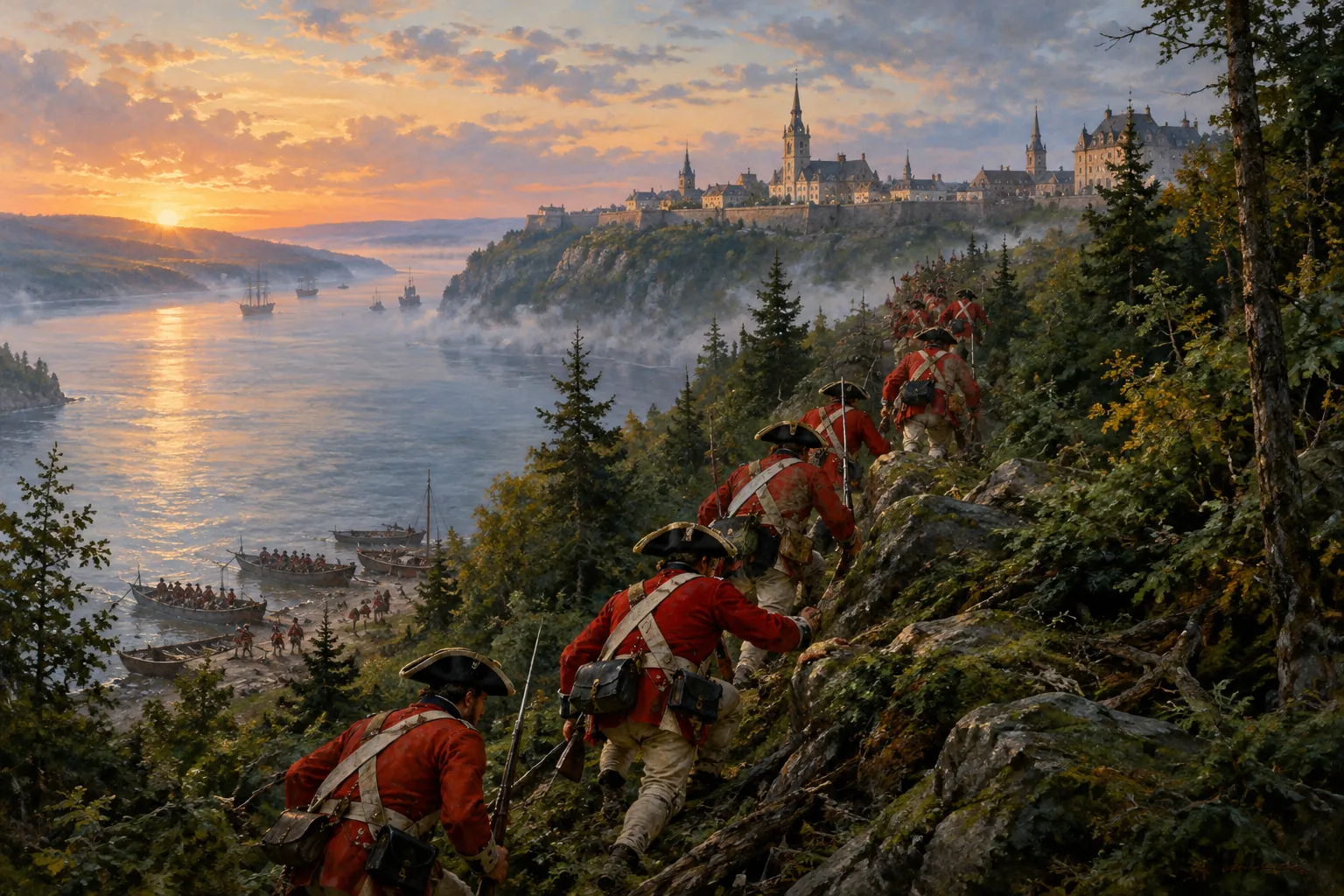
1759: the year of victories. Fort Niagara fell in July. On 13 September 1759 General James Wolfe led British troops up a path to the Plains of Abraham outside Quebec. In the short battle that followed, the French were beaten, and both Wolfe and Montcalm were fatally wounded. Quebec surrendered on 18 September.
1760–1763: the end. Montreal surrendered to General Jeffery Amherst on 8 September 1760, which ended major fighting in Canada. The wider war went on in Europe, the Caribbean and Asia until the peace of 1762–1763.
Who won the French and Indian War?
Britain won. France's loss was complete in North America. Under the Treaty of Paris, signed on 10 February 1763, France gave Canada and the land east of the Mississippi (except New Orleans) to Britain. Spain, which had joined France late, gave Florida to Britain and got Louisiana west of the Mississippi from France in return, under a separate agreement. France kept only a few islands, including Saint-Pierre and Miquelon, and its sugar colonies of Guadeloupe and Martinique.
Native nations lost most. With France gone, they could no longer play one empire against the other. British settlers pushed west, and in 1763 Pontiac's War broke out when Great Lakes and Ohio nations attacked British forts. The Royal Proclamation of 7 October 1763 tried to calm things by banning colonial settlement west of the Appalachian crest. Many colonists ignored it, and resented it.
Why did it lead to the American Revolution?
Three results mattered. First, the threat from France was gone, so colonists needed British protection less. Second, Britain's national debt had nearly doubled, and Parliament believed the colonies should pay part of the cost of defending them. Third, the Proclamation line and a peacetime army angered colonists who had expected to enjoy the new land.
The taxes came quickly: the Sugar Act in 1764 and the Stamp Act in 1765. Colonists replied that they could not be taxed by a Parliament in which they had no vote. Many future leaders, among them Washington and Franklin, had learned how to fight, organise and negotiate in this war. The road ran on to the Declaration of Independence in 1776.
What exams ask
AP-style questions usually ask for these points. Know the causes (the Ohio Country, French forts, colonial expansion). Know the turning points (Pitt's strategy, Quebec in 1759). Know the terms of the Treaty of Paris of 1763. Know the consequences: British debt, the Proclamation of 1763, Pontiac's War, and new taxation leading to colonial protest. A strong answer links the end of the French threat to the weakening of colonial ties with Britain, and mentions Native nations as actors, not background.
Read next
- The Seven Years' War (1756–1763): The First World War? shows the global conflict that this war was part of.
- Seven Years' War vs French and Indian War: Same War? sorts out the two names and dates.
- The Declaration of Independence Explained follows the story to 1776.
- The American Revolution: Causes, War and Independence is the hub for the whole topic.