In five minutes: who was Voltaire?
Who was Voltaire? He was the most widely read French writer of the eighteenth century and one of the leading voices of the Enlightenment. Born François-Marie Arouet in Paris in 1694, he wrote plays, poems, histories, philosophical tales and an enormous number of letters. His weapons were wit and clarity. He made powerful people look foolish, and he made ordinary readers feel that cruelty justified by tradition could be questioned.
He did not build a single grand system like some philosophers. His lasting contribution was a habit of mind: ask for evidence, distrust fanaticism, and defend the right of people to think and worship differently. That habit connects him to the wider movement described in The Enlightenment Explained: Ideas, Thinkers and Legacy.
Early life: from Arouet to Voltaire
Arouet was born in Paris on 21 November 1694 into a well-off family. His father was a notary and his education at a Jesuit school gave him a love of theatre and a sharp command of Latin and French. He chose literature over the law his father wanted for him.
Writing got him into trouble early. In 1717 he was sent to the Bastille for about eleven months after verses mocking the regent were blamed on him. While there he worked on his tragedy Œdipe, which was a success when staged in 1718. Around that time he began to sign his work “Voltaire”, a name whose origin historians still discuss.
Exile in England and the Letters
In 1726 a quarrel with a nobleman, the Chevalier de Rohan, ended with Voltaire in the Bastille again and then in exile. He chose England and stayed until 1728. He saw a country with a parliament, a freer press and a wider range of religious groups than France. He admired the science of Isaac Newton and the empiricism of John Locke, whose ideas are covered in Who Was John Locke? Life, Ideas and Influence.
He turned these impressions into the Letters on the English, also called the Philosophical Letters, published in 1734. The book praised English tolerance and trade and quietly compared them with French habits. French authorities condemned it and had copies burned, and Voltaire left Paris to avoid arrest.
Cirey, Potsdam and Ferney
He found shelter at Cirey, the estate of Émilie du Châtelet, a gifted mathematician and physicist. For about fifteen years they studied and wrote together, and she produced a French translation of Newton’s Principia. She died in 1749 after childbirth.
In 1750 Voltaire accepted an invitation from Frederick II of Prussia and moved to Potsdam. The friendship between the “enlightened” king and the famous writer soured within three years, and Voltaire left in 1753. He eventually settled near Geneva and in 1759 moved into the estate at Ferney, just across the French border, which made it easy to escape any authority that turned against him. From the château at Ferney he ran a kind of one-man publishing and campaigning office for almost twenty years, writing to kings, ministers and ordinary admirers.
Candide and the problem of suffering
On 1 November 1755 an earthquake destroyed much of Lisbon and killed tens of thousands of people. The disaster shook the confident idea that the world was arranged for the best. Voltaire answered with a poem on the Lisbon disaster in 1756, and then with his short satirical novel Candide, published in 1759.
Candide follows a naive young man who is taught that “all is for the best” and then meets war, shipwreck, slavery and the Inquisition. The story mocks easy optimism rather than hope itself. Its closing advice is modest: stop arguing about the universe and cultivate your own garden, meaning do useful work close at hand.
The Calas case and the Treatise on Tolerance
Voltaire’s most famous public campaign began in 1762. Jean Calas, a Protestant cloth merchant in Toulouse, was accused of murdering his son Marc-Antoine, who had been found dead in October 1761. Rumour said the father killed him to stop a conversion to Catholicism. Most historians think the young man took his own life. The local court nevertheless sentenced Calas to be broken on the wheel, and he was executed in March 1762 while insisting he was innocent.
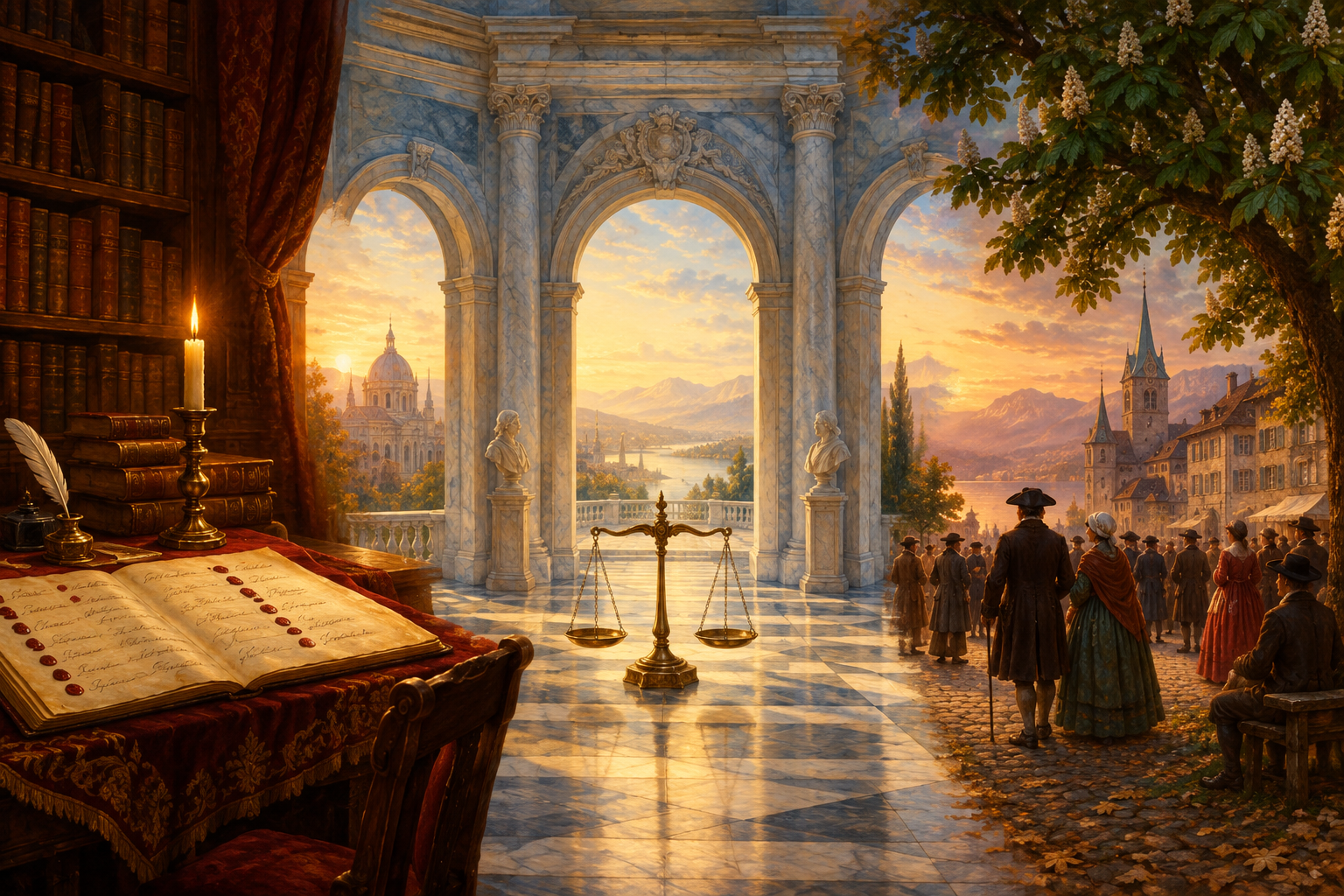
Voltaire read the case, interviewed the family and decided it was a judicial murder driven by religious prejudice. He wrote letters, funded legal help and published pamphlets to put pressure on the authorities. In 1763 he issued the Treatise on Tolerance, which uses the case to argue that persecution for belief is both cruel and useless. In 1765 the sentence was annulled and the family cleared. Voltaire took on similar cases afterwards, including that of the Sirven family.
Not every case ended well. In 1766 the young Chevalier de La Barre was executed for blasphemy, and a copy of Voltaire’s Philosophical Dictionary was burned with his body. The episode hardened Voltaire’s anger at religious fanaticism, which he summed up in the slogan he repeated in letters, “Écrasez l’infâme”, a call to crush bigotry and abuse by the church.
What Voltaire believed
- Tolerance. People will always disagree about religion, so the state should not punish belief.
- Reason and evidence. He trusted observation, science and clear argument over authority and tradition.
- Deism. He believed in a creator but rejected miracle-based religion and priestly power.
- Satire as a tool. Laughter could do what a sermon could not.
- History beyond kings. In his Essay on the Customs and Spirit of Nations he tried to describe whole societies, trade and culture, not only battles. There he also joked that the Holy Roman Empire was neither holy, nor Roman, nor an empire.
He was not a democrat. He preferred reform from above by an informed monarch, and he did not call for the end of monarchy. That separates him from Rousseau, whose ideas about popular will were more radical.
Limits and criticism
Voltaire’s record has real blemishes. He grew rich through business investments while condemning cruelty in his stories. He wrote contemptuous remarks about Jews and about Africans, and these passages are rightly criticised today. Admiring his defence of tolerance does not require ignoring that he did not always apply it himself.
A further caution concerns the most famous line attached to him, the sentence about defending to the death your right to speak. He did not write it. It was coined by a biographer in 1906. The story is in Voltaire Quotes (and the Famous Line He Never Wrote).
Death and legacy
In February 1778 Voltaire returned to Paris after nearly three decades away and was welcomed at the theatre as a celebrity. He died there on 30 May 1778, aged 83. Church burial was disputed, but his body was later placed in the Panthéon in 1791, during the Revolution. His writing helped shape the language later used for freedom of conscience and a fair trial, and the Calas case remains a standard example of how public opinion can correct a miscarriage of justice.
What exams ask
- Voltaire is a leading French philosophe, grouped with Montesquieu, Rousseau and Diderot.
- Key works to know: Letters on the English (1734), Candide (1759), Treatise on Tolerance (1763).
- Be able to explain the Calas affair as an Enlightenment argument against religious persecution.
- Contrast him with Rousseau: Voltaire favoured reform led by enlightened rulers and personal liberty, while Rousseau stressed popular sovereignty.
- Link him to “enlightened absolutism” through his relationship with Frederick II.
Read next
- The Enlightenment Explained: the wider movement Voltaire belonged to.
- Voltaire Quotes (and the Famous Line He Never Wrote): which famous sayings are really his.
- Who Was John Locke?: the English thinker whose ideas Voltaire carried to France.
- Rousseau Quotes and What They Mean: a very different answer to the same age.