In five minutes
Marie Antoinette's last words, in the version most people know, were an apology. On 16 October 1793, as she climbed the scaffold in Paris, the former queen of France trod on the executioner's foot and said, in French, “Pardon me, sir, I did not do it on purpose.” Minutes later she was dead, aged 37.
That line comes from accounts by people who were there, and it spread quickly after her death. Better documented are two other things she said and wrote in her final days: a reply at her trial, and a farewell letter written before dawn on the day she died. Together they give a fuller picture than the quotes usually pinned on her. For the wider story of the revolution that brought her down, see The French Revolution Explained (1789–1799).
Marie Antoinette's last words on the scaffold
By the autumn of 1793 she was no longer a queen at all. The monarchy had been abolished in September 1792, her husband Louis XVI had been guillotined on 21 January 1793, and she was held in the Conciergerie, a prison in the middle of Paris, as “the widow Capet”. Her eight-year-old son had been taken from her in July.
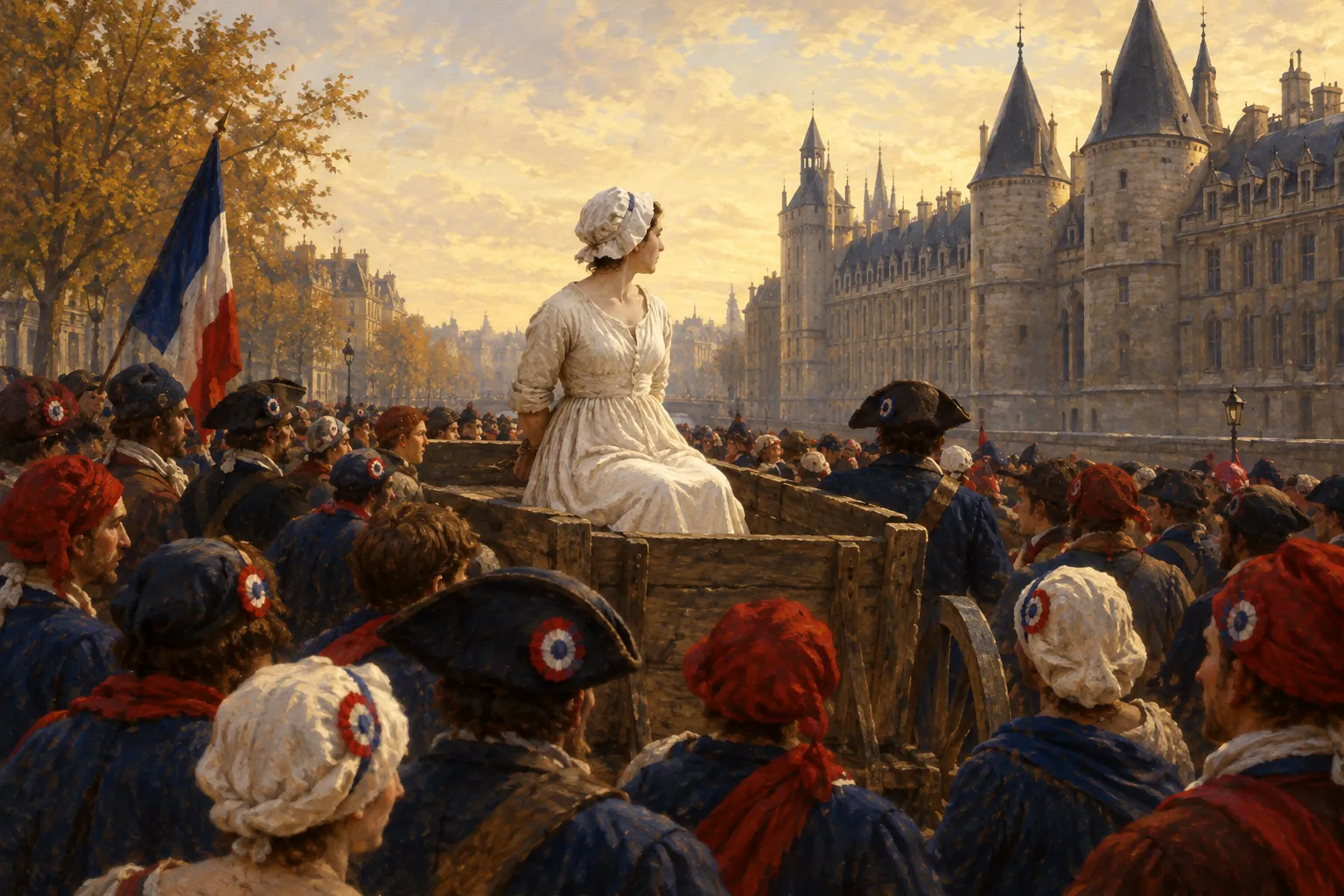
On the morning of 16 October she was dressed in a plain white gown and cap. Her hair had been cut short, and her hands were tied behind her back. She rode through the streets in an open cart, the kind used for common criminals, rather than in a carriage. The painter Jacques-Louis David sketched her from a window along the route, and the drawing still survives. It shows a stiff, tired woman with her chin held high.
The cart reached the Place de la Révolution (today the Place de la Concorde) around midday. As she stepped onto the platform she stumbled against the foot of the executioner's assistant, and the words reported from that moment are the apology above. It is a small, polite sentence, and that is the reason it lasts. After years of being painted as an arrogant spendthrift, her final recorded act was ordinary good manners. The blade fell at about a quarter past twelve.
What she said at her trial
Her trial before the Revolutionary Tribunal ran from 14 to 16 October. The prosecutor, Antoine Quentin Fouquier-Tinville, accused her of draining the treasury, of passing information to Austria and its allies, and of plotting against the Republic. The most shocking charge was added by the journalist Jacques-René Hébert: that she had abused her young son. The boy had been pressured into signing a statement against her.
When the president of the court pressed her on this, she is reported to have answered that nature itself refuses to reply to such a charge against a mother, and then she turned to the women in the room. “I appeal to all mothers who are present.” Accounts say the reaction in the courtroom was uneasy, and even some hardened revolutionaries thought the charge had gone too far. It is her most quoted statement from the trial because it was not a legal argument at all. It was a personal one.
The verdict was never in doubt. She was found guilty on all counts and sentenced to death in the early hours of 16 October.
The letter she wrote before dawn
Soon after the sentence, at about half past four in the morning, she sat down and wrote to Madame Élisabeth, the sister of Louis XVI and the one relative still near her. This letter is the best source for what she was thinking. It never reached Élisabeth; the guards passed it on to the authorities, and it was not published until 1816.
Several lines are quoted often (these are our own translations from the French):
- “I have just been condemned, not to a shameful death, which is only for criminals, but to go and join your brother.”
- “I am calm, as one is when conscience reproaches one with nothing.”
- “I forgive all my enemies the harm they have done me.”
She also asked Élisabeth to tell her children, her son above all, never to seek revenge for their parents' deaths. She said she died in the Catholic faith, and she apologised to anyone she might have hurt without meaning to. The letter is dignified and plain, written by a woman who had learned in prison to say what mattered and to leave the rest unsaid.
Quotes she never said
The most famous “Marie Antoinette quote” is “Let them eat cake”. There is no evidence she ever said it. A similar story about a “great princess” who suggested that starving peasants eat brioche appears in Jean-Jacques Rousseau's Confessions, which he wrote around 1765, when Marie Antoinette was nine years old and still living in Vienna. The line was attached to her later, because it suited the image revolutionaries wanted to draw: a queen who did not know or care how ordinary people lived.
The nickname “Madame Déficit” is different. It was a real insult in the late 1780s, when the crown's debts and the cost of the court were national scandals. Her spending was a small part of the problem, since most of the debt came from wars, but she became its symbol. The Affair of the Diamond Necklace in 1785, a fraud in which she was an innocent target, made it far worse; see The Affair of the Diamond Necklace.
The rule of thumb: be careful with any dramatic one-liner credited to her. The three records above, the scaffold apology, the trial reply and the letter, have the strongest claim to be hers.
Why the words still matter
Her words show how far her public image and her private character had drifted apart. As a young queen she was fashionable, frivolous and unpopular. As a prisoner she was composed, devout and concerned mostly about her children. Historians still argue about how much responsibility she bears for the crisis of the monarchy, and the quotes cannot settle that. What they do show is a person facing a death that was largely political, with more self-control than many of her accusers expected.
What exams ask
- Dates: trial 14–16 October 1793; execution 16 October 1793; Louis XVI executed 21 January 1793.
- Why she was tried: accusations of treason with Austria, of squandering state funds, and of conspiracy against the Republic, during the Terror and the war with Europe's monarchies.
- Significance: her execution showed that the Republic would put even the former queen on trial, and it came during the Reign of Terror, when the Committee of Public Safety held power.
- Source skills: be able to tell a primary source (her letter) from a later legend (the cake remark).
Read next
- Marie Antoinette and Her Mother Maria Theresa: the letters from her mother, who shaped her life from Vienna.
- Who Was Louis XVI?: the husband whose fate she shared, and the king who could not hold the monarchy together.
- The Affair of the Diamond Necklace: the scandal that did the most damage to her reputation.