In five minutes: the Seven Years' War
The Seven Years' War (1756–1763) was a world war fought between two alliances. Britain, Prussia and Hanover stood on one side. France, Austria, Russia, Sweden and, from 1762, Spain stood on the other. Fighting spread from Central Europe to the forests of North America, the sugar islands of the Caribbean, the coast of West Africa, India and the Philippines. That reach is why some historians, and Winston Churchill later, described it as the first world war.
Who won the Seven Years' War? It depends on the theatre. In the contest for empire, Britain won. By the Treaty of Paris in 1763, France gave up Canada and almost all of its land east of the Mississippi River. In Europe, Prussia under Frederick the Great was badly outnumbered but kept the rich province of Silesia, so Austria failed to win its main goal.
Britain's victory came at a price. The national debt nearly doubled, and paying it off led London to tax and regulate its American colonies. That is the thread tying this war to the American Revolution. In North America, the same conflict is called the French and Indian War. Our article on the French and Indian War follows that theatre in detail. This page covers the whole war.
Why did the Seven Years' War start?
Two separate rivalries fed into one war.
The first was between Austria and Prussia. In 1740 the young Prussian king Frederick II seized Silesia, a prosperous province that belonged to the Habsburgs. The War of the Austrian Succession (1740–1748) ended with Prussia keeping it. Empress Maria Theresa of Austria never accepted the loss and waited for a chance to take it back.
The second was between Britain and France. Both wanted control of North America, the Caribbean sugar islands, the slave trade in West Africa and trade in India. In the Ohio Valley, a young Virginia officer named George Washington clashed with French troops in 1754. In 1755 a British army under General Edward Braddock was crushed near the Monongahela River. Fighting in America therefore began before any formal declaration of war.
What tied the two rivalries together was the Diplomatic Revolution of 1756. For decades Britain had been Austria's ally against France. The Austrian chancellor Kaunitz decided that Prussia was the greater enemy and approached France instead. In January 1756 Britain and Prussia signed the Convention of Westminster. In May, France and Austria answered with the First Treaty of Versailles. Russia, under Empress Elizabeth, feared Prussia too and sided with Austria. Britain declared war on France in May 1756, and in August Frederick struck first by invading Saxony.
How the war unfolded
Europe: Prussia against the odds
Prussia faced several much larger states at once. Frederick won two famous victories in late 1757: Rossbach in November, against a French and imperial army, and Leuthen in December, against the Austrians. At Leuthen he used his "oblique order", hitting one flank of the enemy line with most of his strength while the rest of his army held back.
The luck did not last. In August 1759 Russian and Austrian forces crushed him at Kunersdorf. In October 1760 Russian and Austrian troops briefly entered Berlin. Prussia came close to collapse more than once, and Frederick himself wrote in despair.
North America: from Braddock to Quebec
In the early years France did better in America. British forts at Oswego (1756) and William Henry (1757) fell. The turn came when William Pitt, often called Pitt the Elder, took charge of British strategy in 1757. He poured money into the army and navy, and he paid subsidies to Prussia so that Frederick could keep France busy in Europe.
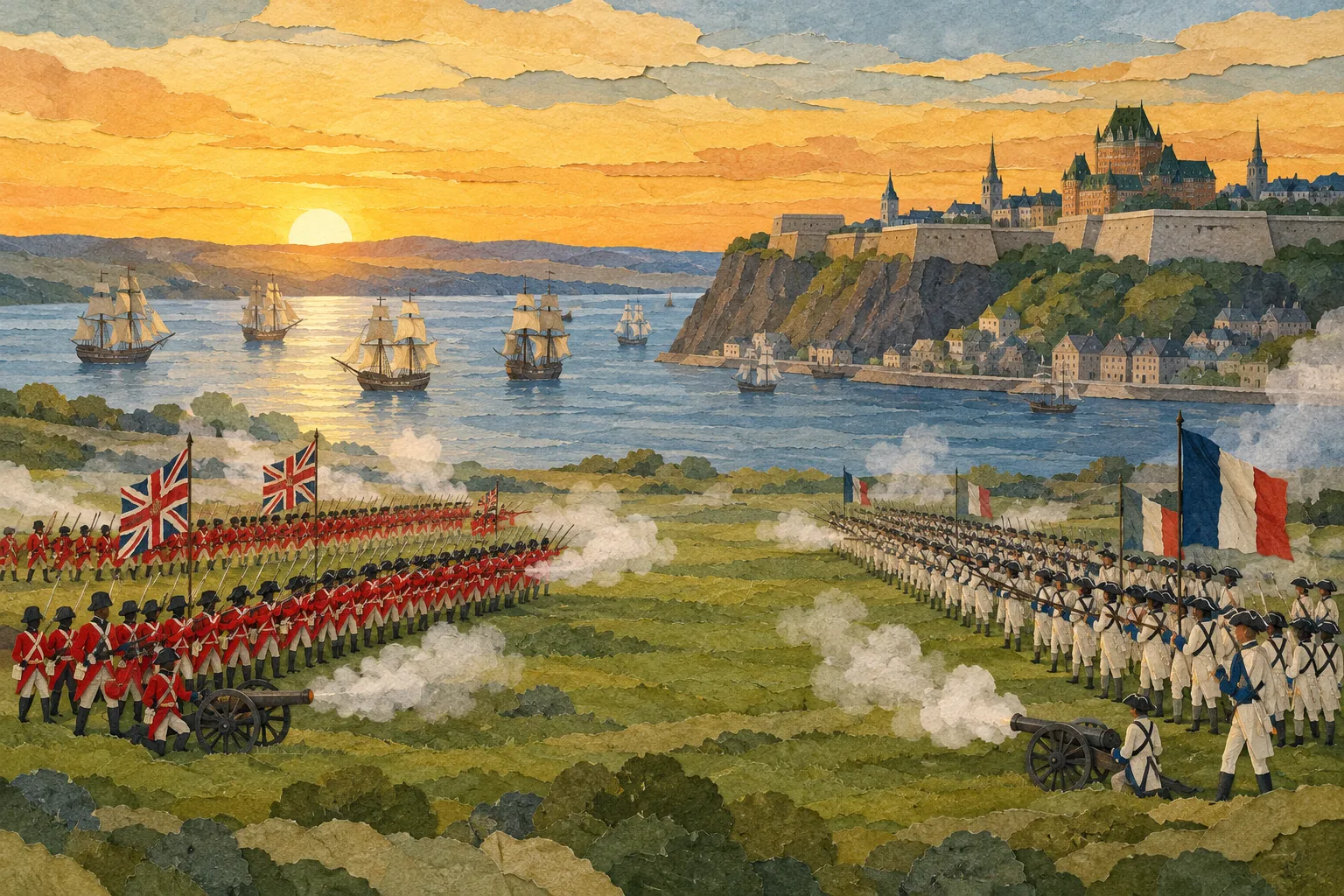
In 1758 the British took the fortress of Louisbourg and Fort Duquesne, which was renamed Pittsburgh. On 13 September 1759, on the Plains of Abraham outside Quebec, General James Wolfe defeated the Marquis de Montcalm. Both commanders died of their wounds. Montreal surrendered in September 1760, and French Canada passed into British hands.
The sea and India
Britain called 1759 its year of victories. The allied army won at Minden in Germany in August. Also in August, a British fleet won off Lagos in Portugal, and in November Admiral Hawke destroyed a French fleet at Quiberon Bay. With the French navy broken, France could no longer supply its colonies.
In India, Robert Clive and the East India Company defeated the Nawab of Bengal at Plassey in June 1757. This was the start of Company rule in Bengal. The French base at Pondicherry fell in January 1761, which ended serious French power in India.
1762: a change of fortune
In January 1762 Empress Elizabeth of Russia died. Her nephew Peter III admired Frederick, so he made peace in May and gave back Russia's conquests. Historians call this the Miracle of the House of Brandenburg. Peter was overthrown a few months later, but his successor Catherine II did not return to the war.
Spain had joined France in January 1762 because of the Family Compact between the two Bourbon crowns. It was a poor moment to do so. A British expedition took Havana in August and Manila in October. Pitt had already left office in October 1761, and the new government under Lord Bute wanted a quick peace.
How did the Seven Years' War end?
The war ended with two treaties in February 1763.
The Treaty of Paris (10 February 1763) was signed by Britain, France and Spain. Its main terms were:
- France gave Canada and the land east of the Mississippi (except New Orleans) to Britain.
- Spain gave Florida to Britain. In exchange, France had secretly handed Spain the Louisiana territory west of the Mississippi in 1762.
- Britain returned Havana and Manila to Spain.
- France got back the sugar islands of Guadeloupe and Martinique, and kept some fishing rights off Newfoundland.
The Treaty of Hubertusburg (15 February 1763) ended the war between Austria, Prussia and Saxony. Everything went back to how it was before the war, so Prussia kept Silesia. After seven years, the German powers had gained and lost no land.
The cost in human lives was enormous. Estimates of the dead, soldiers and civilians together, run from about 900,000 to well over a million.
Why the Seven Years' War mattered
It made Britain the leading imperial power. With France pushed out of North America and weakened in India, Britain controlled the seas and the richest colonial trade.
It led toward the American Revolution. Britain's debt nearly doubled, and it now had to garrison a huge new territory. The Royal Proclamation of October 1763 closed the land west of the Appalachians to settlers, partly to avoid more wars with Native nations such as the one led by Pontiac in 1763. Then came new taxes: the Sugar Act of 1764 and the Stamp Act of 1765. Colonists who no longer feared French Canada saw less reason to accept them. France, still angry about its defeat, later allied with the Americans in 1778. For the story of what happened next, read the Declaration of Independence explained.
It made Prussia a great power. Surviving against Austria, France and Russia raised Prussia's standing, and the rivalry with Austria shaped German history until 1866.
It strained France. The war and its debts weakened French finances, a problem that grew worse in the decades before 1789.
What exams ask
- Name the war correctly. The French and Indian War is the North American part of the Seven Years' War. It began in 1754, so it lasted longer than seven years there.
- Causes: the Austria–Prussia fight over Silesia, the Anglo-French rivalry for empire, and the Diplomatic Revolution of 1756.
- Outcomes: the Treaty of Paris (1763) and the Treaty of Hubertusburg (1763).
- Significance (AP-style): the end of French power in mainland North America, the end of British "salutary neglect", the Proclamation of 1763, and the new taxes that caused colonial protest.
- Link it: war debt → taxes → colonial resistance → revolution. See also the effects of the American Revolution.
Read next
- The American Revolution: Causes, War and Independence: the hub for this topic, showing how the war's aftermath led to independence.
- The French and Indian War: the North American theatre in close detail.
- The Declaration of Independence Explained: the colonists' answer to the taxes that followed the war.
- Effects of the American Revolution: what changed after independence.