In five minutes
The World War I Eastern Front was the long line of fighting between Germany and Austria-Hungary (the Central Powers) and Russia. Unlike the trenches of the Western Front, it ran across plains, forests and marshes from the Baltic Sea down toward the Black Sea, and armies could still move, surround and destroy each other. It opened in August 1914, when Russia invaded German East Prussia and was crushed at Tannenberg. It closed when revolutionary Russia signed the Treaty of Brest-Litovsk on 3 March 1918.
This page is one part of our overview, World War I (1914–1918): Causes, Course and Consequences. Here we follow the war in the east from start to finish.
Why the Eastern Front looked different
Germany's war plan counted on Russia being slow. The Schlieffen Plan sent most German troops west to beat France quickly, and left only one army, the Eighth, to guard East Prussia. Planners thought Russia would need weeks to gather its forces. Russia moved faster than expected, partly to help its ally France, and two Russian armies crossed the border in August 1914.
The geography changed everything. The front was far longer than the one in France and Belgium, and there were fewer soldiers and fewer railways for each mile. A line could not be packed with trenches and guns everywhere, so breakthroughs were possible and whole armies could be cut off. The price was also high: supply was poor, winters were harsh, and Russia in particular ran short of rifles and shells. Compare this with the stalemate described in The Western Front.
Tannenberg, August 1914
The Russian First Army under Paul von Rennenkampf came in from the east, and the Second Army under Alexander Samsonov came in from the south. The German Eighth Army, led by Maximilian von Prittwitz, fought the first clash at Gumbinnen on 20 August and withdrew. Prittwitz then lost his nerve and talked of retreating behind the Vistula, which would have given up East Prussia. He was replaced within days by Paul von Hindenburg, a retired general, with Erich Ludendorff as his chief of staff. Officers such as Max Hoffmann had already begun a bolder plan.
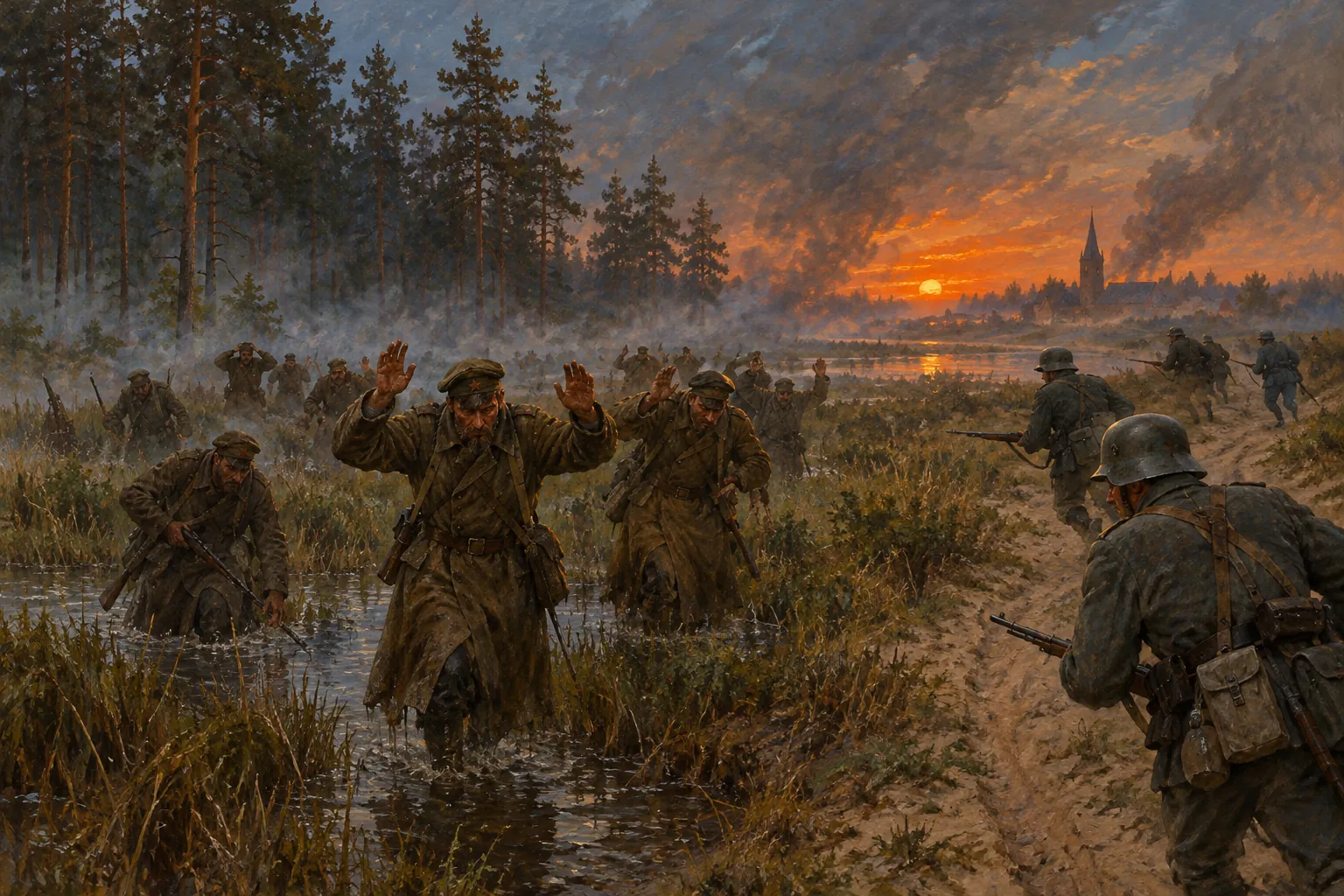
The Germans used the railways to move troops quickly, and they could read many Russian radio messages because they were sent without code. They saw that Rennenkampf was slow to help Samsonov. They left a thin screen against the First Army and wrapped around the Second Army from both sides. From 26 to 30 August, near Allenstein and Hohenstein, the Russian Second Army was surrounded in forests and marshes. About 92,000 Russian soldiers were taken prisoner, and tens of thousands more were killed or wounded. Samsonov shot himself. German losses were far smaller.
Hindenburg named the battle Tannenberg after a village close by, where the Teutonic Knights had been defeated by Polish and Lithuanian forces in 1410. A victory in the same place, he suggested, balanced the old account. From 9 to 14 September, at the First Battle of the Masurian Lakes, the Germans drove the Russian First Army out of East Prussia too. Hindenburg and Ludendorff became national heroes, and their fame later helped them rise to run the German war effort. Tannenberg did not end the war in the east, but it saved East Prussia and badly hurt Russian confidence.
Austria-Hungary in Galicia
In the south, the story was worse for the Central Powers. Austria-Hungary was fighting Serbia and Russia at once, and its chief of staff, Franz Conrad von Hötzendorf, launched attacks into Russian Poland. Russian armies counterattacked in the Battle of Galicia in August and September 1914. The Austro-Hungarian army lost huge numbers of trained officers and men, and gave up Lemberg (today Lviv) in early September.
The fortress of Przemyśl was cut off by Russian forces and held out through the winter. It surrendered on 22 March 1915, with a garrison of well over 100,000 men. Fighting in the Carpathian Mountains in winter caused more deaths from cold and illness than from bullets. From this point on, Germany had to keep helping its weaker ally.
1915: Gorlice-Tarnów and the Great Retreat
In 1915 the Germans decided to knock Russia back. In May, German and Austro-Hungarian troops attacked at Gorlice and Tarnów in Galicia, after a short but very heavy artillery bombardment. The Russian lines broke, and Russian guns had few shells to answer with. The Russians fell back in what is called the Great Retreat. They lost Galicia, then Poland (Warsaw fell on 5 August 1915), and parts of Lithuania and Courland. As they went, they burned crops and pushed many civilians east, causing a refugee crisis.
In September 1915 Tsar Nicholas II took personal command of the army. This tied the Tsar himself to every later defeat, and left the government in Petrograd in weaker hands. The Russian army survived, because the Germans could not trap it as they had at Tannenberg, but it was exhausted.
1916: the Brusilov Offensive
The next big move came from Russia. In June 1916 General Aleksei Brusilov attacked Austro-Hungarian lines in the south-west. Instead of massing everything at one place, he attacked at several points along a wide front, so the defenders could not tell where to send help. The Austro-Hungarian army suffered very heavy losses, and Russia took ground in Galicia and Bukovina.
The effects reached far beyond the east. Germany had to move divisions from the Western Front, which eased the pressure at Verdun, and Austria-Hungary pulled troops away from its fight against Italy. Romania then joined the Entente in August 1916, hoping to win land, but German, Austro-Hungarian and Bulgarian forces overran it, and Bucharest fell in December. The Brusilov Offensive weakened Austria-Hungary for good, yet Russia also lost enormous numbers of men, and the offensive faded by autumn. For the wider picture of that year, see Key Battles of WWI: Marne, Verdun, Somme, Gallipoli.
1917–1918: revolution and Brest-Litovsk
By 1917 Russia faced food shortages, rising prices and huge casualties. In March 1917 (February by the old Russian calendar), strikes and mutinies in Petrograd forced Nicholas II to abdicate. The Provisional Government chose to stay in the war, and in the summer it launched another offensive. It failed, and discipline in the army collapsed. In November 1917 the Bolsheviks under Lenin took power, promising peace.
An armistice was signed in December 1917, and peace talks began at Brest-Litovsk. When the Russian side refused the German terms, Germany resumed its advance in February 1918 and moved forward with almost no resistance. The Treaty of Brest-Litovsk was signed on 3 March 1918. Russia gave up Poland and the Baltic region, and accepted German influence in Ukraine and other lands. Germany could now shift many divisions west for its 1918 offensives, although it still had to keep large forces in the east to control what it had taken.
The treaty did not last. After the Armistice of 11 November 1918, Germany had to give up what it had gained in the east.
Why it mattered
The Eastern Front helped destroy three empires. Russia collapsed into revolution and then civil war. Austria-Hungary, kept alive by German support, broke apart in 1918. Germany lost the war. New states, including Poland, Czechoslovakia and the Baltic countries, appeared on the map. Many of the later borders and conflicts in Central and Eastern Europe have roots in these years. It also showed what total war could do to a society, even without the trenches of the west.
What exams ask
- Schlieffen Plan: expect a question on why Germany left few troops in the east and why Russia's quick mobilisation mattered.
- Tannenberg (26–30 August 1914): know Hindenburg and Ludendorff, the encirclement of Samsonov's Second Army, and the German use of railways and intercepted radio messages.
- Contrast with the west: mobile warfare in the east against trench stalemate in the west, and the reasons (space, fewer men per mile).
- Russia's exit: link military defeat, shortages and the 1917 revolutions, then the terms of Brest-Litovsk.
- AP-style significance: the war on two fronts strained Germany, and the collapse of Russia changed the war's last year.
Read next
- The Western Front: the trench war that the Eastern Front is often compared with.
- Key Battles of WWI: Marne, Verdun, Somme, Gallipoli: the big battles in the west and beyond that shaped 1916.
- What Is Militarism? How It Led to WWI: how mobilisation plans like Russia's and Germany's pushed Europe into war.
- World War I (1914–1918): Causes, Course and Consequences: the full overview of the war.