In five minutes
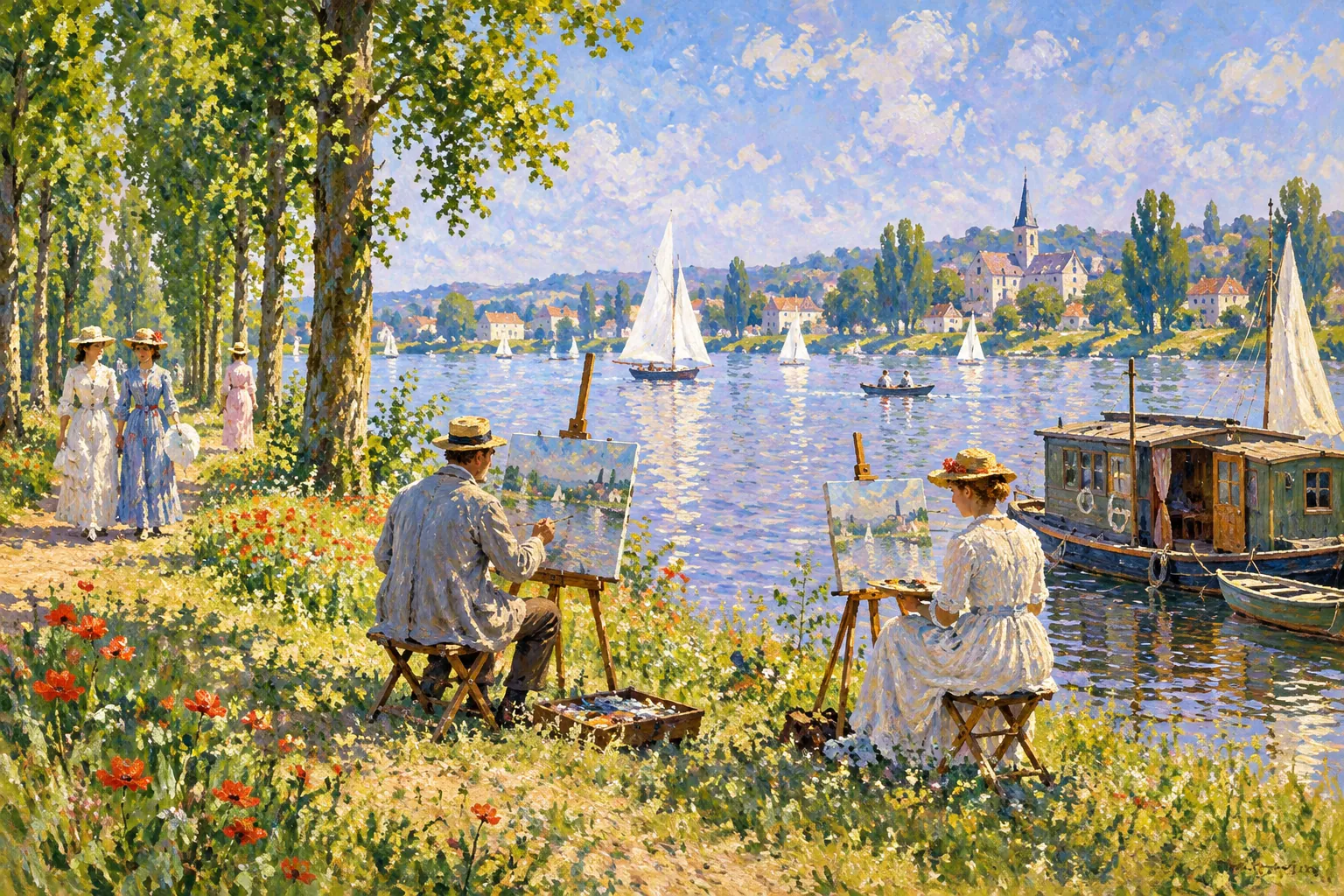
Impressionism was a French art movement that took shape in Paris in the 1860s and 1870s. Its painters tried to catch a moment: sunlight on water, a crowd at a dance, a station full of steam. They used quick, visible brushstrokes and bright colour, and they often painted outdoors. The best-known Impressionist painters are Claude Monet, Pierre-Auguste Renoir, Edgar Degas, Camille Pissarro, Alfred Sisley, Berthe Morisot, Mary Cassatt and Gustave Caillebotte.
The name comes from Monet's Impression, Sunrise, shown in April 1874 at the group's first independent exhibition. A critic used the word as a joke, and the painters kept it. This page is part of 19th-Century Art and Culture. For the ideas behind the style, see What Is Impressionism?
Why Impressionism began
In mid-19th-century France, a painter's career ran through the official Salon, a large yearly exhibition run by the art establishment. Its jury liked polished surfaces and subjects from history, myth and the Bible. Landscapes and everyday scenes ranked lower.
Younger painters wanted something else. Paint sold in metal tubes made it easy to carry colours outdoors. Railways took city artists to the Seine valley and the coast. Paris itself was being rebuilt with wide boulevards, cafés and parks, which gave them new subjects. Édouard Manet's Luncheon on the Grass was shown at the Salon des Refusés in 1863, an exhibition of works the Salon jury had rejected, and it showed that modern subjects could shock and attract crowds at once.
After repeated rejections, Monet, Renoir, Pissarro, Sisley, Degas, Morisot and others organised their own show in 1874, in a former photographer's studio at 35 boulevard des Capucines. About 30 artists took part. They went on to hold eight group exhibitions, the last in 1886.
Famous Impressionist paintings and the painters behind them
Claude Monet: Impression, Sunrise and Water Lilies
Monet is the painter most people mean by "Impressionist". Impression, Sunrise (1872) shows the harbour of Le Havre in orange morning mist, with a few quick strokes for the boats and the sun. It gave the movement its name. Later he painted the same subject again and again under different light: the Haystacks (1890–91), the Rouen Cathedral series (1892–94) and, from the 1890s until his death in 1926, around 250 canvases of the water-lily pond in his garden at Giverny. See Monet and Impression, Sunrise for the full story of that first picture.
Pierre-Auguste Renoir: Bal du moulin de la Galette
Renoir painted people enjoying themselves. Bal du moulin de la Galette (1876) shows a Sunday dance in Montmartre, with sunlight falling through the trees in blue-and-yellow flecks across dancers' clothes. Luncheon of the Boating Party (1880–81) shows friends at a restaurant on the Seine at Chatou. His warm, soft figures made him one of the most popular painters of the group.
Edgar Degas: dancers and city life
Degas disliked painting outdoors and did not like the label "Impressionist", yet he exhibited with the group. He is known for ballet dancers, such as The Star (c. 1876–77), and for cafés and laundresses. His pictures often look like snapshots: figures are cropped at the edge, and the viewpoint is unusual. He worked in oil, pastel and sculpture.
Camille Pissarro: the elder of the group
Pissarro was the oldest of the main group and took part in all eight exhibitions, which no one else did. He painted villages, fields and, late in life, busy Paris streets seen from hotel windows, such as the Boulevard Montmartre pictures of the 1890s. Younger painters, including Cézanne, learned from him.
Alfred Sisley: quiet river landscapes
Sisley, born in Paris to British parents, painted the Seine valley almost all his life. The Flood at Port-Marly (1876) shows a village street under water, with the sky reflected in the flood. His calm skies and water were rarely appreciated in his lifetime; he died in 1899.
Berthe Morisot: modern life at home
Morisot showed at seven of the eight exhibitions, beginning with the first. She painted family life, gardens and women in private rooms. The Cradle (1872) shows her sister Edma watching her sleeping baby through a veil of fine fabric. Her fast, light brushwork is among the freest of the group.
Mary Cassatt: mothers and children
Cassatt, an American from Pennsylvania who lived in Paris, joined the group at Degas's invitation and exhibited with it in 1879. Her best-known subjects are mothers and children, as in The Child's Bath (1893), a picture with flat patterns and a high viewpoint influenced by Japanese woodblock prints.
Gustave Caillebotte: Paris in the rain
Caillebotte painted the new Paris with a sharper, more realistic eye. Paris Street; Rainy Day (1877) shows pedestrians with umbrellas on wet cobblestones in a crossing of wide avenues. He was also a wealthy collector who bought his friends' paintings, and his bequest brought many into French state collections.
Édouard Manet: the painter they looked up to
Manet was a few years older than most of the group and is often linked to them, but he never took part in their exhibitions. Olympia (painted 1863, shown at the Salon in 1865) and Luncheon on the Grass broke the rules of academic painting. In the 1870s he turned to lighter colour and outdoor scenes, and his last great picture was A Bar at the Folies-Bergère (1882).
How these paintings changed art
Impressionist paintings did not try to tell a story or teach a moral. They recorded how a scene looks at one moment, and they left the brushwork visible. That was a break with the smooth finish expected by the Salon.
At first, critics and many visitors mocked the shows. Over the 1880s the mood changed, and dealers such as Paul Durand-Ruel helped sell the work abroad, especially in the United States. By the end of the century the group's pictures were widely admired.
The next generation took the freedom further. Paul Cézanne, Vincent van Gogh, Georges Seurat and Paul Gauguin, grouped as Post-Impressionists, used colour and form to express structure or feeling, not just a passing look. Impressionism opened the door to modern art.
What exams ask
- Name the group's first exhibition and its year: 1874, in Paris, organised by artists independent of the Salon.
- Explain where the name came from: Monet's Impression, Sunrise and a mocking review by the critic Louis Leroy.
- Match painters and works: Monet with Water Lilies, Renoir with Bal du moulin de la Galette, Degas with ballet dancers.
- Describe the techniques: loose brushwork, pure bright colours, outdoor painting and everyday modern subjects.
- Give the significance: Impressionism challenged the academic system and prepared the way for Post-Impressionism and 20th-century modern art.
Read next
- What Is Impressionism? explains the style, its techniques and its main ideas.
- Monet and Impression, Sunrise tells the story of the painting that gave the movement its name.
- What Is Romanticism? shows the earlier 19th-century movement that Impressionism broke away from.