In five minutes
The British Empire flag most people have in mind is the Union Flag, also called the Union Jack: the red, white and blue design that joins the crosses of England, Scotland and Ireland. The empire never had one single official flag, though. Warships, merchant ships, governors, colonies and self-governing dominions each flew their own version, and nearly all of them carried the Union Flag somewhere in the design. This page belongs to our guide to The Victorian Era (1837–1901), the period when the empire reached its widest spread. It explains how the flag was assembled, what the different imperial flags meant and which of them survive today.
The British Empire flag: how the Union Flag was built
The flag grew in three steps, and each step marked a political union.
- 1606: James VI of Scotland had also become James I of England in 1603. A royal proclamation told ships of both kingdoms to fly a flag that joined the red cross of St George, for England, with the white diagonal cross of St Andrew, for Scotland. The two kingdoms were still separate states, and some Scottish sailors disliked the design.
- 1707: The Acts of Union merged England and Scotland into the Kingdom of Great Britain, and the joined flag became the flag of the new state.
- 1801: Ireland joined the United Kingdom on 1 January, and a thin red diagonal cross, linked with St Patrick, was added. This is the flag we know today.
Wales has no separate part in the design. It had been joined to the Kingdom of England by law in the sixteenth century, so it was counted under the cross of St George. The red Welsh dragon never appeared on the Union Flag.
Look closely and you will see that the red diagonal stripes are not centred. They are shifted so that the white stripe of St Andrew is wider on the upper side next to the pole. That is why the flag has a right way up, and why flying it upside down can be read as a signal of distress.
Why is it called the Union Jack?
A jack is a small flag flown from a pole at the front of a ship. Warships flew the Union Flag in that position, and sailors began to call it the Union Jack. For a time some people argued that the name was correct only at sea. In 1908 the government told Parliament that the Union Jack could be flown on land or at sea, and the argument faded. Today both names are in ordinary use, and this page treats them as two names for the same flag.
Before the colonies: the East India Company flag
Not every flag of the empire belonged to the state. The East India Company, a trading firm that came to rule large parts of India, flew its own flag: red and white horizontal stripes with the English cross, and later the Union Flag, in the upper corner. It shows an early habit of the empire, which was to add a recognisable piece of the national flag to the symbols of a separate organisation.
Ensigns: one flag family for ships
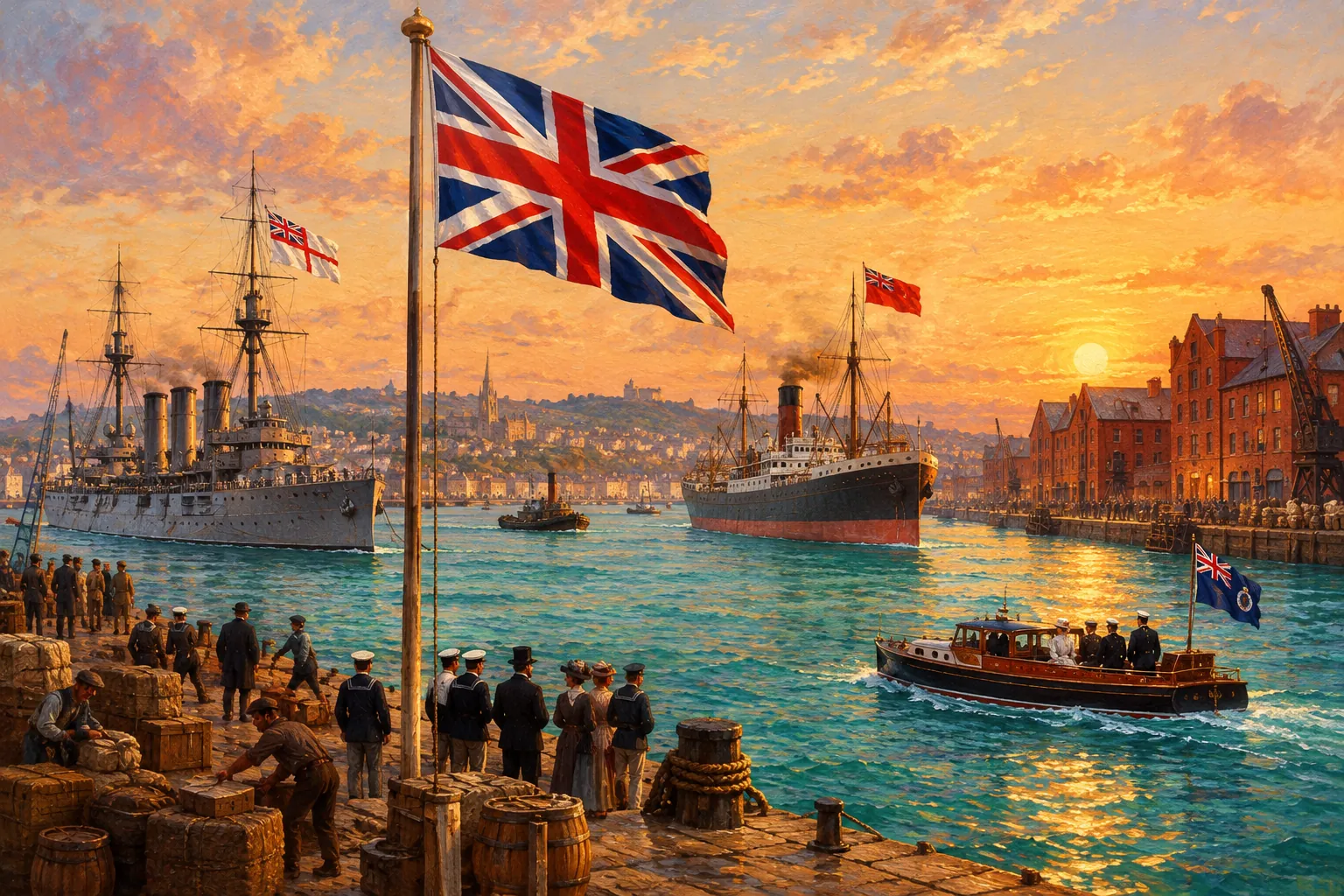
An ensign is the flag a ship flies at the stern to show who it belongs to. The Union Flag sits in the upper corner next to the pole, and the colour of the field behind it tells you the ship's role.
- White Ensign: the Royal Navy. In 1864 the Navy dropped its old system of red, white and blue squadron flags and made white its own.
- Red Ensign: merchant ships. The Merchant Shipping Act of 1894 made it the proper flag for British-registered merchant vessels.
- Blue Ensign: government vessels and some naval reserve ships. It also became the base for colonial flags.
In a crowded port, a quick glance at the stern told you whether a ship was a warship, a trader or a government vessel. The empire was joined together by sea routes, so its flags developed first on ships.
Colonial flags: a badge for each territory
The Colonial Naval Defence Act of 1865 told colonial government vessels to fly the Blue Ensign with the colony's badge in the fly, which is the half away from the pole. The badge was drawn inside a disc and used a local scene or symbol. Hong Kong's badge, for example, showed a view of its harbour.
Governors had a different flag. From 1869 a governor used the Union Flag with the colony's badge in the centre, ringed by a laurel wreath. The Union Flag in the middle showed that the governor represented the Crown. In India the badge was the Star of India.
The system was practical: one shared piece, the Union Flag, plus a small local mark, could turn dozens of very different territories into one visible family. It also shows who held the power. The main design stayed British, and the local identity sat inside a small circle.
Dominion flags: stars, shields and leaves
When settler colonies won self-government and became dominions, they began choosing their own flags. Most started from a British ensign and added local symbols.
- Australia: a Blue Ensign with the Southern Cross and the large Commonwealth Star, chosen in a public competition in 1901 and approved by the king in 1902.
- New Zealand: a Blue Ensign with four red stars of the Southern Cross, adopted in 1902.
- Canada: the Canadian Red Ensign, with a shield of arms, was used for decades. It was replaced by the Maple Leaf flag on 15 February 1965.
- South Africa: a flag of orange, white and blue stripes adopted in 1928, with a small Union Flag and the flags of the old Orange Free State and Transvaal in the centre. It was used until 1994.
These flags show both ties and independence. The Union Flag stayed in the corner, but the Southern Cross or a shield of arms told people that this was a distinct country.
The flags after the empire
As the empire ended, countries made different choices. India adopted its own tricolour when it became independent in 1947. Canada dropped the Red Ensign in 1965 and South Africa changed its flag in 1994. Australia, New Zealand, Fiji and Tuvalu still keep the Union Flag in the corner of their national flags, and the question of whether to change that comes up in some of them from time to time.
The British Overseas Territories mostly fly ensigns with badges, and mostly Blue Ensigns. In Hong Kong, the British colonial flag came down at the handover on 1 July 1997.
What exams ask
- The three crosses: the red cross of St George (England), the white diagonal cross of St Andrew on blue (Scotland) and the red diagonal cross of St Patrick (Ireland).
- The dates: 1606 (flag joined for ships), 1707 (Acts of Union) and 1801 (Ireland added). Be ready to say which union added which part.
- Wales: why it has no part of its own in the design.
- Jack versus ensign: a jack flies at the bow, an ensign at the stern.
- Significance: colonial flags were a British ensign plus a local badge, while dominion flags added local stars or arms. Both show how the empire managed its unity and its differences.
Read next
- British Empire Colonies List: see which territories flew these flags and when they joined.
- Why Did the British Empire Fall?: the story behind the flags that were lowered after 1945.
- Who Was Queen Victoria?: the monarch whose reign saw the empire's flags spread across the world.