In five minutes
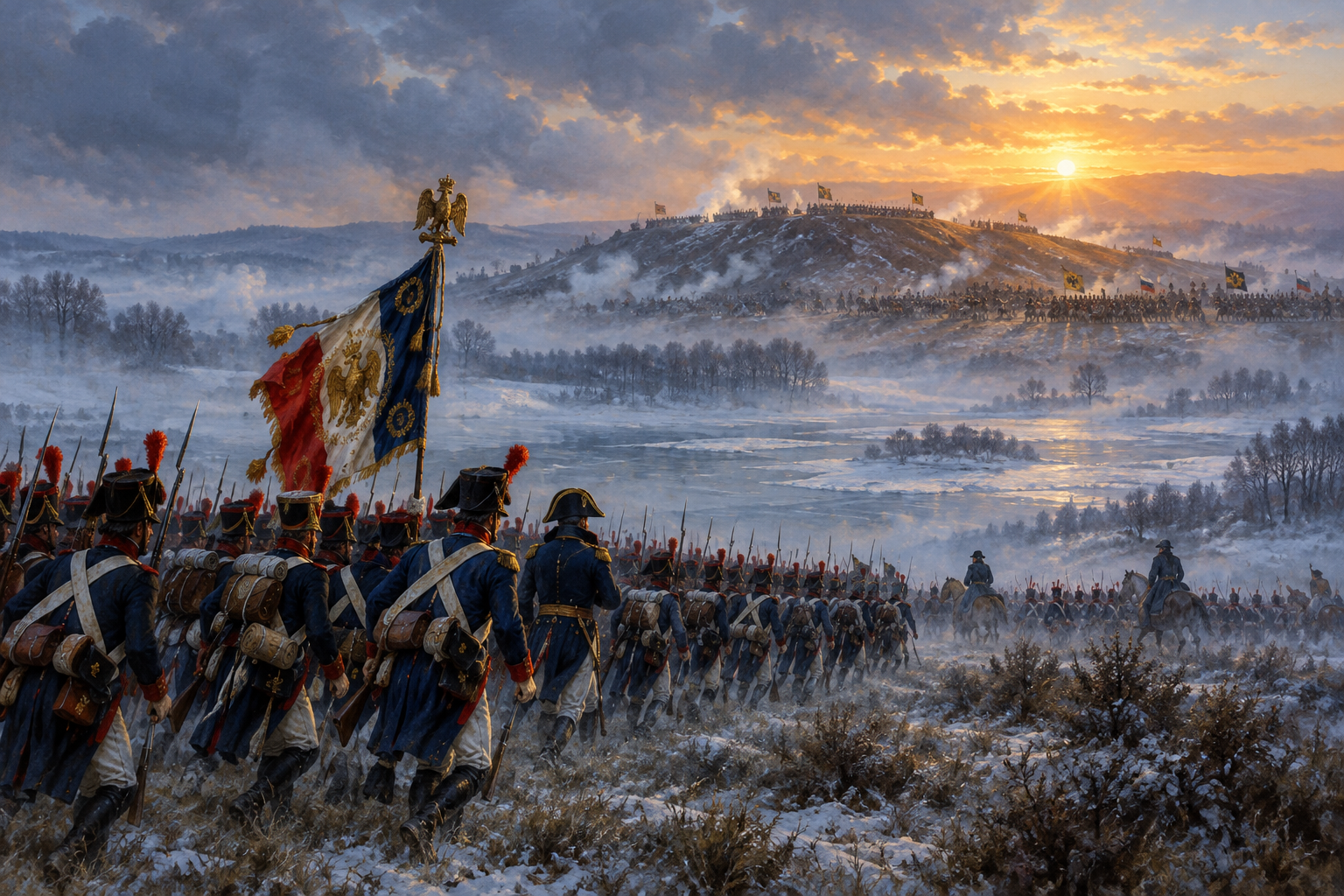
Napoleon's invasion of Russia was the 1812 campaign in which the French emperor marched the largest army Europe had yet seen across the Niemen River, on 24 June 1812, and lost most of it before the year was over. His aim was simple: make Tsar Alexander I obey the economic blockade against Britain. Instead the Russians kept retreating, burned or emptied the land behind them and refused to negotiate. Napoleon took Moscow in September, found it abandoned and burning, and waited about five weeks for a peace offer that never came. The retreat in October and November, through hunger, disease and early frost, destroyed his army. Only a small fraction of the men who had crossed the river came back across it. This page is part of our guide to The Napoleonic Era (1799–1815).
Why did Napoleon attack Russia?
The short answer is the blockade. In 1806 Napoleon issued the decrees that created the Continental System, which tried to starve Britain by closing European ports to British goods. After defeating Russia at Friedland in 1807, he made peace with Alexander I at Tilsit, and Russia joined the system.
It did not work well for Russia. Its nobles earned their money by selling grain, timber and other raw goods, and much of that trade went to Britain. At the end of 1810 Alexander opened Russian ports to neutral shipping and put heavy duties on some French luxury goods. For Napoleon this was open defiance.
Other quarrels piled up. France had annexed the Duchy of Oldenburg, whose duke was related to the tsar. Russia worried about the Duchy of Warsaw, the Polish state Napoleon had created on its border, and feared it would grow into a threat. Napoleon, for his part, believed that another quick, decisive campaign would settle the matter, as it had against Austria and Prussia. He also knew that he could not afford to let one ally break the system and expect the others to stay loyal.
The invasion begins (June–August 1812)
The Grande Armée was enormous. About 450,000 men crossed the Niemen in the first weeks, and more than 600,000 served in the campaign as reinforcements arrived. Fewer than half were French. The rest came from Poland, the German states, Italy, Switzerland and other lands tied to Napoleon, and Austria and Prussia sent smaller contingents under pressure.
The Russian armies in the west were much smaller, roughly 200,000 men, and split between Barclay de Tolly and Bagration. Napoleon wanted one big battle near the border. Russia refused to give him one. The army fell back, the two Russian armies joined at Smolensk, and the countryside emptied ahead of the French. Heat, dust, bad water and broken supply lines hit the French hard. Horses died in large numbers, and sickness and desertion thinned the columns long before the first great battle.
At Smolensk, on 16–18 August, the French stormed the city, but the Russians slipped away again. Napoleon pressed on towards Moscow, because he judged that the Russians could not give up the old capital without a fight.
Borodino and the fall of Moscow (September 1812)
Public anger at the retreat led Alexander to name Mikhail Kutuzov commander in chief in August. Kutuzov chose to fight at Borodino, about 120 km west of Moscow, on 7 September 1812. It was the bloodiest single day of the Napoleonic Wars: the two sides lost about 70,000 men together, with estimates for each army differing between sources. The Russians held their ground for hours and then withdrew in order. Napoleon kept the field but did not destroy the Russian army, which was what he needed.
The French entered Moscow on 14 September. The city was largely empty, its governor had removed most of the people and supplies, and fires broke out almost at once. They burned for several days and destroyed a large part of the city. Historians still argue about who started them, but the effect was clear: the French had no winter quarters worth the name.
Napoleon waited, writing to Alexander and hoping for terms. The tsar did not answer. Meanwhile Kutuzov rested and reinforced his army to the south, and the French foragers were harassed by Cossacks and peasants.
The retreat (October–December 1812)
Napoleon left Moscow on 19 October. He tried to march south by a new route, but after a hard fight at Maloyaroslavets on 24 October he turned back to the road he had come by, which the army had already stripped bare. That decision doomed many men.
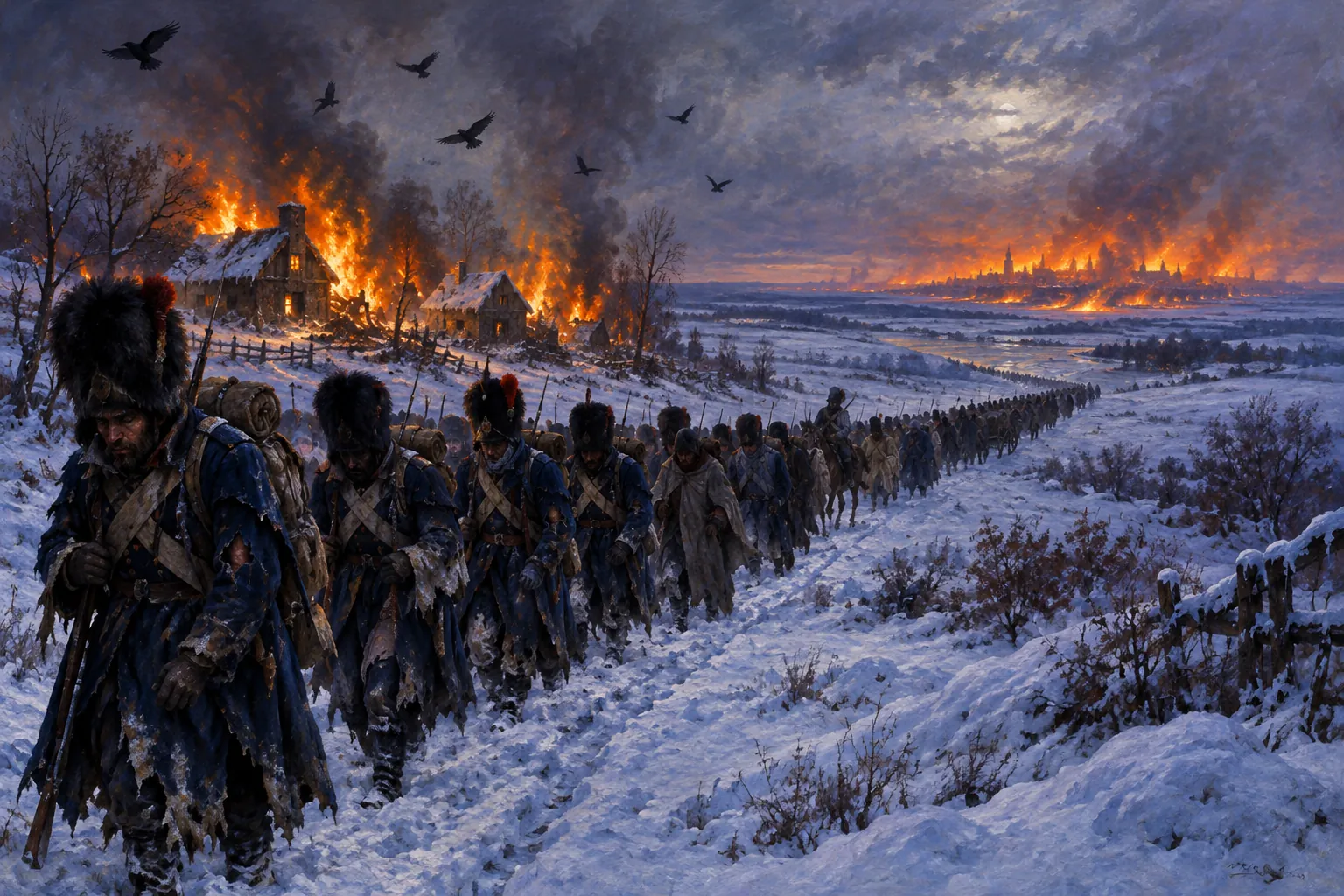
Cold came in early November. Soldiers froze at night, horses went down, guns and wagons were abandoned, and stragglers were picked off by Cossacks. Discipline broke down in many units. Russian armies pressed from the sides, and at Krasnoi in mid-November the French lost heavily again.
The worst crisis came at the Berezina River, where Napoleon's engineers built bridges under fire between 26 and 29 November. Part of the army escaped, but thousands of stragglers and camp followers were left behind when the bridges were destroyed. On 5 December Napoleon left the army at Smorgon and rushed back to Paris, arriving on 18 December to rebuild his forces. The last survivors recrossed the Niemen in mid-December. Estimates of the dead, prisoners and deserters run to several hundred thousand, and only a small part of the army returned as organised units.
What changed afterwards
The campaign ended Napoleon's reputation for invincibility. He lost most of his experienced soldiers and, just as important, most of his cavalry horses, and these were hard to replace. In December 1812 the Prussian general Yorck signed the Convention of Tauroggen with the Russians, and Prussia soon changed sides. Russia, Prussia and later Austria and others formed the Sixth Coalition.
Napoleon rebuilt an army in 1813 and won some battles, but he lost the great Battle of Leipzig (16–19 October 1813), known as the Battle of the Nations. In April 1814 he abdicated and was sent to Elba; his return in 1815 is told in Elba and the Hundred Days. In Russia, the war became the Patriotic War of 1812, a founding memory for the nation and the setting for Tolstoy's novel War and Peace. To understand the man behind the campaign, start with Who Was Napoleon Bonaparte?
What exams ask
- Cause: Russia's withdrawal from the Continental System (1810) and Napoleon's wish to enforce it. Be ready to link it to the 1806 decrees and the Treaty of Tilsit (1807).
- Strategy: Russia's retreat, scorched earth and avoidance of a decisive battle. Weather alone did not defeat the army; supply, disease and distance had already done most of the damage before the deep cold.
- Key places and dates: Niemen (24 June), Smolensk (August), Borodino (7 September), Moscow (14 September), Berezina (late November).
- Significance: the loss of the Grande Armée made the Sixth Coalition and the defeat at Leipzig possible, leading to the abdication of 1814 and the Congress of Vienna.
Read next
- The Continental System (1806): the blockade policy that pushed Napoleon towards Russia.
- Elba and the Hundred Days: what happened after the empire collapsed in 1814.
- Who Was Napoleon Bonaparte?: his life from Corsica to St Helena.