In five minutes
Between about 1815 and 1914, European powers, the United States and Japan used several different tools to control other countries. There were four main ones. A colony was ruled directly by the imperial government. A protectorate kept a local ruler on the throne but handed foreign policy and key decisions to the protecting power. A sphere of influence was a region where one power claimed exclusive rights to trade, railways and investment. Economic imperialism controlled a country through loans, trade treaties and company concessions, with no formal rule at all.
These types overlap, and the same empire often used all four in different places. This page is part of our hub, Imperialism: What It Was, Why It Happened, What It Left Behind. For the question of why industrial states wanted overseas control in the first place, see How Industrialisation Led to Imperialism.
Why one empire used different tools
Direct rule was expensive. It needed soldiers, tax collectors, courts and officials. A government that only wanted open markets, or wanted to keep a rival out of a region, often found it cheaper to take less. The choice depended on three things: how strong the local state was, how much the imperial power wanted to spend, and how much its rivals would tolerate. A weak, fragmented society in tropical Africa could be taken as a colony. A large, old state such as China was harder to swallow whole, so several powers carved out zones inside it instead.
Colonies: direct control
A colony is a territory governed by an outside state, which appoints the governor, makes the laws and decides the economy. Historians usually separate two kinds. Settler colonies, such as Australia and French Algeria, received large numbers of migrants from the home country, and the Indigenous population was pushed aside. Exploitation colonies had few settlers; the aim was to extract goods and tax. The Congo Free State, recognised by the powers in 1885 and run as the personal possession of King Leopold II of Belgium, was the harshest example. Belgium took it over as a state colony in 1908 after international protest.
India shows how colonial rule could change form. The East India Company ruled large areas until the rebellion of 1857. In 1858 the British Crown took over directly, and the Company was abolished.
Not every colony was ruled the same way day to day. Under indirect rule, associated with Frederick Lugard in Northern Nigeria after 1900, the British governed through existing emirs and chiefs, who collected taxes and kept order under British supervision. Under direct rule, European officials did this themselves. Indirect rule was cheaper, but it still left real power with the colonial government.
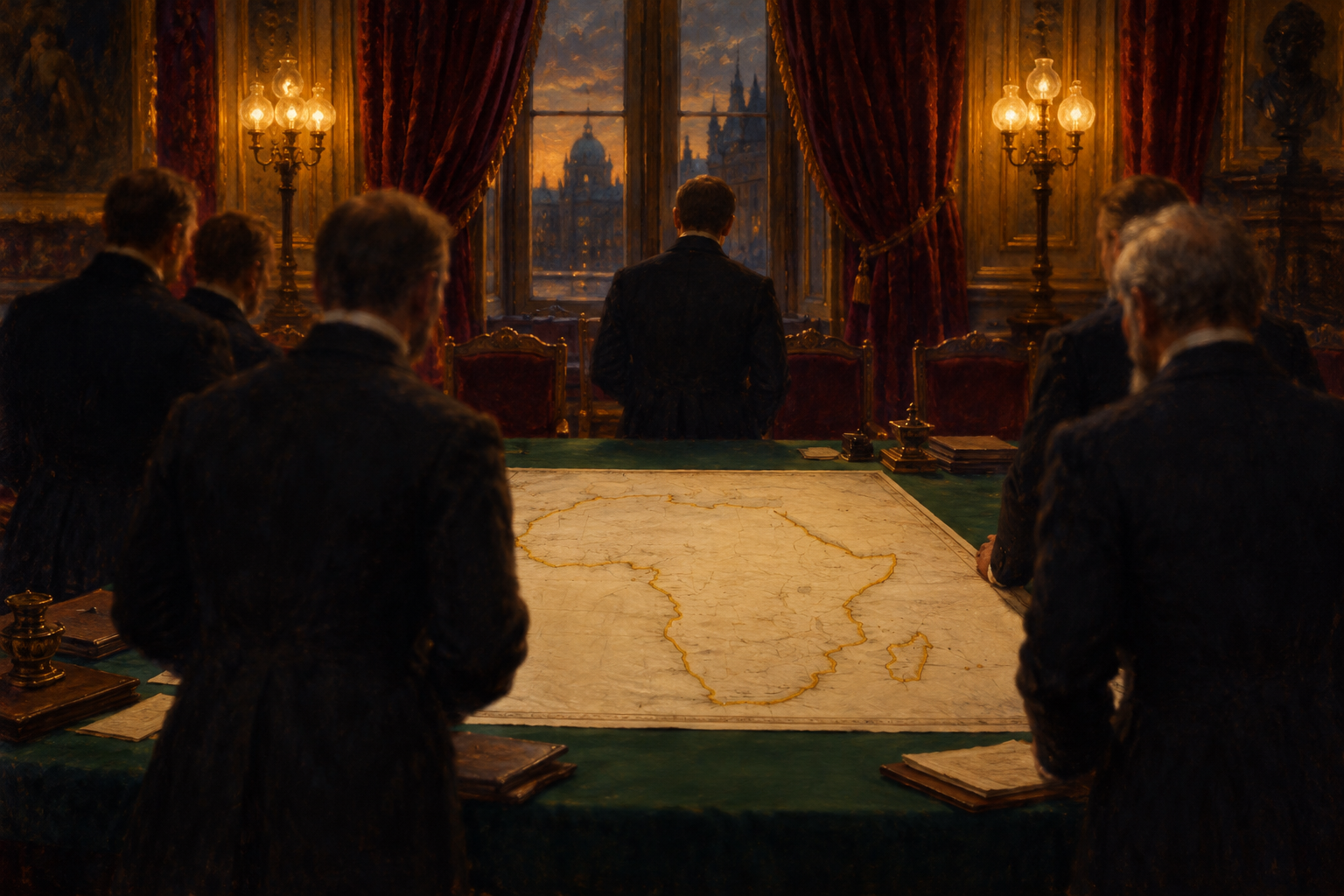
The Berlin Conference of 1884 to 1885 set rules for the scramble for Africa. It stressed 'effective occupation' of coasts, which pushed powers to put officials and troops on the ground. No African state took part in the decisions.
Protectorates: a ruler stays, power moves
A protectorate leaves the local ruler and government in place on paper, while a foreign power controls defence and foreign affairs and usually much more. It was often set up by treaty, signed under military pressure.
- Cambodia (1863): France made King Norodom accept a protectorate, later using it as a base for French Indochina.
- Tunisia (1881): the Treaty of Bardo, signed after French troops entered, let France run Tunisia's foreign affairs and finances while the Bey kept his title.
- Morocco (1912): the Treaty of Fez gave France a protectorate over most of the country, with a Spanish zone in the north.
- Egypt (1914): Britain had occupied Egypt in 1882 while keeping the Ottoman-linked khedive in place. At the start of the First World War, in December 1914, it declared a formal protectorate.
- Korea (1905): after the Russo-Japanese War, Japan forced the Korean government to accept control of its foreign relations, and a Japanese Resident-General was installed. Japan annexed Korea outright in 1910.
Powers liked protectorates for practical reasons. The local ruler's name gave legitimacy, fewer officials were needed, and rivals were less likely to object than to an annexation. Korea shows the other side: a protectorate could be a stepping stone to full colonial rule.
Spheres of influence and leased territories
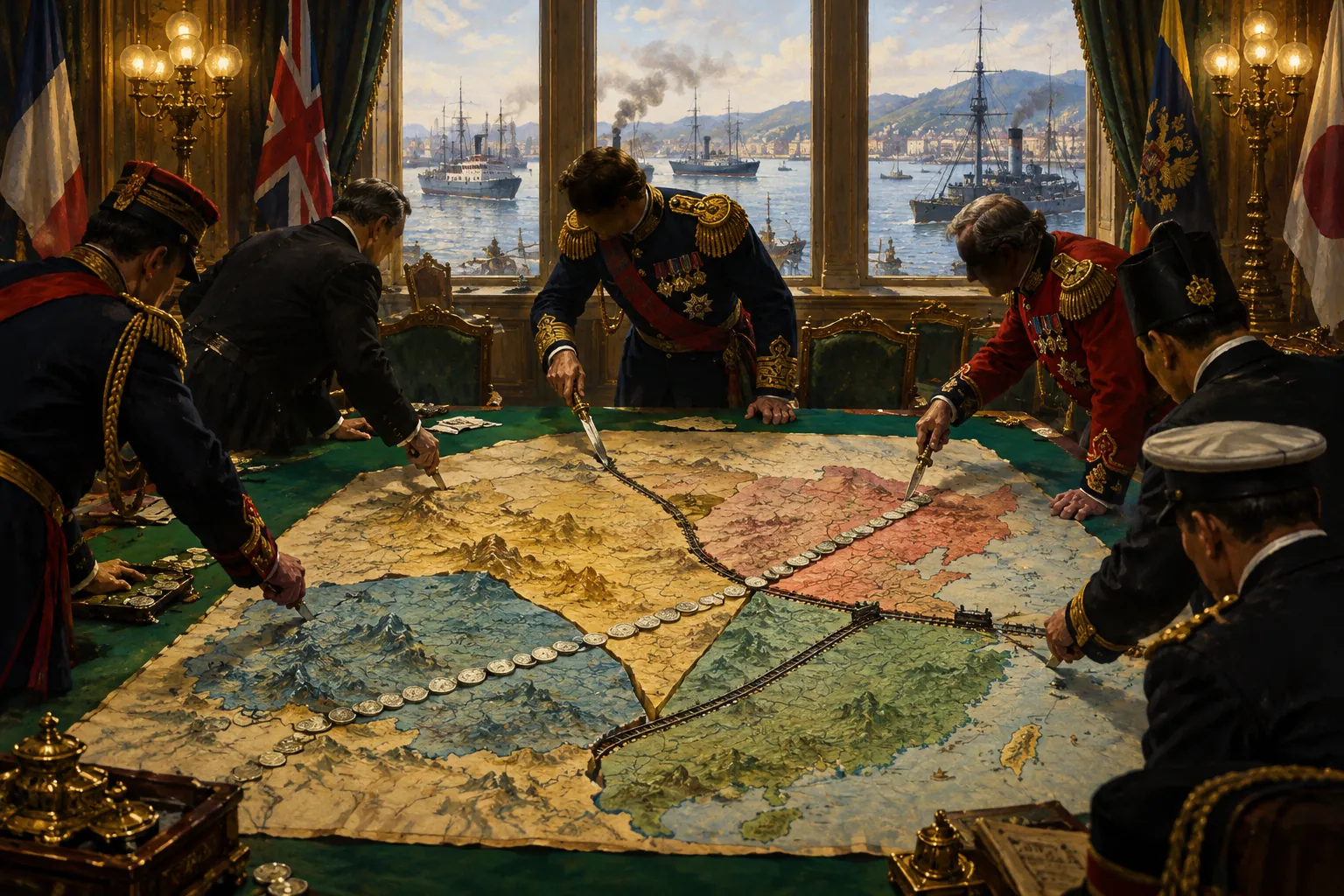
A sphere of influence is a region where one power claims special rights, usually agreed with other powers, but where the local state remains formally independent. The model case is China in the 1890s. After China lost the war with Japan in 1895, the powers competed for concessions. In 1898 Germany leased Kiaochow Bay in Shandong, Russia leased Port Arthur and the Liaodong peninsula, Britain leased Weihaiwei and extended Hong Kong by leasing the New Territories for 99 years, and France obtained a lease at Guangzhouwan in 1899. Each power also sought railway and mining rights in its zone. Britain focused on the Yangtze valley, and Japan on Fujian.
The United States, which had no zone, sent the Open Door notes in 1899. They asked the powers to keep trade in their zones open to all. This was not a rejection of imperialism; it was a way to share access to the Chinese market.
Another example is Persia. By the Anglo-Russian Convention of 31 August 1907, Britain and Russia divided the country into a Russian zone in the north, a British zone in the southeast and a neutral zone in between. Persia was not asked, and stayed formally independent.
Leases like Kiaochow sit between a sphere and a colony: the land stayed Chinese in law, but the lessee ran it as its own territory for decades.
Economic imperialism: control without a flag
The term economic imperialism describes control exercised through finance and trade rather than formal rule. Examples include:
- Unequal treaties. The Treaty of Nanjing (1842) after the First Opium War ceded Hong Kong, opened five ports and set low tariffs. Later treaties added extraterritoriality, meaning foreigners were tried under their own laws.
- Debt control. After Egypt's debts grew, Britain and France set up financial supervision in 1876. In 1881 the Ottoman Empire accepted an international Public Debt Administration that collected part of its revenue for European creditors.
- Concessions and investment. Foreign companies built railways, ports and mines under contracts that gave them land and special rights.
- Right to intervene. The Platt Amendment (1901) wrote into Cuba's constitution a US right to intervene and a naval base at Guantánamo.
In 1953 the historians John Gallagher and Ronald Robinson argued in 'The Imperialism of Free Trade' that Britain often preferred informal influence where it could get it and formal rule only where it had to. The idea is now called informal empire. The English economist J. A. Hobson (1902) and Lenin (1917) explained imperialism through capital export; read Lenin's Imperialism, the Highest Stage of Capitalism for that argument.
How to tell the types apart
- Who governs? The imperial state's officials: colony. A local ruler under foreign advice: protectorate. Local rulers with foreign privileges: sphere or economic control.
- Who signs foreign treaties? The imperial power: colony or protectorate. The local state, under pressure: sphere or economic control.
- What is the legal claim? Sovereignty: colony. Treaty rights: protectorate. Exclusive economic rights: sphere.
Be careful: in real cases the label changes over time. Egypt went from debt control to occupation to protectorate. Korea went from protectorate to colony.
What exams ask
In AP World History and similar courses, expect questions that ask you to compare two cases, such as French Tunisia and Dutch Java, or the Belgian Congo and British Northern Nigeria. Good answers name the type, give a date and name a mechanism (a treaty, a lease, a loan). Common mistakes are calling every European-influenced area a colony, and treating the Open Door policy as anti-imperial. Remember also that the legal form hides the experience on the ground: taxes, forced labour and land loss occurred under all types, though most severely under direct colonial rule. The long-term legacy of these arrangements, from borders to debt, is covered in the hub.
Read next
- Imperialism: What It Was, Why It Happened, What It Left Behind is the overview for this topic.
- How Industrialisation Led to Imperialism explains why factories created demand for raw materials and markets.
- Lenin's Imperialism, the Highest Stage of Capitalism shows the economic theory behind the idea of financial control.
- The Abolition of the Slave Trade and Slavery explains the shift from the slave trade to 'legitimate' commerce that preceded much of the African scramble.