In five minutes: WW1 aircraft
Aircraft changed World War I in four years. In 1914 they were slow, lightly built machines that flew out to look over the next hill. By 1918 there were fighters, bombers and low-flying ground-attack planes, and Britain had created the Royal Air Force, the first air force that was independent of both army and navy. The story moves in four steps: reconnaissance, artillery spotting, air-to-air combat and bombing. Each step forced the enemy to respond, and each response produced a better aircraft.
This page follows that cycle. For the wider war, see the hub article World War I (1914–1918): Causes, Course and Consequences.
Before the war: a new and fragile machine
The Wright brothers first flew in 1903, only eleven years before the war began. Armies were curious but cautious. Aircraft had small engines, carried one or two people and could stay up for a few hours at most. Many generals expected cavalry to remain the eyes of the army.
Even so, every great power had started a small flying service by 1914. Britain sent four squadrons of the Royal Flying Corps to France in August 1914. Germany, France and Russia each had at most a few hundred aircraft. Governments saw them as scouts, not weapons. Germany also had its huge rigid airships, the Zeppelins, built for long-range scouting and later used for bombing. Early pilots carried pistols or rifles, because nobody had planned a gun for the aeroplane.
The eyes of the army: reconnaissance and artillery spotting
The first real job was to see. In August and September 1914 pilots reported enemy columns that cavalry patrols had missed. During the Battle of the Marne in September 1914, Allied airmen reported that the German First Army was swinging southeast of Paris. That helped French and British commanders judge that a gap was opening between the German armies. Aerial reports were also used in the Battle of Tannenberg in East Prussia in August 1914.
When the Western Front settled into trenches, aerial photographs became more valuable than almost any other report. Cameras were fitted to aircraft, and the photographs were joined into maps of enemy trenches, gun positions and railways.
The other great task was artillery spotting. Gunners could not see their targets, so an observer in an aircraft sent corrections by wireless telegraph, signal lamp or dropped message: a little to the left, a little short. Accurate shelling depended on the plane overhead. That is why each side tried to drive away the other's observers, and why fighting in the air began.
Learning to fight in the air
At first, rival crews sometimes waved as they passed. Soon they were shooting at each other with rifles and pistols. On 5 October 1914 a French Voisin crew, pilot Joseph Frantz and mechanic Louis Quénault, shot down a German Aviatik with a machine gun. It is usually counted as the first aerial victory of the war.
The real problem was aiming forward, because the propeller was in the way. In spring 1915 the French pilot Roland Garros fitted steel deflector plates to his propeller so that bullets hitting the blades would bounce off. He shot down several German aircraft before he was forced down and captured on 18 April 1915. The Dutch designer Anthony Fokker, working for Germany, then developed a synchronisation gear that let a machine gun fire between the turning blades.
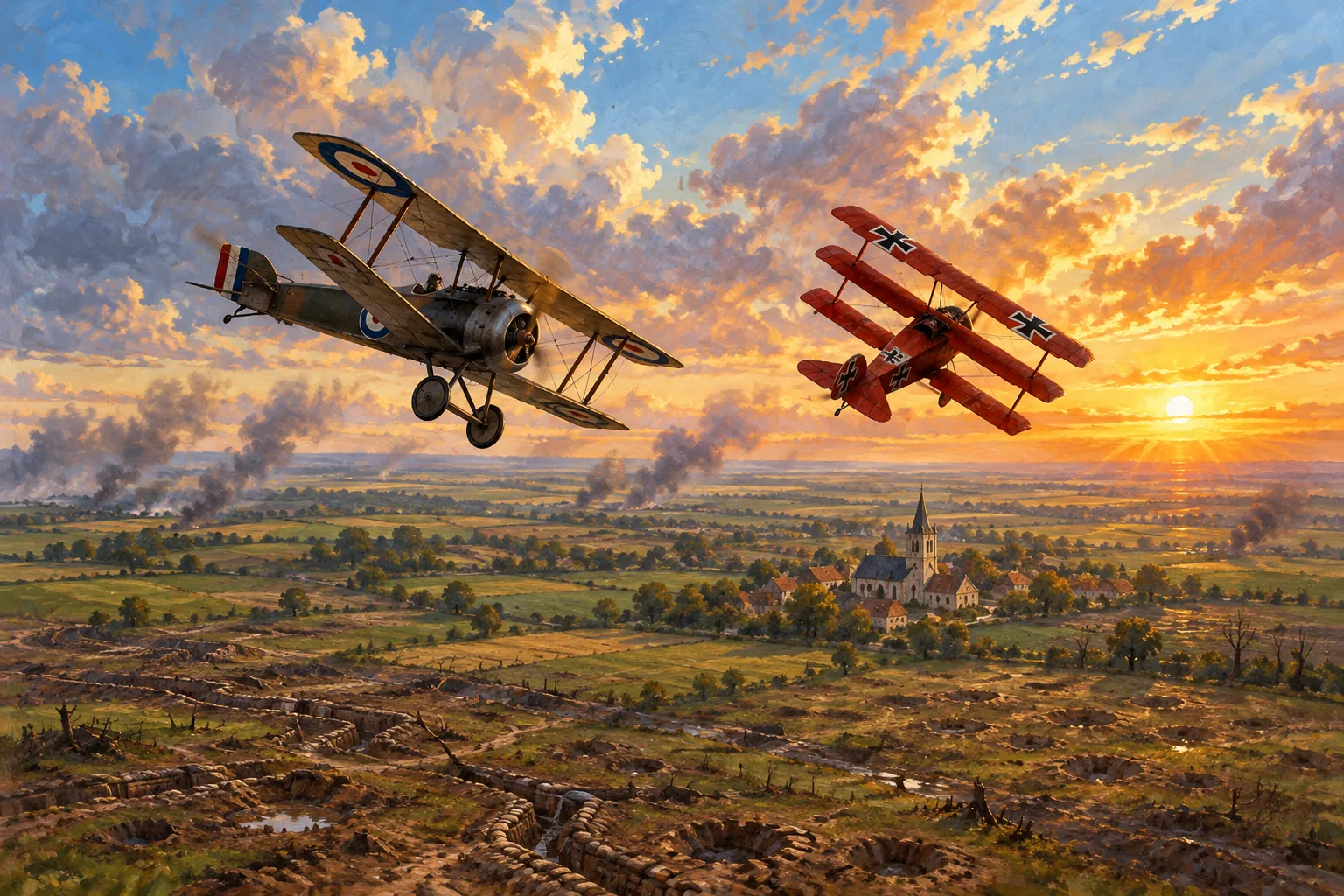
Aircraft fitted with it, the Fokker Eindecker, gave German pilots such as Max Immelmann and Oswald Boelcke an advantage from late 1915 into 1916. The Allies called the period the "Fokker Scourge". They answered with new fighters such as the French Nieuport 11 and the British DH.2, and over the Somme in the summer of 1916 they won back control of the air.
From 1916 Germany organised special fighter units, the Jagdstaffeln, or hunting squadrons. In June 1917 several of them were grouped into Jagdgeschwader 1 under Manfred von Richthofen, nicknamed the "Flying Circus" for its brightly painted aircraft. Richthofen was credited with 80 victories and was killed on 21 April 1918. By convention a pilot with five victories was an "ace". Among the best-known were René Fonck of France, credited with 75, and Billy Bishop of Canada, credited with 72. Newspapers loved the aces because trench warfare offered few individual heroes.
Bombers, Zeppelins and the first air raids on cities
Bombing began with small bombs and shells dropped by hand. Then specialised aircraft arrived. German Zeppelins raided Britain from January 1915, hitting coastal towns first and London from the end of May 1915. They were hard to destroy until special incendiary ammunition was available. On the night of 2–3 September 1916 Lieutenant William Leefe Robinson shot down the airship SL 11 north of London, and the crowds who watched it burn saw that the airships could be beaten.
Germany then turned to twin-engined Gotha bombers. Their daylight raid on London on 13 June 1917 killed about 160 people, including children in a school. Britain built up guns, searchlights, fighter patrols and warning systems. The raids shocked the public and helped persuade the government to merge the army's and navy's air services. The Royal Air Force was created on 1 April 1918. In June 1918 it set up the Independent Force, which attacked German industry with Handley Page bombers.
The damage was small compared with the bombing of World War II. But the idea that war could reach people's homes, far from any front line, began here.
Factories, the sea and the last year
Air power rested on factories. All sides together built roughly 180,000 to 200,000 aircraft during the war, and engines, fuel and trained pilots became strategic resources. Losses were heavy. In "Bloody April" 1917, during the Battle of Arras, the Royal Flying Corps lost well over 200 aircraft against better German Albatros fighters. Many new pilots reached the front with very little training. Parachutes were issued to German airmen only in 1918 and were not generally issued to British ones.
By 1918 excellent fighters filled the sky, among them the Sopwith Camel, the SE5a, the SPAD XIII and the Fokker D.VII. Aircraft also helped the infantry: they machine-gunned trenches, dropped bombs and flew low "contact patrols" to find out where the front line really was. At Cambrai in November 1917 aircraft worked alongside tanks and infantry.
There were new steps at sea too. On 19 July 1918 Sopwith Camels flown from the British carrier HMS Furious bombed Zeppelin sheds at Tondern, which is generally described as the first air strike launched from a carrier. Japan also took part. During the siege of Tsingtao in autumn 1914, Japanese forces used aircraft, including seaplanes carried by the ship Wakamiya, for reconnaissance and bombing.
What the air war left behind
Aircraft did not win the war alone, and the trench stalemate was not broken from the sky. But the air war taught lessons that every army and navy took away: control of the air protects your own guns and blinds the enemy's, civilians can be targets, and an air force needs its own organisation, training and industry. Those lessons shaped the 1920s and 1930s and led straight to the airpower of the next war.
What exams ask
In AP-style questions, aircraft appear among the new technologies that made the conflict a total war, alongside machine guns, poison gas, tanks and submarines. A good answer separates the stages and gives one example for each:
- Early role: reconnaissance and artillery spotting, for example at the Marne.
- Air combat: Garros's deflector plates and Fokker's synchronisation gear.
- Strategic bombing: Zeppelin and Gotha raids, which blurred the line between front and home front.
- Organisation: the Royal Air Force on 1 April 1918, the first independent air force.
A common mistake is to say that aircraft broke the stalemate on their own. Historians stress that they helped other weapons and tactics work better, rather than deciding the outcome alone.
Read next
- Tanks in World War I: the other new machine of 1916–1918, and how it worked with aircraft at Cambrai.
- Machine Guns and New Weapons of WWI: the weapon that Garros and Fokker had to fit onto an aircraft.
- What Is Militarism? How It Led to WWI: why the great powers had armies and fleets ready to put new technology to use.