In five minutes
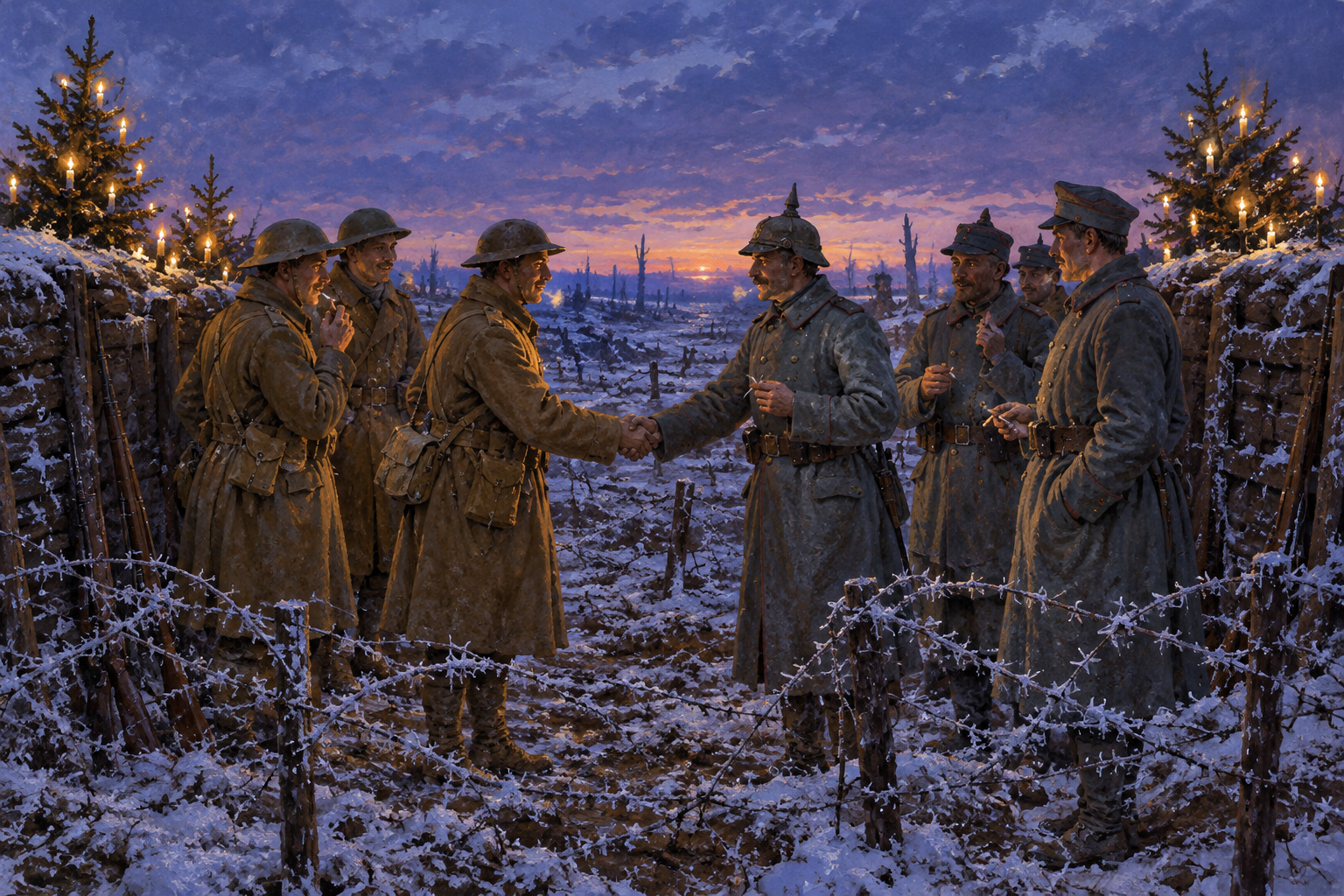
Trench warfare is the way soldiers fought on the Western Front in World War I: from deep ditches in the ground, facing an enemy in ditches of his own, with a strip of wasteland called no man's land in between. It began in the autumn of 1914, when the war of movement that the great powers had planned for ran into modern firepower. By the end of that year, a nearly continuous line of trenches ran from the North Sea to the Swiss border, roughly 700 kilometres. It barely moved for more than three years. This article is part of our guide to World War I: causes, course and consequences.
The short version: machine guns, rifles and quick-firing artillery made it extremely dangerous to cross open ground, while defenders who dug in were hard to dislodge. Attackers could break into a trench line, but they could rarely push through and keep going. Armies answered with bigger bombardments, then with gas, tanks, aircraft and new infantry tactics. Only in 1918 did the front become mobile again.
Why armies dug in
In August 1914 the German army tried to win quickly in the west with the Schlieffen Plan, a sweep through Belgium and northern France. The French and British stopped it at the Battle of the Marne in September. Both sides then tried to outflank each other to the north, in what is called the Race to the Sea, which ended at the Channel coast in the autumn. After the First Battle of Ypres in October and November, neither side could go around the other because there was no open flank left.
At that point digging in was the sensible thing to do. A rifleman in a trench, and above all a machine-gun crew behind barbed wire, could stop many times their number. Artillery had also changed: guns could fire fast and accurately from far behind the line, so any group of men in the open was a target. European armies had trained for movement and bayonet charges, a mindset linked to the militarism of the pre-war years. In practice, an attack across open ground now meant heavy losses for little gain.
How a trench system worked
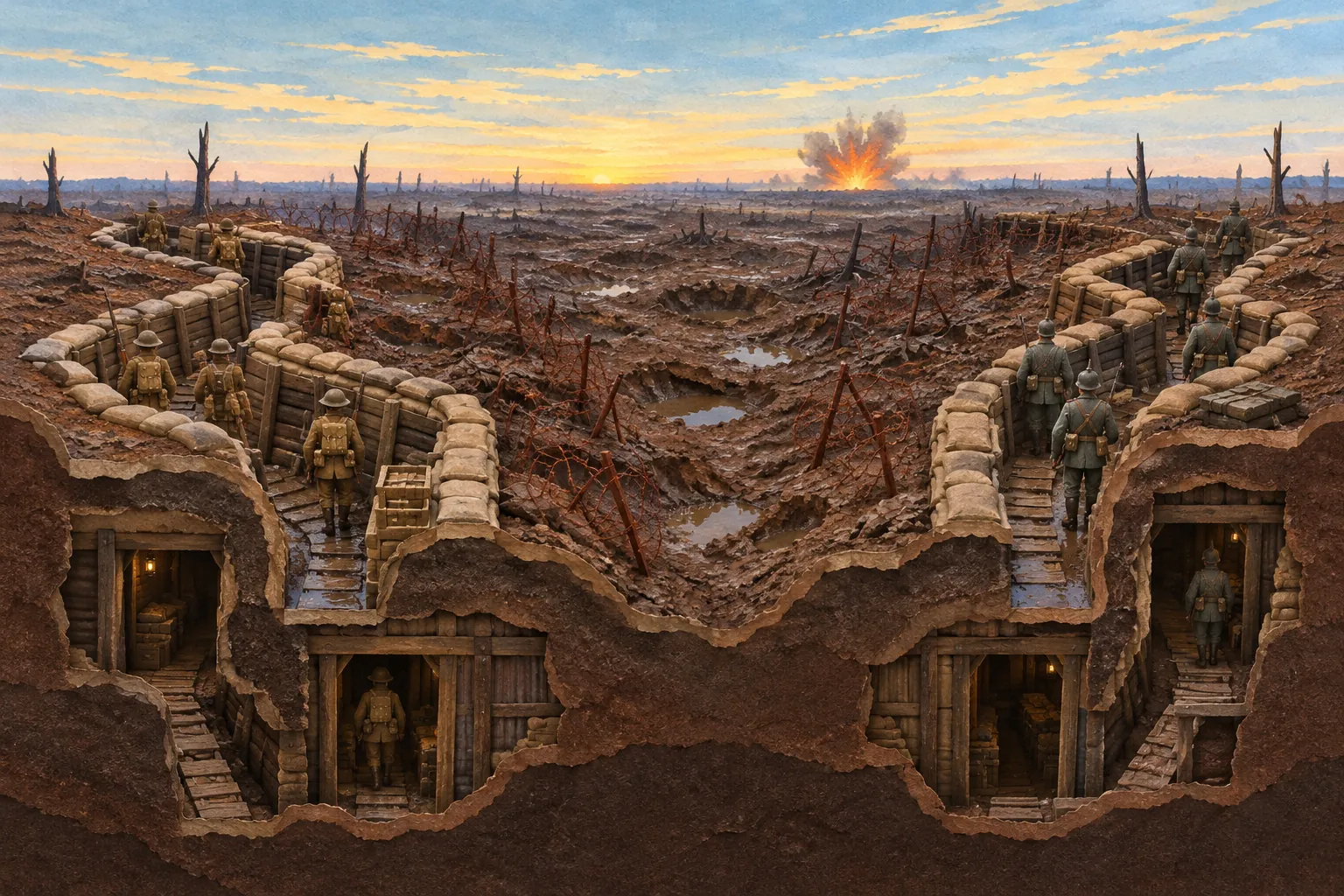
A trench was not one ditch but a layered system. The front line, or fire trench, had a raised step, the fire-step, from which soldiers could shoot over the parapet at the front. Behind it ran support trenches and reserve trenches, and sometimes several lines more. Narrow communication trenches linked them so that men, food, ammunition and messages could move without crossing open ground.
Trench lines were dug in zigzags or in sections divided by walls of earth called traverses, so a shell or an enemy who got in could not sweep a long stretch at once. Sandbags built up the parapet; wooden duckboards covered the floor against mud; dugouts gave some cover from shellfire. In front lay belts of barbed wire. Beyond the wire was no man's land, whose width varied from a few dozen metres in some places to several hundred in others, pitted with shell holes.
The two sides built differently. The Germans, who had decided to hold ground in the west and fight elsewhere, often built deeper, stronger positions with concrete shelters. In early 1917 they pulled back to a shorter and stronger zone, the Hindenburg Line, and used defence in depth: a thinly held front zone and strong reserves ready to counterattack.
Life in the trenches
Most soldiers did not stay at the front line all the time. Units normally rotated between the front, support and rest areas, so a man might spend only a few days at a stretch in the most exposed trench. Even so, conditions were hard. Rain filled trenches with water and mud; men suffered from trench foot, a condition caused by cold, wet feet; lice spread trench fever; rats fed on rubbish and the dead. Shelling, snipers and raids were a constant danger, and the strain left many with what was then called shell shock, an early name for what we now understand as combat stress and trauma.
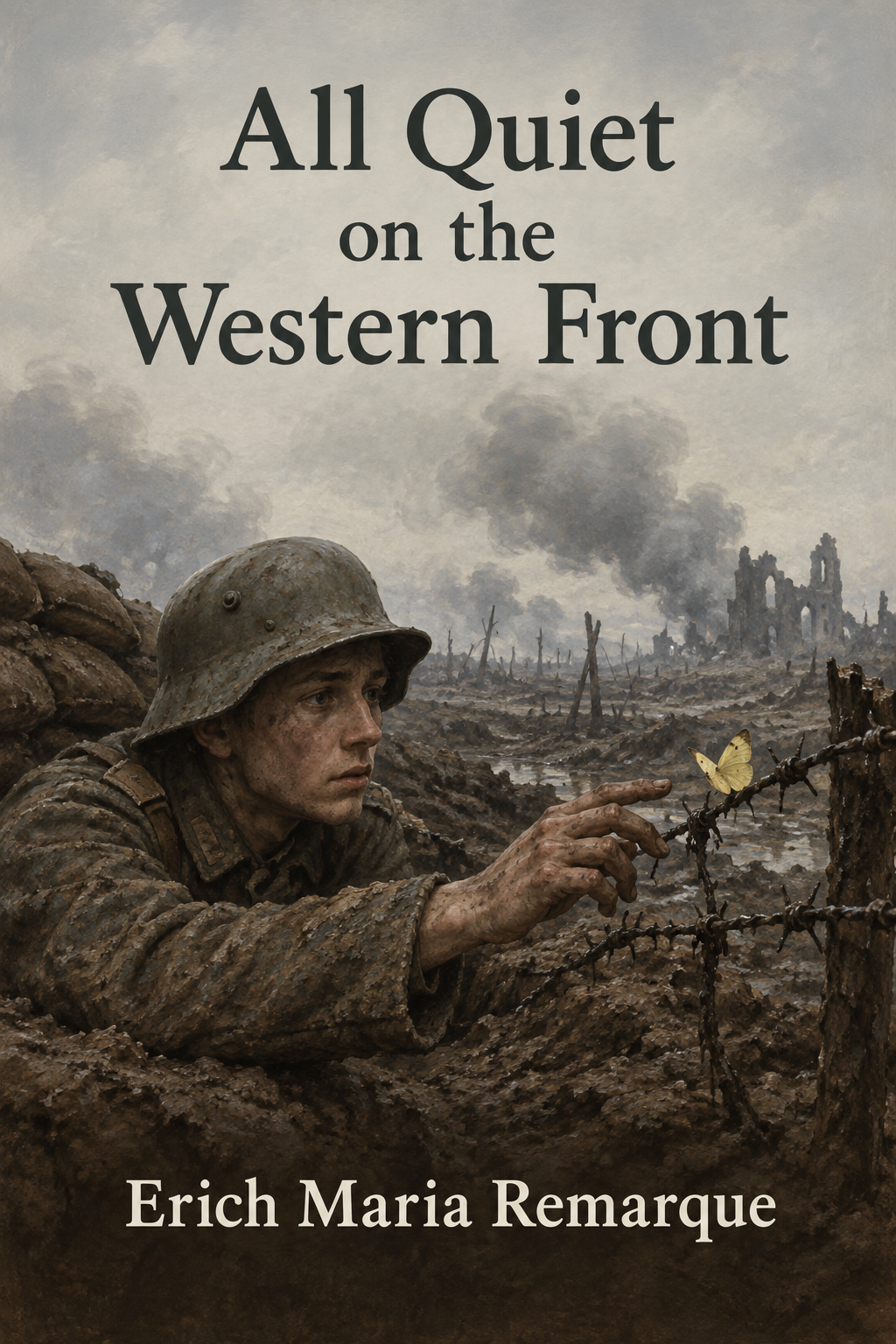
Much of the work was dull: repairing parapets, pumping water, carrying supplies at night, standing watch. Small trench raids tested enemy positions, captured prisoners and kept the enemy uneasy. Letters, food, tea or rum, and the company of comrades mattered a great deal. Erich Maria Remarque's novel, All Quiet on the Western Front, gives a vivid sense of how this felt from a German soldier's side.
The great attritional battles
From 1915 the Allies and Germans tried again and again to break the line, usually after days of artillery fire meant to destroy the wire and the defenders. It often failed: the guns could not reliably cut all the wire or kill men in deep dugouts, and the bombardment warned the enemy where the attack would come.
- Verdun (February–December 1916): Germany attacked a ring of French forts to force France to throw in men. France held, and the two sides together suffered roughly 700,000 casualties.
- The Somme (July–November 1916): A British and French offensive. On 1 July alone the British Army had about 57,000 casualties, around 19,000 of them killed. Total casualties on all sides across the battle passed one million.
- Passchendaele, or the Third Battle of Ypres (July–November 1917): A British offensive in Flanders fought in heavy rain and shell-churned mud.
These battles are often called battles of attrition, because each side hoped to wear the other down faster than it was itself worn down. They also showed why the war needed whole societies behind it, an idea explained in our article on total war.
Breaking the deadlock
Commanders tried many ways to get past the trenches. Germany used poison gas on a large scale at Ypres on 22 April 1915, and both sides soon used gas shells; gas caused terrible suffering but did not win the war, as gas masks quickly spread. Miners dug tunnels and blew huge mines under enemy lines, as the British did at Messines in June 1917. Aircraft were used for reconnaissance and to direct artillery.
The tank, first used by the British at Flers-Courcelette on the Somme in September 1916, was meant to cross wire and trenches under machine-gun fire. Early tanks were slow and broke down often, but in November 1917 at Cambrai the British used them in large numbers together with new artillery methods.
Tactics changed as much as machines. Artillery learned to fire a creeping barrage, a moving curtain of shells that the infantry followed closely, and to hit enemy guns by sound and survey rather than by long warning bombardments. Germany developed infiltration tactics, using small, well-armed groups of stormtroopers who bypassed strong points. These helped its spring offensive of March 1918 break deep into Allied lines. The Allies then answered with combined attacks of infantry, tanks, artillery and aircraft in the Hundred Days Offensive from August 1918, and the war ended with the armistice on 11 November 1918. The front where this all unfolded is described in our article on the Western Front.
Why it matters
Trench warfare left a lasting picture of World War I as a conflict of mud, waiting and mass death. Historians now add that generals did learn and adapt, and that the war became more mobile again in 1918. The experience still shaped the 1920s and 1930s: France built the Maginot Line, and many commanders prepared either to avoid a repeat or to use tanks and aircraft for fast movement in the next war.
What exams ask
- Cause: Why did the Western Front become static? Combine machine guns, quick-firing artillery, barbed wire and the lack of an open flank after the Race to the Sea.
- Examples: Know Verdun and the Somme (both 1916) and Passchendaele (1917) as attrition battles, with the correct dates.
- Technology: Link gas (1915), tanks (1916) and aircraft to the attempt to break the stalemate; be ready to judge how much each really changed things.
- Significance: Explain how trench warfare supported the idea of total war and why 1918 became mobile again.
Read next
- The Western Front: the geography and main campaigns of the front where trenches were dug.
- The Schlieffen Plan: the German plan whose failure at the Marne led to the trench lines.
- Total War: How WWI Mobilised Whole Societies: how long attrition fighting drew in industry and civilians.
- What Is Militarism? How It Led to WWI: the pre-war military culture that expected a short, mobile war.