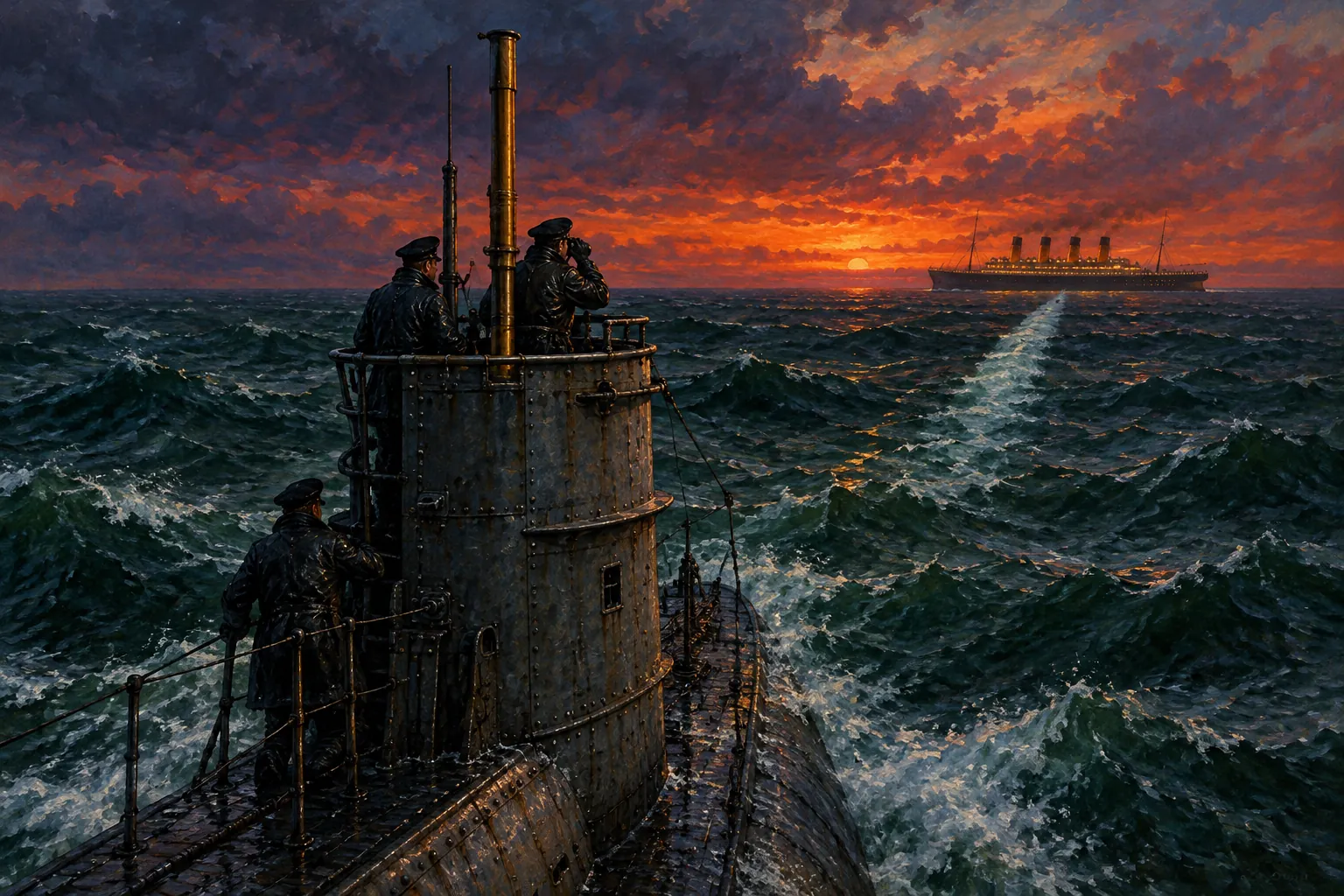
In five minutes
Unrestricted submarine warfare means sinking ships without warning, without searching them and without saving their crews. In World War I, Germany used its U-boats this way to cut Britain off from the food, fuel and raw materials it imported by sea. The campaign was a gamble. In 1917 it came close to working, then it pulled the United States into the war and was beaten by convoys.
- What: German submarines attacked merchant ships, neutral ones included, inside declared war zones.
- When: a first phase in 1915 and 1916, stopped under American pressure, then a full restart on 1 February 1917.
- Why it matters: it was the main reason the United States entered the war on 6 April 1917.
Why Germany turned to the submarine
By 1915 the war on land was stuck in the trenches, and at sea Britain was far stronger. The Royal Navy was bigger than the German High Seas Fleet. In November 1914 Britain declared the North Sea a military area and began a blockade that choked German trade. Food ran short in Germany, and the winter of 1916–1917, remembered as the Turnip Winter, was especially hard.
Germany's answer was to hit Britain's own weak point. Britain was an island that imported well over half of its food, along with most of the raw materials its factories needed. Warships could not break the blockade, but submarines could threaten the supply line itself.
There was also a legal problem. Under the accepted rules of the time, often called cruiser rules, a warship had to stop a merchant ship, search it and let the crew take to the lifeboats before sinking it. A submarine could hardly do this. It was small and fragile, it had no room for prisoners, and if it surfaced to give a warning, an armed or disguised merchant ship, such as a British Q-ship, could sink it. Attacking without warning was the submarine's most effective method, which is why German leaders kept returning to it.
German leaders also argued that Britain was already starving German civilians with its blockade, so Germany could answer in kind. That argument carried little weight with neutral countries, whose ships and citizens were the ones caught in the middle.
What happened: three phases
1914–1915: the first campaign and the Lusitania
U-boats proved themselves quickly. On 22 September 1914, a single boat, U-9, sank three British armoured cruisers in one morning, and about 1,400 sailors died. On 4 February 1915, Germany declared the waters around the British Isles a war zone. From 18 February, it said, enemy merchant ships found there would be destroyed, and neutral ships could be hit by mistake.
The turning point came on 7 May 1915, when U-20 torpedoed the British liner Lusitania off the coast of Ireland. Nearly 1,200 people died, including 128 Americans. Germany said the ship carried war supplies, and it did carry rifle ammunition, but the deaths of so many civilians caused outrage in the United States. President Woodrow Wilson sent sharp protests. After another liner, the Arabic, was sunk in August 1915, Germany promised not to sink passenger ships without warning. The United States did not go to war. Wilson kept the country neutral for almost two more years.
1916: a pause
On 24 March 1916, a U-boat struck the French ferry Sussex in the English Channel, killing and wounding many passengers, some of them American. Wilson threatened to break off diplomatic relations. On 4 May, Germany made the “Sussex pledge”: its submarines would follow the cruiser rules, provided the United States also pressed Britain to ease its blockade. The campaign was effectively paused.
Meanwhile, the Battle of Jutland at the end of May showed that the German surface fleet could not break the British blockade, and the fighting at Verdun dragged on without a result. Inside the German high command, the argument that only the submarine could win the war grew stronger.
1917: all in
On 22 December 1916, Admiral Henning von Holtzendorff, head of the naval staff, argued in a memorandum that sinking about 600,000 tons of shipping a month would force Britain to make peace in roughly five months, before American help could matter. Generals Hindenburg and Ludendorff backed him. Chancellor Theobald von Bethmann Hollweg feared the American reaction, but he gave way at a conference at Pless on 9 January 1917. On 31 January, Germany told Washington that unrestricted attacks would begin the next day in a zone around Britain, France, Italy and the eastern Mediterranean.
Wilson broke diplomatic relations on 3 February. On 1 March, newspapers published the Zimmermann telegram, in which Germany proposed an alliance with Mexico in case of war with the United States. In March, U-boats also sank several American merchant ships. On 2 April, Wilson asked Congress to declare war, and Congress voted for it on 6 April.
How it ended and what it changed
At first the campaign worked. Allied and neutral shipping losses passed 800,000 tons in April 1917, and British officials feared shortages of food and supplies. The Royal Navy had been reluctant to use convoys, partly because it doubted it could protect so many ships at once. Under pressure from Prime Minister David Lloyd George and others, convoys were tried from May 1917 and widely used by late summer. Merchant ships now crossed in groups with destroyers beside them. U-boats found fewer easy targets and faced more danger themselves. Depth charges, hydrophones and mines added to the defence, losses fell, and Britain never ran out of food.
The campaign failed for a second reason: it created the enemy it was meant to avoid. American soldiers needed time to train and cross the Atlantic, but through 1918 they reached France in growing numbers, and the US Navy helped escort convoys. Japan, an Allied power, also sent destroyers to the Mediterranean in 1917 to protect shipping. Germany stopped unrestricted attacks on 20 October 1918 during armistice talks, and the war ended on 11 November. Over the whole war, U-boats sank more than 5,000 merchant ships.
The idea did not disappear. The Treaty of Versailles banned Germany from having submarines, and a 1936 protocol to the London Naval Treaty restated that submarines must follow the cruiser rules. Yet in World War II Germany fought the Battle of the Atlantic with U-boats, and the US Navy began unrestricted submarine warfare against Japan right after Pearl Harbor.
What exams ask
Questions on this topic usually test cause and effect. Be ready to explain these points:
- Cause: Britain's naval blockade and Germany's U-boat response to it.
- Sequence: Lusitania (May 1915), then the Sussex pledge (May 1916), then the resumption (1 February 1917), then US entry (6 April 1917).
- Significance: it shows the character of total war, which drew in civilians and neutral countries. It also shifted the balance toward the Allies by bringing in the United States, and convoys became the standard answer to submarine attack.
- Common mistake: the Lusitania did not bring the United States into the war in 1915. Entry came almost two years later, after the 1917 campaign and the Zimmermann telegram.
Read next
- Why Did the US Enter World War I? The full story of Wilson's decision and the other pressures behind it.
- What Is Militarism? How It Led to WWI Shows the mindset that made risky military gambles like this one easier to approve.
- WWI Propaganda Posters Shows how the Lusitania and the U-boat threat were used to win public support.
- World War I (1914–1918): Causes, Course and Consequences The overview that places the submarine campaign within the whole war.