What is Dark Romanticism? In five minutes
Dark Romanticism is the shadowed side of Romanticism. The Romantics put feeling, imagination and nature above cold reason. The Dark Romantics agreed that feeling matters, then asked what happens when feeling goes wrong: guilt that will not fade, desire that turns into obsession, a mind that cannot trust itself. The label was added later by critics, not by the writers themselves. It is most often used for Edgar Allan Poe, Nathaniel Hawthorne and Herman Melville in the United States, and it grew out of an older European tradition, the Gothic novel. This page belongs to the wider story told in 19th-Century Art and Culture: From Romanticism to the Belle Époque.
The short version: Gothic fiction supplied the scenery, with ruined castles, storms and buried secrets. Dark Romanticism turned that scenery inward, so that the real haunted house became the human mind.
Where it came from: the Gothic
In 1757 the British thinker Edmund Burke published an essay on the sublime and the beautiful. His argument was that fear, felt from a safe distance, can be thrilling. A storm at sea or a dark cliff overwhelms us, and that is exactly why we are drawn to it. Writers and painters took the idea and ran with it.
The first Gothic novel followed in 1764. Horace Walpole, who had turned his London-area home, Strawberry Hill, into a make-believe medieval castle, published The Castle of Otranto. It opens with a giant helmet falling from the sky into a courtyard and crushing a young prince on his wedding day. It is far-fetched, but it set the pattern: an old castle, a family curse, a hidden crime from the past.
Ann Radcliffe made the form popular with The Mysteries of Udolpho (1794). Her heroine is frightened by strange noises and hidden rooms, and the mysteries are explained at the end by natural causes. Matthew Lewis went the other way in The Monk (1796), which was lurid and shocking and caused a scandal. Between them they showed the two faces of the Gothic: fear that is explained away, and fear that is not.
Why did these stories appear when they did? This was the Age of Reason, when many educated readers believed that science and good government would clear away superstition. The Gothic gave readers a place for everything that reason could not tidy up: cruelty, dread, desire and the past that will not stay buried.
What marks Dark Romanticism
Scholars point to a handful of recurring ideas. You do not need all of them in one work; two or three is enough to call a story Dark Romantic.
- Guilt and hidden sin. A character carries a secret that slowly poisons everything around them.
- The divided self. Doubles, split personalities and narrators who cannot trust their own minds. Reason is shown as fragile.
- Nature that does not care. Wordsworth found comfort in the countryside. Dark Romantics often show a forest, an ocean or a storm that is indifferent or even hostile.
- Science and ambition going wrong. The brilliant scientist or the driven captain who pushes past what is safe.
- Ambiguity. Is the ghost real, or is the narrator mad? The story often will not say.
In the United States this stood in direct contrast to Transcendentalism. Ralph Waldo Emerson and his circle believed that people are basically good and that nature leads us toward truth. Hawthorne and Melville, in particular, wrote as people who doubted that cheerful picture. For the wider movement they were reacting against, see Romantic Literature.
Europe: monsters, doubles and nightmares
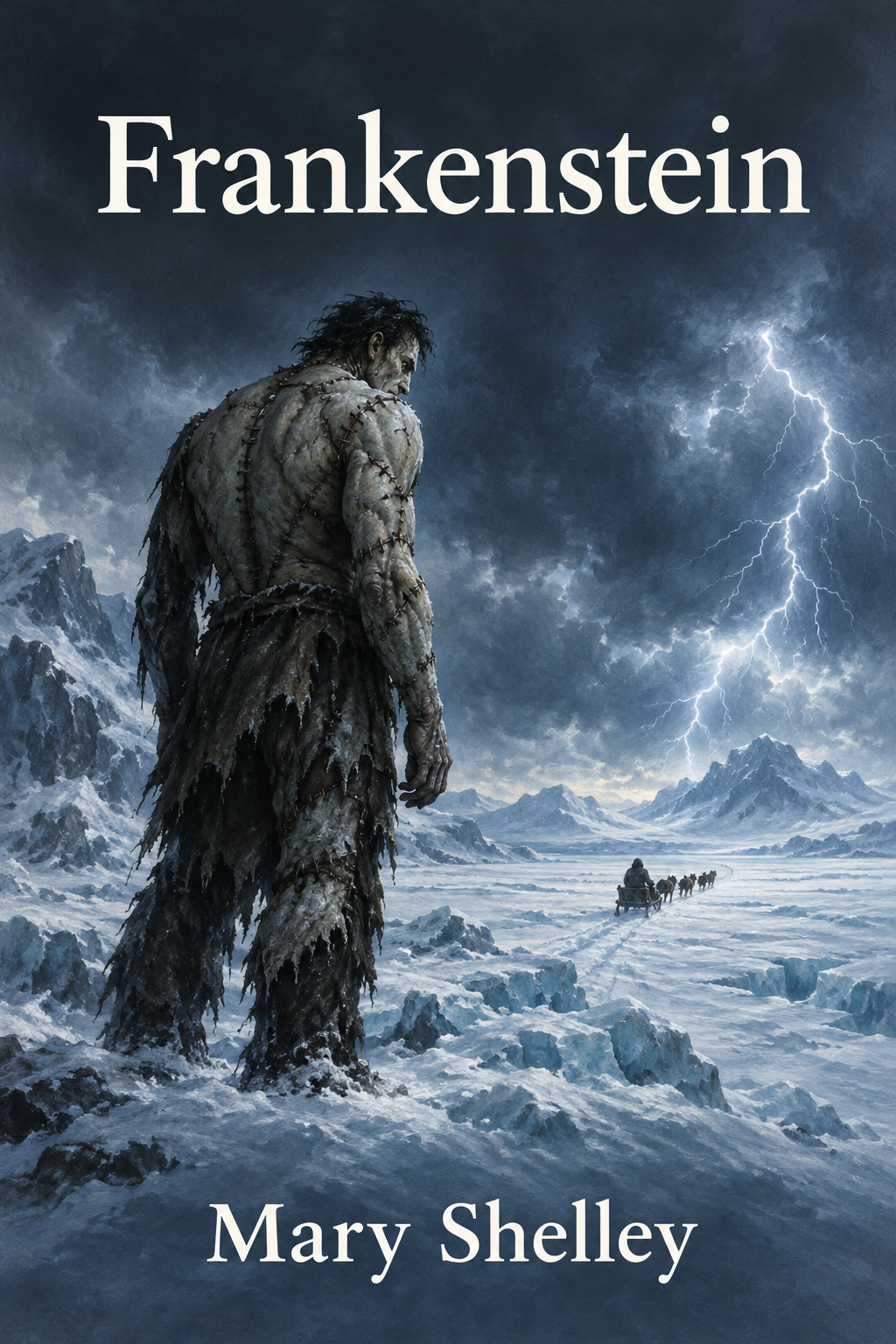
The most famous European example is Frankenstein by Mary Shelley, published in 1818. Its origin is well known. In the summer of 1816 she was staying with Lord Byron, her future husband Percy Shelley and the physician John Polidori at the Villa Diodati near Lake Geneva. The weather was unusually cold and wet, a result of the 1815 eruption of Mount Tambora, and the group stayed indoors and challenged each other to write ghost stories. Hers grew into a novel about a young scientist who builds a living creature and then refuses to take responsibility for it. Polidori's story The Vampyre appeared in 1819 and helped launch the modern vampire tale. You can read more in our guide to Frankenstein.
Elsewhere in Europe the same mood appears again and again.
- Goethe, Faust, Part One (1808). A scholar bargains with the devil for limitless knowledge and pays for it with another person's life.
- E. T. A. Hoffmann, The Sandman (1816). A young man is haunted by a childhood terror and slowly loses his grip on what is real.
- Henry Fuseli, The Nightmare (1781). A sleeping woman with a goblin crouching on her chest. It scandalised and fascinated London.
- Francisco Goya, Los Caprichos (1799). A set of prints that includes the famous image of a sleeping man surrounded by owls and bats, with the caption that the sleep of reason produces monsters. Later, around 1819 to 1823, he painted the dark, disturbing works now known as the Black Paintings on the walls of his own house.
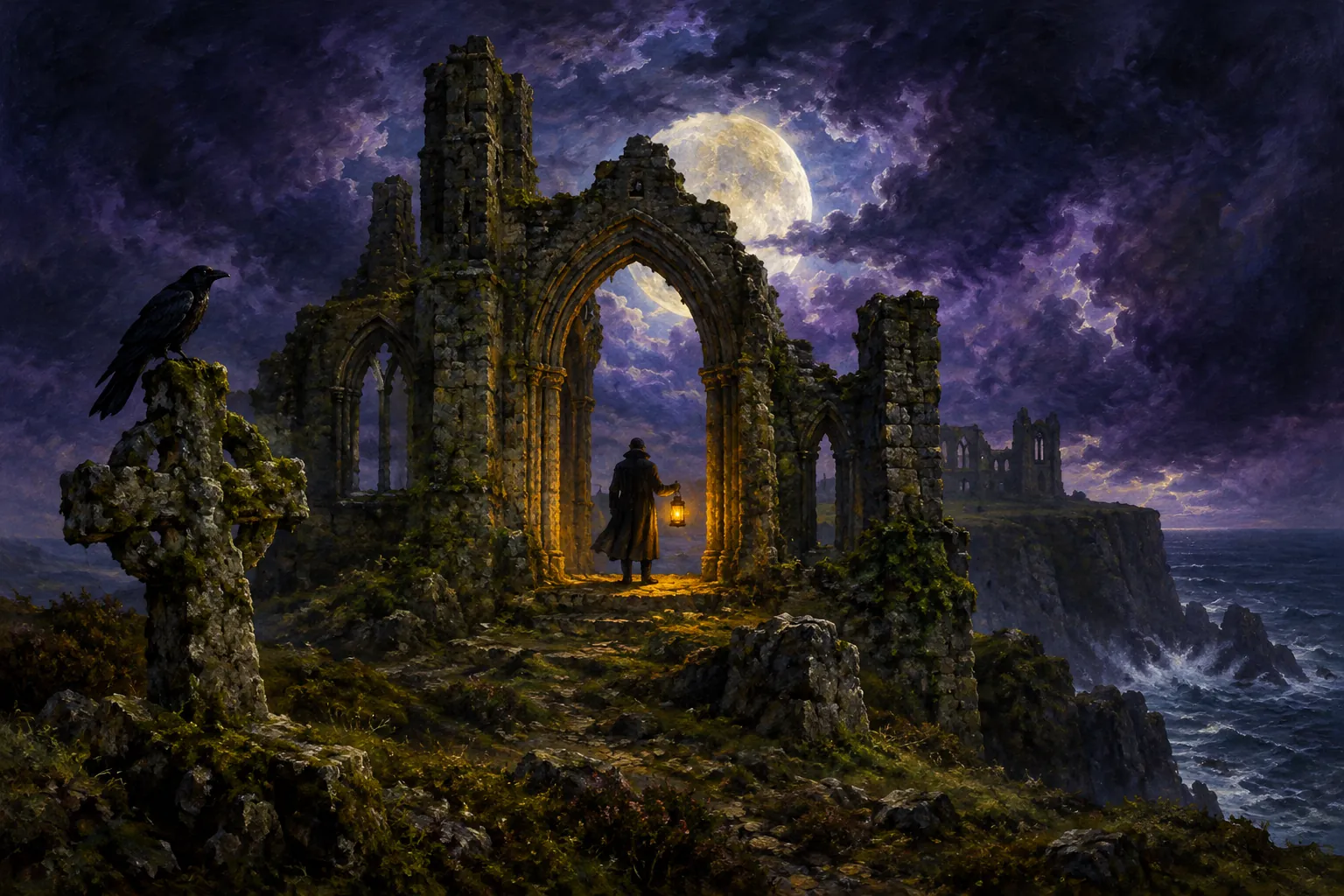
- Caspar David Friedrich, Abbey in the Oakwood (about 1809 to 1810). A ruined church, bare trees and a tiny funeral procession. It shows how landscape painting could carry the same dread as a novel.
- Emily Brontë, Wuthering Heights (1847). A love story soaked in revenge and haunted by the moors, published under the pen name Ellis Bell.
For the more hopeful side of the movement, compare Romantic Poetry: Wordsworth to Byron.
America: Poe, Hawthorne and Melville
American writers took the Gothic out of the European castle and put it in a New England village, a decaying mansion or a whaling ship.
Nathaniel Hawthorne was haunted by his Puritan ancestors, one of whom took part in the Salem witch trials. In the short story "Young Goodman Brown" (1835), a young Puritan walks into the forest at night, sees what seem to be respected neighbours at a devil's meeting, and returns home unable to trust anyone again. The story never says whether it was real or a dream. The Scarlet Letter (1850) follows Hester Prynne, who is forced to wear the letter A for adultery, and the minister Arthur Dimmesdale, whose secret guilt eats at him far more than her public shame eats at her.
Edgar Allan Poe turned the Gothic into a study of the mind. In "The Fall of the House of Usher" (1839), a narrator visits a friend, Roderick Usher, whose nerves are in ruins and whose sister seems close to death. The house, the family and the mind of Usher decay together, and the building finally splits and falls. In "The Tell-Tale Heart" (1843), a narrator insists again and again that he is sane while describing a murder, and his own words give him away. The poem "The Raven" (1845) uses rhythm and repetition to make grief sound like madness.
Herman Melville brought the same darkness out to sea. In Moby-Dick (1851), Captain Ahab pursues a white whale across the oceans, driven by a hatred that ends up destroying his crew. The whale itself is never explained. Is it evil, or only a whale? The novel leaves the question open, and that open question is very Dark Romantic.
Why it lasted
Dark Romanticism did not end in 1850. Its habits are everywhere in later horror, from Bram Stoker's Dracula (1897) to modern films, games and anime that put a hidden crime or a troubled mind at the centre of a spooky house. The core idea has stayed useful: the scariest thing in a story is often not the monster but what the monster shows us about ourselves.
What exams ask
In AP-style literature and US history courses, the key points are usually these:
- Define it. Dark Romanticism is a strand of Romanticism that stresses human flaws, guilt, the irrational and the limits of reason, rather than the goodness of nature and the individual.
- Contrast it with Transcendentalism. Emerson and Thoreau: optimistic, self-reliant, trusting nature. Poe, Hawthorne and Melville: suspicious of easy optimism.
- Name examples and match them. Poe with "The Fall of the House of Usher", Hawthorne with "Young Goodman Brown" and The Scarlet Letter, Melville with Moby-Dick.
- Explain the Gothic roots. Walpole's Otranto (1764) and Radcliffe's Udolpho (1794), and the reaction against Enlightenment confidence in reason.
- Spot the devices. Unreliable narrators, symbols, decaying settings and ambiguity about whether events are supernatural.
Read next
- What Is Romanticism? The bigger movement that Dark Romanticism grew out of, and the ideas it reacted to.
- Romantic Literature A tour of the major Romantic novels and stories, including the Gothic.
- Romantic Poetry: Wordsworth to Byron The poets who gave nature and emotion their voice, and the Byronic hero.
- What Is Impressionism? What came next in art, when painters turned from drama to light.
- Frankenstein The best single book to read if you want to see Gothic and Dark Romantic ideas in action.