In five minutes: why the colonies rebelled
The causes of the American Revolution come down to one question: who had the right to tax and govern the thirteen colonies? After winning the Seven Years' War in 1763, Britain had a huge debt and a much larger empire to defend. Parliament decided the colonies should pay part of the bill. Colonists, who had long run their own local affairs, replied that they could be taxed only by assemblies in which they were represented. Each new law, protest and punishment made compromise harder. By April 1775, soldiers and militia were firing at each other in Massachusetts. This page follows the causes in order, from the long-term background to the final sparks, as part of the story told in The American Revolution: Causes, War and Independence.
Background: an empire that mostly left the colonies alone
For most of the early 1700s, Britain governed its North American colonies with a light hand. Trade rules existed, such as the Navigation Acts, which required colonial goods to travel on British ships and through British ports. But enforcement was loose, and colonial assemblies controlled taxes, local courts and budgets. Historians often call this habit "salutary neglect". Colonists came to see self-government as a normal right, not a favour. That expectation is the soil in which every later quarrel grew.
Cause 1: the Seven Years' War left a bill and a border problem
Britain and France fought the Seven Years' War (1756–1763), which in North America is often called the French and Indian War. Britain won, and the Treaty of Paris in 1763 gave it Canada and land east of the Mississippi. But the war nearly doubled the British national debt, to roughly £130 million, and Britain now had to garrison a vast new territory.
The frontier was already tense. In 1763 Native nations in the Ohio country and Great Lakes region rose in a conflict known as Pontiac's War. In response, the Royal Proclamation of 7 October 1763 told colonists not to settle west of the Appalachian crest. London saw this as a way to keep the peace cheaply. Many colonists, including land speculators and families hoping to move west, saw it as a barrier placed by a distant government that had not asked them.
Cause 2: new taxes and the cry of "no taxation without representation"
To raise money and tighten control, Parliament passed a string of measures.
- Sugar Act (1764): cut the duty on molasses but enforced it strictly, and sent smuggling cases to courts without juries. It also aimed to raise revenue, not just to regulate trade.
- Currency Act (1764): limited colonial paper money, which hurt debtors and merchants.
- Stamp Act (1765): required an official stamp on newspapers, legal papers, playing cards and many other printed items. It was the first direct tax Parliament had laid on the colonists.
- Quartering Act (1765): required colonies to help house and supply British troops.
The Stamp Act caused the first great uproar. Crowds, often organised by groups calling themselves the Sons of Liberty, intimidated stamp distributors. In October 1765 delegates from nine colonies met in the Stamp Act Congress and argued that only colonial assemblies could tax colonists. Merchants boycotted British goods. Parliament repealed the act in March 1766, but on the same day it passed the Declaratory Act, claiming the right to make laws for the colonies "in all cases whatsoever". The tax was gone; the principle behind it was not.
That principle is the heart of the dispute. British leaders argued that members of Parliament spoke for the whole empire, a view sometimes called "virtual representation". Colonists, who elected no one to the House of Commons, rejected this. Their slogan, "no taxation without representation", summed up the claim.
Cause 3: duties, troops and boycotts
In 1767 Parliament tried again with the Townshend Acts, which placed duties on glass, lead, paint, paper and tea imported into the colonies. Part of the money was meant to pay the salaries of royal governors and judges, which would make them less dependent on colonial assemblies. Colonists feared exactly that. Boycotts spread, and in 1768 Britain sent troops to Boston to support customs officers.
Tension between soldiers and townspeople led to the Boston Massacre on 5 March 1770. A crowd confronted a squad of soldiers, shots were fired, and five colonists died. Patriot writers spread the story widely. The soldiers were tried in court, and most were acquitted, with the lawyer John Adams defending them. In April 1770 Parliament repealed most of the Townshend duties but kept the tax on tea.
Cause 4: ideas about rights and self-government
Laws and taxes alone do not explain why many colonists moved from complaint to independence. Ideas mattered too. Colonial pamphlet writers drew on English traditions of limited government, such as the idea that the Crown's power was bound by law, and on Enlightenment thinkers such as John Locke, who argued that governments exist to protect people's natural rights and can lose legitimacy when they fail to do so. Lawyers like James Otis argued that taxation required consent. Newspapers, pamphlets and committees of correspondence carried these arguments from colony to colony, and helped people in Virginia, Massachusetts and Pennsylvania see their grievances as a shared cause.
Cause 5: the Tea Act, the Tea Party and the Intolerable Acts
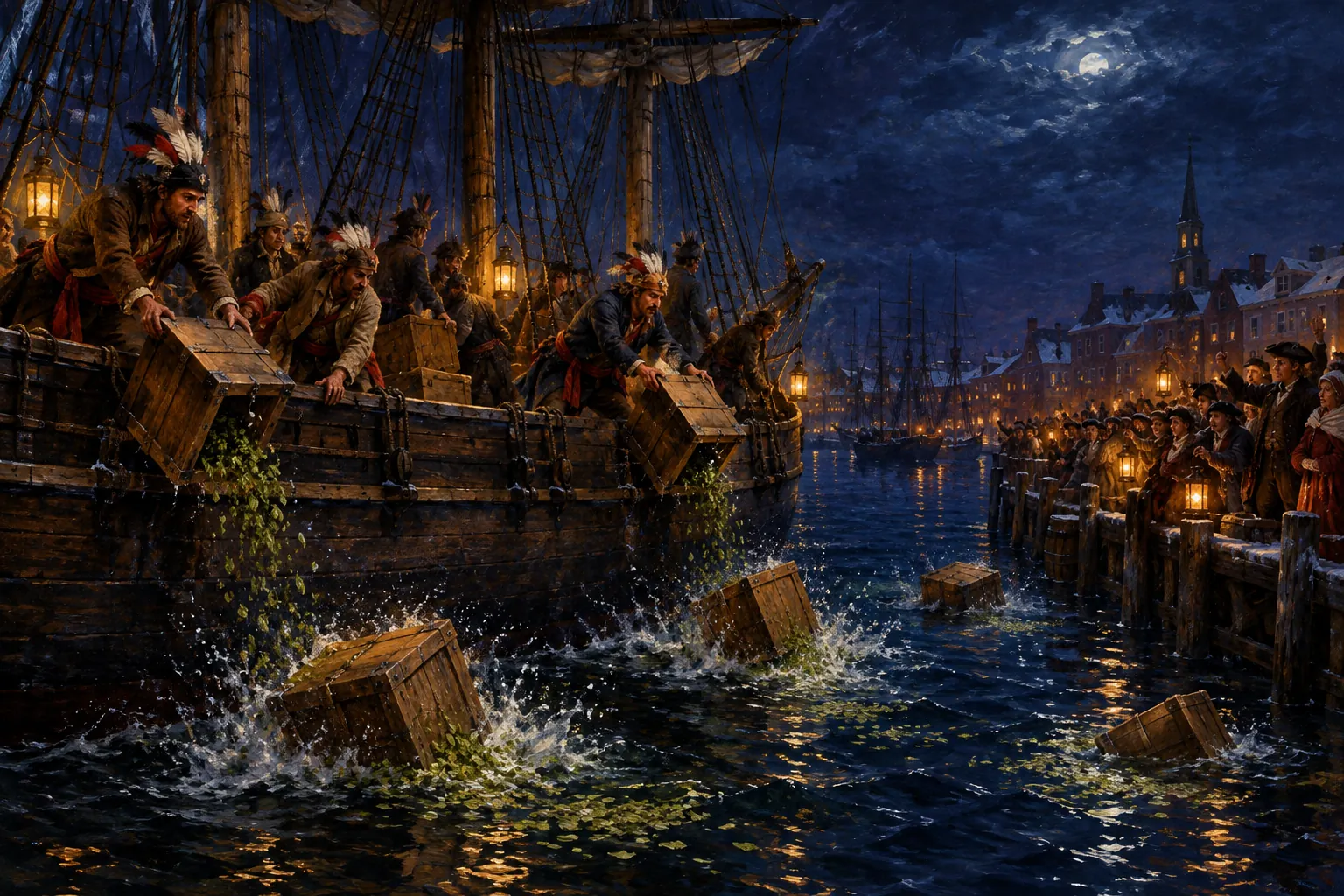
The final crisis began with tea. The Tea Act of May 1773 let the struggling East India Company sell tea directly in the colonies, making it cheaper even with the tax. But colonists saw a trap: buying it meant accepting Parliament's right to tax them. On 16 December 1773, in the Boston Tea Party, a group of colonists boarded ships in Boston Harbor and threw 342 chests of tea into the water.
Parliament responded in 1774 with the Coercive Acts, which colonists called the Intolerable Acts. The Boston Port Act closed the harbor until the tea was paid for. The Massachusetts Government Act cut back self-government in the colony. Other measures protected officials accused of crimes and expanded the housing of troops. The Quebec Act of the same year, which extended Quebec's boundary toward the Ohio River, was widely read in the colonies as another blow to their western hopes. Instead of isolating Boston, the punishments united the colonies behind it. In September and October 1774 the First Continental Congress met in Philadelphia, with delegates from twelve colonies, and organised a boycott of British trade.
The spark: Lexington and Concord, April 1775
By early 1775 Massachusetts was under military rule and militia were collecting arms. On 19 April 1775, British troops marched from Boston toward Concord to seize military supplies. They met colonial militia at Lexington and fought at Concord, and the fighting continued as the troops retreated to Boston. The war had begun. Even then, many colonists still hoped to stay in the empire. Thomas Paine's pamphlet Common Sense, published in January 1776, helped turn opinion toward independence, and the Declaration of Independence followed on 4 July 1776.
Short answer: the main causes in order
- The costs and changes after the Seven Years' War (1763).
- Parliament's new taxes and its claim of authority over the colonies.
- The belief that only elected colonial assemblies could tax colonists.
- Troops, boycotts and clashes such as the Boston Massacre.
- The Tea Act, the Boston Tea Party and the Intolerable Acts.
- Fighting at Lexington and Concord, which made reconciliation much harder.
What exams ask
In AP US History and similar courses, the causes of the American Revolution are usually tested as a chain of action and reaction. Expect questions on the following.
- Why Britain changed policy after 1763: war debt, the cost of defending new territory, and the Proclamation of 1763.
- The constitutional argument: "no taxation without representation", virtual representation versus actual representation, and the Declaratory Act.
- Forms of resistance: the Stamp Act Congress, boycotts, the Sons of Liberty, committees of correspondence.
- The sequence from 1773 to 1775: Tea Act, Tea Party, Intolerable Acts, First Continental Congress, Lexington and Concord.
- Ideas: the influence of Enlightenment thought and English rights traditions.
A strong answer separates long-term causes (salutary neglect, self-government, ideas) from immediate ones (the taxes and punishments after 1763).
Read next
- American Revolution Timeline 1763–1789: every event above on one dated line, plus what came after.
- The American Revolutionary War (1775–1783): what happened once the fighting began.
- The Declaration of Independence Explained: how the colonists put their complaints into a founding document.