In five minutes
Paul Revere was a Boston silversmith and engraver who rode out of Boston on the night of April 18–19, 1775, to warn the countryside that British soldiers were about to march. His message helped local militias prepare for Lexington and Concord, the first battles of the American Revolution. He did not ride alone, he never reached Concord, and a British patrol stopped him on the road. He became the best-known rider of that night mostly because of a poem published in 1861.
Quick answers
- Who: Paul Revere, a Boston craftsman and trusted courier for the Patriot cause, together with the riders William Dawes and Samuel Prescott.
- When: the night of April 18 into the early hours of April 19, 1775.
- Why: a British force was leaving Boston to seize military supplies at Concord, and Patriot leaders feared arrests.
- Result: the towns of Lexington and Concord were alerted, and fighting began at dawn.
Who was Paul Revere?
Revere was born in Boston in 1735. His father was a French-born silversmith who had arrived in Massachusetts as a boy, and Paul learned the trade in the family workshop. He made teapots, spoons and bowls, and he also engraved copper plates for prints. In 1770 his engraving of the Boston Massacre, which showed British soldiers firing into a crowd, was copied and passed around widely. It hardened feelings against the troops.
By the 1770s Revere was well connected in Boston’s Patriot circles. He took part in the Boston Tea Party in December 1773. He was also an express rider, someone who carried news and letters between towns for the Patriot committees. He rode to New York and Philadelphia with news of the Tea Party, and in 1774 he took the Suffolk Resolves, a Massachusetts declaration of resistance to British policy, to Philadelphia. So when Dr. Joseph Warren needed a messenger in April 1775, Revere already had plenty of practice.
Why the ride happened
After the Tea Party, Parliament passed the Coercive Acts in 1774. They closed Boston’s port until the tea was paid for and cut back self-government in Massachusetts. General Thomas Gage, the senior British commander in North America, also became governor of the colony and held Boston with several thousand soldiers. Outside the city, towns drilled their militias and stored gunpowder, cannon and food in places such as Concord, about 20 miles west of Boston.
In the spring of 1775, Gage received instructions from London to act against the rebels. He decided to send a column of about 700 soldiers to destroy the supplies at Concord. He tried to keep the plan secret, but Patriots in Boston noticed the signs: boats being readied and officers moving about at night. Joseph Warren, a physician and one of the movement’s leaders, concluded that the troops would march that night. He feared for the supplies at Concord and for Samuel Adams and John Hancock, who were staying in Lexington. He sent two messengers, Revere and William Dawes, by different routes so that at least one would get through.
The night of April 18–19, 1775
Boston sat on a narrow peninsula, so there were only two ways out: the land route across Boston Neck, watched by British sentries, or a boat across the Charles River. Dawes took the land route. Revere went by water.
Before leaving, Revere arranged a backup signal with friends in Charlestown, in case he could not get across. Lanterns would be shown in the steeple of the Old North Church: one if the troops were going by land, two if they were going by water, meaning across the river by boat. Two lanterns were shown. The church’s sexton, Robert Newman, is usually named as the man who hung them. The signal was meant for Patriots on the Charlestown side, and Revere himself was already crossing the river, rowed past the British warship HMS Somerset.
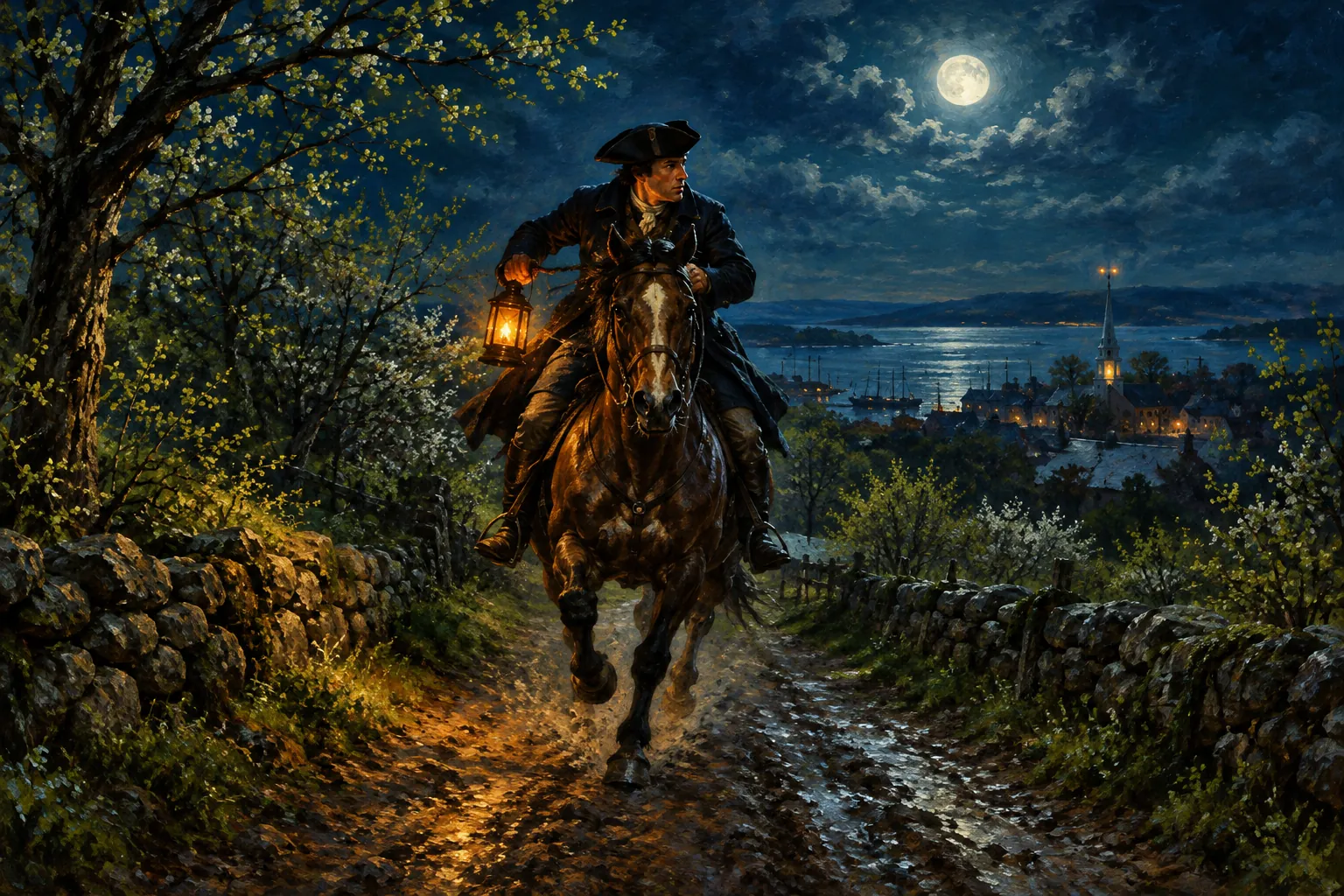
In Charlestown he borrowed a horse and rode west toward Lexington, warning houses and militia officers along the way. He reached Lexington around midnight and went to the home of Reverend Jonas Clarke, where Hancock and Adams were staying. Dawes arrived a short time later. After resting briefly, the two set off for Concord, and on the road they met Samuel Prescott, a young doctor riding home from a visit, who joined them.
Near Lincoln, a British patrol stopped the riders. Prescott jumped a stone wall and escaped, then reached Concord and raised the alarm. Dawes also got away. Revere was held at gunpoint and questioned. He told the officers that the countryside was alarmed and that many armed men would meet the troops. The patrol eventually let him go but kept his horse. He walked back to Lexington, where he helped Hancock and Adams leave the area and carry away a trunk of papers.
What happened next
At dawn on April 19, the British column reached Lexington Green, where a small company of militia stood. A shot was fired, and nobody knows who fired it. Eight militiamen were killed. The soldiers marched on to Concord, searched for supplies, and clashed with militia at the North Bridge. On the long march back to Boston they were attacked again and again from behind walls and trees by militia arriving from many towns. By evening the British had suffered roughly 270 casualties and the Americans about 90.
The alarm had worked. Because word spread so fast, thousands of militiamen could gather in a single day, and soon they surrounded Boston, beginning a siege that lasted nearly a year. Revere was only one of many riders that night and the next day. The fighting grew into the war described in The American Revolutionary War (1775–1783), and in July 1776 the colonies announced their break with Britain in the document explained in The Declaration of Independence Explained.
Myths and facts about the ride
- “The British are coming!” Most historians doubt that Revere shouted this. Secrecy mattered, patrols were nearby, and colonists still thought of themselves as British. The words attributed to him in reports are closer to a warning that the Regulars, meaning the army’s regular soldiers, were out.
- He rode alone. He did not. Dawes took another route, and Prescott carried the alarm to Concord.
- He reached Concord. He did not. He was stopped near Lincoln, and the horse he had been riding was taken.
- He hung the lanterns. He arranged the signal, but others hung the lamps, and the signal was for Charlestown, not for him.
- He was famous at once. Not really. Revere was known locally, but the ride became a national story after Henry Wadsworth Longfellow published his poem “Paul Revere’s Ride” in 1861, about 86 years later. It begins, “Listen, my children, and you shall hear / Of the midnight ride of Paul Revere.” The poem is gripping, but it bends the facts.
Revere after the ride
Revere stayed active in the war. In 1779 he served as an artillery officer in the Penobscot Expedition, a failed attempt to drive the British from a base in what is now Maine. He was blamed for part of the failure, and he was cleared in 1782. After the war he returned to his craft and expanded it. He ran a foundry that cast bells and cannon, and in 1801 he opened a copper-rolling mill in Canton, Massachusetts. His copper was used on the USS Constitution and on the dome of the Massachusetts State House. Revere died in Boston on May 10, 1818, aged 83.
What exams ask
In AP-style questions, Revere’s ride is a case study in how Patriots used committees, messengers and local militias to coordinate resistance. It shows how the conflict moved from protest to armed fighting in April 1775. Exams also like the contrast between sources: Revere’s own account, written down after the event, versus Longfellow’s poem, written in 1860 with the divided nation of that time in mind. Expect these questions:
- Why did General Gage send troops toward Concord?
- What were the Coercive Acts, and how did they lead to the ride?
- How did Longfellow’s poem change the public memory of Revere?
- Why is the “one if by land, two if by sea” signal often misunderstood?
Read next
- The American Revolution: Causes, War and Independence: the full story of how the colonies went from protest to independence.
- The American Revolutionary War (1775–1783): what happened after Lexington and Concord, battle by battle.
- The Declaration of Independence Explained: how the fighting led to the colonies’ formal break with Britain in 1776.