Chopin in five minutes
Frédéric Chopin (1810–1849) was a Polish composer and pianist who wrote almost nothing except music for the piano. He left Warsaw at twenty, settled in Paris, and never saw Poland again. His mazurkas, nocturnes, études and ballades made the piano a place for private feeling, and many listeners have heard in them the longing of a country that had lost its independence. He died in Paris at thirty-nine. He is one of the central figures of 19th-century art and culture, the age of Romanticism, when music became a way to express the inner life of one person.
A Poland without a state
When Chopin was born in 1810, Poland was not an independent country. Russia, Prussia and Austria had divided it in three partitions, in 1772, 1793 and 1795. Napoleon created a small Duchy of Warsaw in 1807, which gave Poles brief hope. After his defeat, the Congress of Vienna in 1815 placed the core of that territory under the Russian tsar, who became king of a new Kingdom of Poland. Chopin grew up in this half-free Warsaw.
His father, Nicolas, had come from France and taught French. His mother, Justyna, was Polish, and the household was full of music. A polonaise by the boy was printed when he was a child, and at seven he played at a public charity concert. He later studied at the Warsaw music school with Józef Elsner, a teacher wise enough to guide his talent without forcing him into rigid rules. Summer holidays in the countryside let him hear village dances and songs, the raw material of his later mazurkas.
Leaving Warsaw, 1830
In November 1830 Chopin left Warsaw for Vienna, hoping to build a career abroad. On 29 November, soon after he had gone, Poles rose against Russian rule in what is called the November Uprising. Chopin was far away, and his family stayed in Warsaw. The Russian army crushed the uprising, and Warsaw fell in September 1831. Chopin received the news while travelling toward Paris and, according to those who knew him, was devastated. He settled in France and never returned to Poland.
Paris was full of Polish soldiers, writers and politicians who had fled after the defeat. They are known as the Great Emigration, and Chopin stayed close to this community for the rest of his life.
Paris: salons, teaching and fame
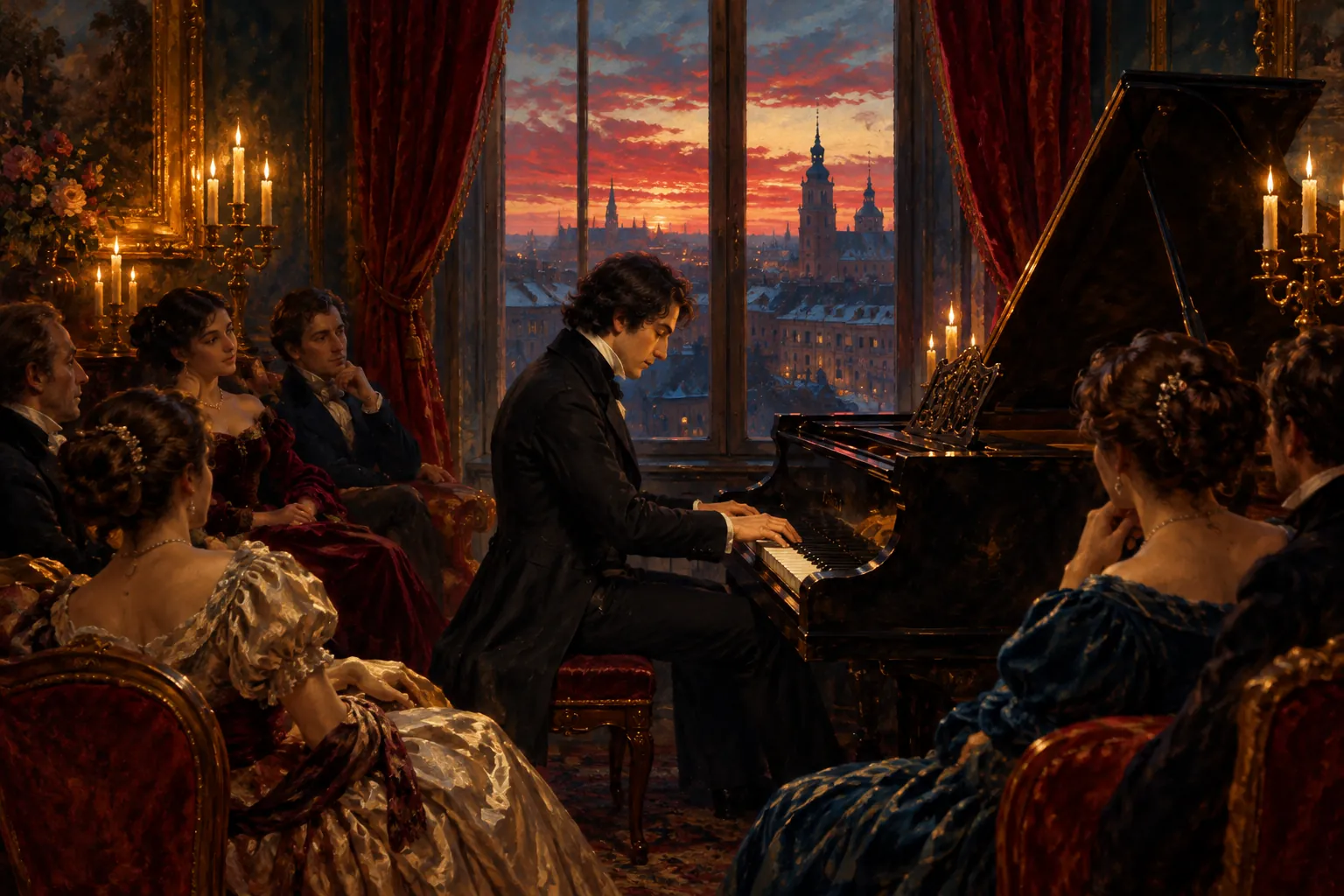
Chopin gave his Paris debut at the Salle Pleyel on 26 February 1832, and the city noticed him quickly. He became part of the circle of Franz Liszt, Hector Berlioz and the painter Eugène Delacroix, and he knew Polish exiles such as the poet Adam Mickiewicz. Yet he disliked large halls. He gave only about thirty public concerts in his whole life and preferred small salons, where a soft touch could be heard. He earned his living mainly by teaching well-off pupils and by selling his scores to publishers in Paris, Leipzig and London. He favoured pianos made by the Pleyel firm.
What made his music new
Chopin wrote a few works for other instruments, including two early piano concertos, but the piano was his world. His main forms are easy to sort:
- Mazurkas and polonaises. He took Polish folk and court dances and made them into concert art. The polonaise is a proud triple-time dance; the Polonaise in A-flat, Op. 53, is often called the “Heroic”.
- Nocturnes. A singing melody floats over a gently moving left hand. The form came from the Irish composer John Field, and Chopin deepened it with the long, vocal lines of Italian opera, especially Vincenzo Bellini.
- Études. His 27 studies, mostly in Op. 10 and Op. 25, each train one technical problem, yet each is a finished piece of music.
- Preludes, Op. 28. Twenty-four short pieces, one in every major and minor key, in the spirit of Bach’s Well-Tempered Clavier. He completed them during the winter of 1838–39.
- Ballades, scherzos and sonatas. Large, dramatic works. The Piano Sonata No. 2 contains the well-known funeral march.
He also used rubato, a flexible give-and-take in tempo, so that a melody could breathe like a voice. Many nicknames, such as “Raindrop” or “Revolutionary”, were added by later people, not by Chopin.
George Sand, illness and the last years
From the late 1830s Chopin was close to the French writer George Sand, the pen name of Aurore Dupin. The two spent the winter of 1838–39 on the island of Majorca, hoping for a gentler climate. The weather turned wet and cold, and Chopin’s health got worse, though he finished the Preludes there. In the following summers at Sand’s country house at Nohant he wrote some of his finest music. Their relationship ended in 1847.
Chopin gave his last Paris concert on 16 February 1848. After the revolution that year he travelled to England and Scotland, where he played and taught, then returned to Paris exhausted. He died there on 17 October 1849 after a long illness, usually given as tuberculosis. Mozart’s Requiem was sung at his funeral at the Madeleine church, and he was buried at Père Lachaise cemetery. His sister Ludwika brought his heart to Warsaw, and it rests today in the Holy Cross Church.
Why Chopin still matters
Chopin changed what piano music could do. His harmony, his use of the pedal and his melodies influenced later composers from Liszt to Debussy and Rachmaninoff. In Poland he became a national symbol. During the German occupation in the Second World War, public performance of his music was banned, and his monument in Warsaw’s Łazienki Park was destroyed in 1940. Since 1927 the International Chopin Piano Competition has been held in Warsaw, every five years, and it remains one of the most watched in the world. Compare his world with Mozart in the Enlightenment: Mozart wrote for courts and public theatres, Chopin for salons and private feeling.
What exams ask
- Romanticism. Know that Chopin belongs to the Romantic period, which valued emotion, individuality and national feeling.
- Nationalism without a nation. Poland had been partitioned in 1772, 1793 and 1795, and Chopin’s dances turned national identity into art.
- The November Uprising. It began on 29 November 1830 and was defeated in 1831, which led to the Great Emigration.
- The piano and the middle class. Growing wealth and better instruments made the piano a household object and the salon a stage.
- Significance. A typical short answer: Chopin raised national dance forms and the solo piano to high art, and became a symbol of Polish cultural survival under foreign rule.
Read next
- 19th-Century Art and Culture: From Romanticism to the Belle Époque: the wider movement that Chopin belongs to.
- Vincent van Gogh and Post-Impressionism: another artist whose life away from home shaped his work.
- Mozart: Music of the Enlightenment: the earlier age of classical music, for comparison.