In five minutes
The Irish Potato Famine (1845–1852), known in Irish as An Gorta Mór, ‘the Great Hunger’, was the worst disaster in Ireland’s modern history and one of the darkest chapters of the Victorian era. A disease destroyed the potato crop year after year. Millions of poor tenant families lived almost entirely on potatoes, so when the crop rotted they had nothing to fall back on. Ireland was part of the United Kingdom, and the government in London did respond, but too slowly and too stingily for the scale of the crisis. Hunger and fever killed about one million people. At least another million emigrated. Ireland’s population fell by roughly a fifth to a quarter, and it kept shrinking for decades.
Why Ireland depended on the potato
The blight did not create Ireland’s poverty. It exposed it. Since the Act of Union took effect in 1801, Ireland had been governed from Westminster, but most of its land belonged to a small group of landlords, many of them Protestant descendants of earlier settlers and some living in England. Most farmers were Catholic tenants on short leases. They paid high rents, could be evicted, and had little reason to improve their land. Below them were cottiers and farm labourers who rented a scrap of ground in exchange for work.
On a few acres, or even less, only one crop could feed a whole family: the potato. By the 1840s roughly a third of the population, concentrated in the west and south, relied on it as their main food. Tenants grew grain and raised animals to pay the rent, and kept potatoes to eat. The population had grown to about 8.2 million by the 1841 census, one of the densest rural populations in Europe. Most farmers also planted just one or two varieties, chiefly the high-yielding Lumper, so the whole crop shared the same weakness.
The blight arrives, 1845–1846
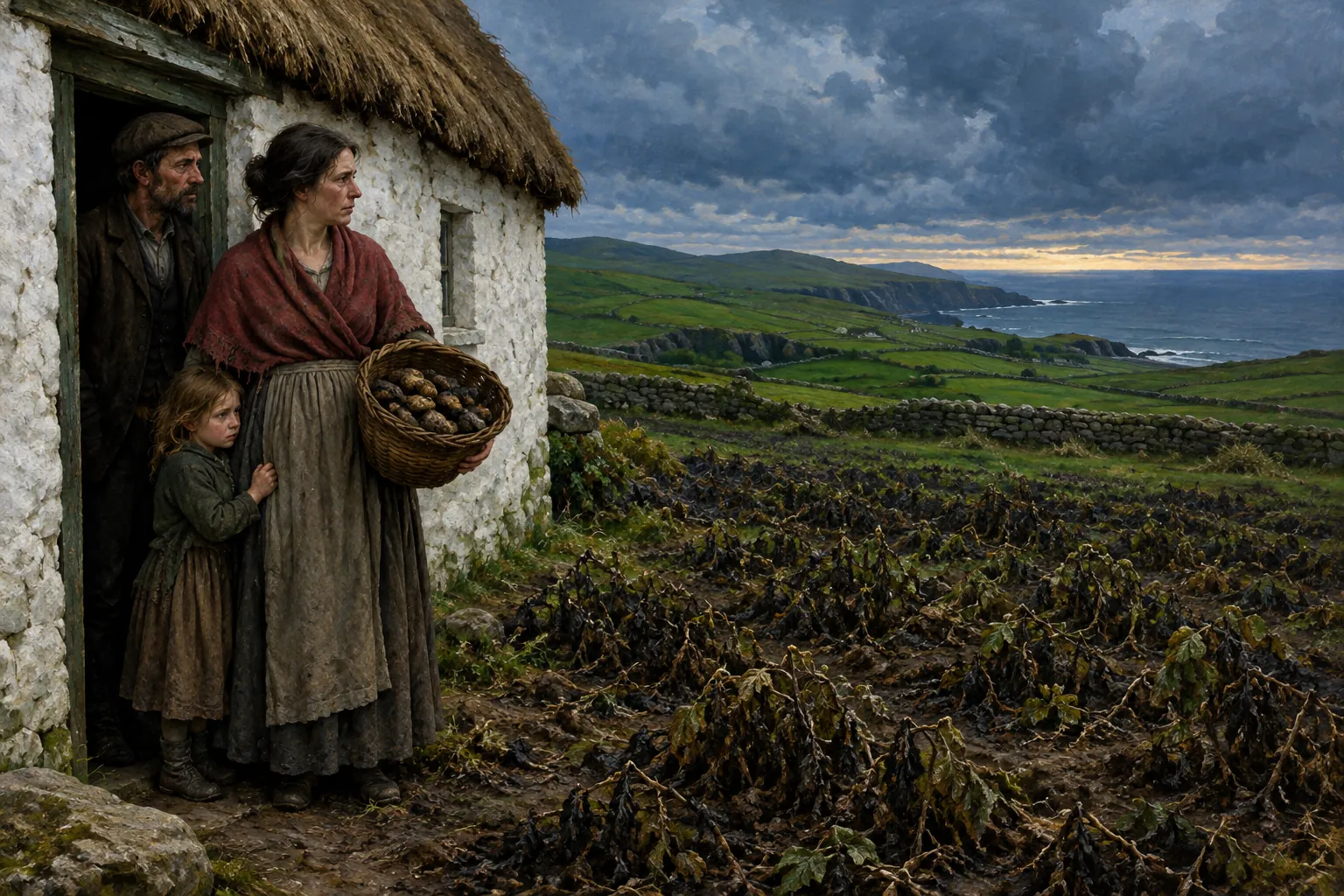
In 1845 a water mould called Phytophthora infestans, probably carried from North America, reached Europe and caused potato blight. Leaves blackened, and tubers that looked healthy in the ground turned to a stinking mush within days. The disease was confirmed in Ireland in September 1845. It hit much of Europe, but only in Ireland did so many people depend on a single crop.
The Conservative prime minister, Sir Robert Peel, responded fairly quickly. He had maize (Indian corn) bought secretly from the United States to sell cheaply, set up a relief commission, and started public works. The first year’s loss was serious but manageable. Peel also argued that the crisis showed why the Corn Laws, which kept grain prices high through import duties, should go. They were repealed in June 1846 (see the Corn Laws and their repeal), but Peel’s party split and his government fell the same month.
The blight returned in the summer of 1846 and this time destroyed most of the crop across the country. Peel’s successor, the Whig Lord John Russell, led a government that put more faith in free markets and less in direct state action. Charles Trevelyan, the senior Treasury official in charge of relief, believed that the state should not interfere with private food traders, and that Irish landowners should pay for Irish poverty.
Black ’47 and the failure of relief
The winter of 1846–47 was unusually severe and is remembered as ‘Black ’47’. Relief at first took the form of public works, such as building roads, which paid wages so that people could buy food. Hundreds of thousands signed up, about 700,000 at the peak in early 1847. But wages were low, food prices were high, and weak, hungry men worked outdoors in freezing weather. Many roads led nowhere in particular. Deaths from famine and fever rose sharply.
In February 1847 the government changed course and set up soup kitchens. They worked far better: by the summer about three million people were being fed every day. Yet ministers wanted them to be temporary, and closed them in the autumn of 1847. From then on, relief was left to the Poor Law, funded by local property taxes in Ireland itself, including the poorest districts, where almost nobody could pay. An 1847 amendment, known as the quarter-acre clause or Gregory Clause, refused relief to anyone holding more than a quarter of an acre. To get a place in the workhouse, a family had to give up its land.
Workhouses overflowed and became centres of infection. Typhus, relapsing fever and dysentery killed more people than starvation alone. Meanwhile Ireland kept exporting grain, butter and livestock, because landowners and merchants sold wherever the price was best. Imports of cheap maize helped, but many of the poor had no money to buy anything. The result angered many people at the time and still does.
Fever, eviction and emigration, 1848–1852
A smaller crop was planted in 1847 because families had eaten their seed potatoes, and the blight came back in 1848. A small rising by the Young Ireland nationalists that July at Ballingarry was easily crushed. Cholera struck in 1849. The Encumbered Estates Act of the same year made it easier to sell off indebted estates, and new owners often cleared tenants who could not pay. Thousands of families were evicted, and many cabins were pulled down.
Those who could leave did. Emigrants crossed to Liverpool and Glasgow, or sailed to Canada and the United States. The ships were often overcrowded, and some earned the nickname ‘coffin ships’ because of deaths from typhus on board. At the quarantine station of Grosse Île near Quebec, thousands of Irish migrants died in 1847. The blight eased in the early 1850s, and the famine is generally treated as over by about 1852.
How many died?
No one counted at the time. Historians estimate that about one million people died of hunger and disease, with some estimates a little higher, and that at least another million emigrated during the decade. The west and south suffered most, and so did the landless poor: counties such as Mayo, Clare and Cork lost huge parts of their population. The 1851 census counted about 6.5 million people, down from about 8.2 million ten years earlier. Emigration continued for generations, and by the early twentieth century the population of the whole island was below 4.5 million.
Help from abroad
Private charity did what the state would not. Quaker groups ran soup kitchens, the British Relief Association raised money across Britain and its empire, and Queen Victoria issued a ‘Queen’s Letter’ in 1847 asking the public to donate. Help also came from the United States. The Choctaw Nation, itself recently forced from its homeland, sent about $170 in 1847, a gift Ireland still remembers. Charity could not match the scale of the need.
Why it still matters
The famine changed Ireland and the world. The emigrants and their descendants built large Irish communities in the United States, Britain, Canada and Australia. In Ireland, the memory of evictions and of a government that seemed indifferent fed a lasting bitterness towards British rule and became part of the foundation of later Irish nationalism. The population loss reshaped Irish society too: later marriages, fewer children and constant emigration became normal.
Historians still argue about blame. Few doubt that the blight was a natural disaster, but most agree that government choices made it far worse: ideology about markets, mistrust of the Irish poor, and a reluctance to spend money. Some writers use the word genocide, while many historians prefer to speak of policy failure and neglect. In 1997 the British prime minister Tony Blair said that those who governed in London at the time had failed the Irish people by standing by while a crop failure turned into a massive human tragedy.
What exams ask
AP-style questions usually ask for causes, response and consequences. Strong answers separate three layers: the natural cause (blight), the structural cause (reliance on one crop, a landlord-and-tenant system, a growing population) and the political cause (laissez-faire policy and the limits of relief). Link the famine to the repeal of the Corn Laws in 1846, to mass emigration and the Irish diaspora, and to the growth of Irish nationalism. A common comparison asks how far the British response was shaped by free-market economics. Remember the dates: blight in 1845, repeal in 1846, soup kitchens in 1847, and the end around 1852.
Read next
- The Corn Laws and Their Repeal (1846): shows why Peel changed course on grain duties just as the famine deepened.
- Who Was Queen Victoria?: explains the monarch whose reign covers the famine years.
- Why Did the British Empire Fall?: places Irish resentment within the longer story of imperial rule.