In five minutes: the Russo-Turkish War
The Russo-Turkish War of 1877–1878 was a war in which Russia, together with Romania, Serbia, Montenegro and Bulgarian volunteers, defeated the Ottoman Empire in the Balkans and the Caucasus. Tsar Alexander II declared war on 24 April 1877. An armistice was signed at Adrianople (Edirne) on 31 January 1878. The peace came in two steps: the Treaty of San Stefano in March 1878, which the other great powers refused to accept, and the Congress of Berlin in June and July 1878, which cut back Russia’s gains.
The war sits in the middle of the story told in The Russian Empire (1721–1917). It shows Russia at the height of its Balkan ambitions and, at the same time, the limits that Britain and Austria-Hungary put on them. People often confuse it with the Crimean War. They are different wars, twenty years apart, and the second one was a Russian victory.
Why the war began
The Ottoman Empire had been losing ground in Europe for a century. In the 1870s its Christian subjects in the Balkans pushed harder for change. In 1875 a revolt broke out in Herzegovina and spread to Bosnia. In April 1876 Bulgarians rose in what is called the April Uprising. Ottoman irregular troops put it down with great violence, and reports of the killings of civilians reached Western newspapers and caused outrage, above all in Britain.
In the summer of 1876 Serbia and Montenegro declared war on the Ottomans. Serbia’s army was beaten, and Russia, which saw itself as the protector of the Orthodox Slavs, sent an ultimatum in October that forced a ceasefire. Russian public opinion, stirred by Pan-Slavism, pressed the government to act. The great powers met at the Constantinople Conference in December 1876 and asked the Sultan for reforms. He answered by announcing a constitution, and in early 1877 he rejected the powers’ proposals.
Alexander II did not want to fight alone. Russia made deals first. It reached an understanding with Austria-Hungary that Vienna would stay neutral and could later occupy Bosnia and Herzegovina. In April 1877 it signed an agreement with Romania that let Russian troops cross its land. Romania declared independence from the Ottomans in May.
How the war was fought
Crossing the Danube
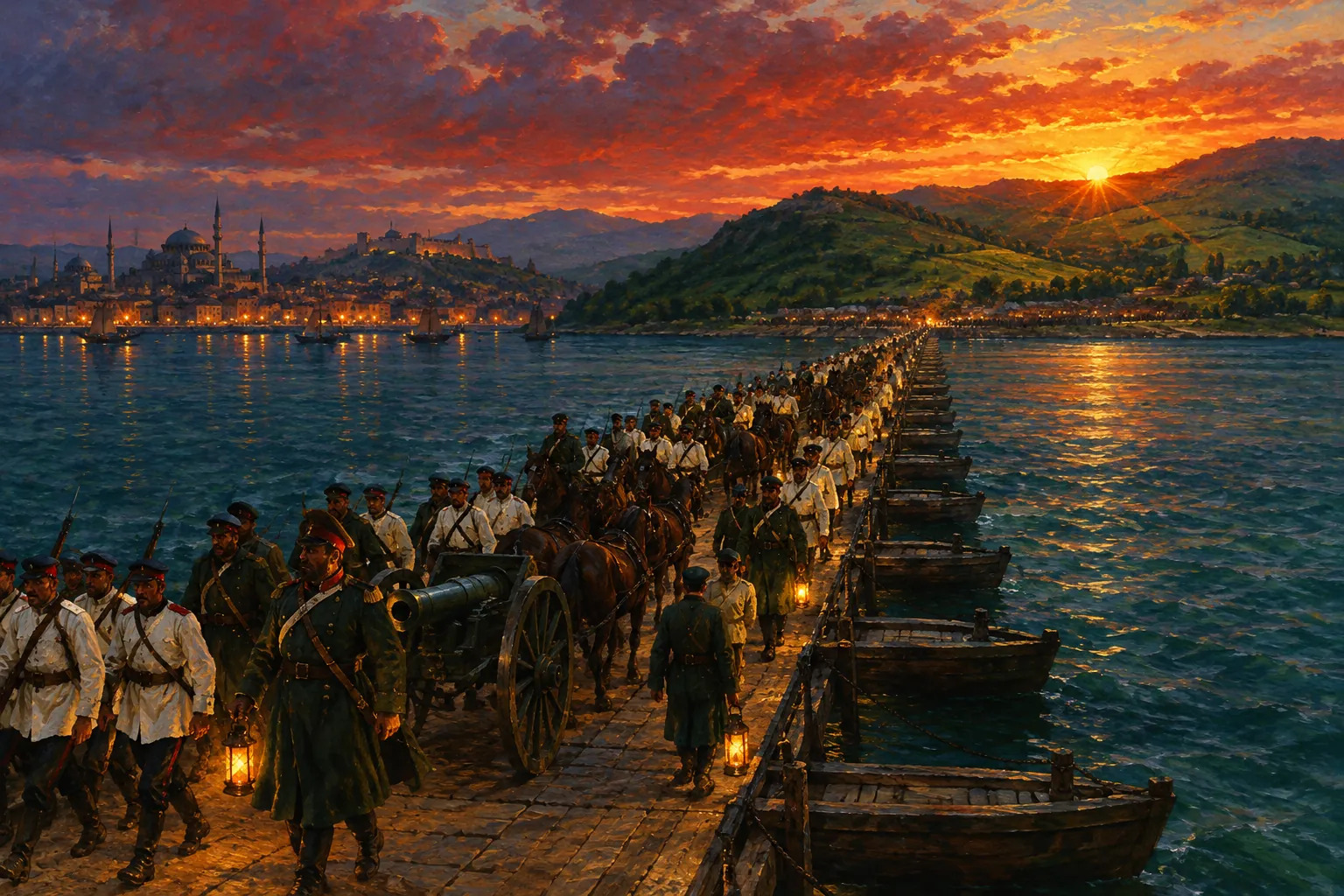
The main Russian force, under Grand Duke Nicholas Nikolayevich, crossed the Danube in June 1877 near Svishtov. The Ottomans had strong river fortresses but did not stop the crossing. A Russian advance guard under General Gurko then moved south, took the Shipka Pass in the Balkan Mountains in July, and raised hopes of a quick finish.
The siege of Plevna
The quick finish did not come. Osman Pasha moved an Ottoman army into the town of Plevna (now Pleven) on the Russian right flank, and it could not be ignored. The Russians attacked twice in July and failed. A third attack on 11–12 September, with Romanian troops fighting alongside them, also failed at heavy cost. After that the allies, with Romania’s Prince Carol in nominal command and the engineer General Totleben in charge of the siege, surrounded the town and starved it out. On 10 December 1877 Osman Pasha tried to break out, was wounded, and surrendered with tens of thousands of soldiers.
Shipka and the winter march
While Plevna held, the Ottomans attacked the Shipka Pass in August. A small Russian force and Bulgarian volunteers held it, at great cost, and the pass stayed in Russian hands. After Plevna fell, the Russians crossed the Balkan Mountains in midwinter. In January 1878 they won at Shipka-Sheynovo, took Plovdiv and occupied Adrianople. Their army then stood close to Constantinople.
The Caucasus front
A second front opened in the Caucasus. Russia took Ardahan in May 1877, won the battle of Aladzha in October, and captured the fortress of Kars in November 1877. Those successes explain why the peace gave Russia territory in the east.
The peace: San Stefano and Berlin
With the Russian army near the capital, the Ottomans asked for terms. The Treaty of San Stefano, signed on 3 March 1878, created a large autonomous Bulgaria reaching from the Danube to the Aegean Sea, with Russian troops to stay for two years. It recognised the independence of Romania, Serbia and Montenegro, and it gave Russia Kars, Ardahan, Batum and southern Bessarabia, plus a money indemnity.
The other powers saw a huge Bulgaria as a Russian client state on the road to the Mediterranean. Britain sent warships into the Sea of Marmara in February 1878 as a warning, and Austria-Hungary was unhappy because the treaty ignored its own plans for Bosnia. Germany’s chancellor Otto von Bismarck offered to host a conference and described himself as an honest broker.
The Congress of Berlin met from 13 June to 13 July 1878. It divided the large Bulgaria into three. Northern Bulgaria became an autonomous principality under the Sultan’s distant authority. Eastern Rumelia, south of the Balkan Mountains, became a self-governing province inside the Ottoman Empire. Macedonia went back to direct Ottoman rule. Romania, Serbia and Montenegro were recognised as independent. Austria-Hungary received the right to occupy and administer Bosnia and Herzegovina. Britain gained Cyprus through a separate agreement with the Sultan. Russia kept Kars, Ardahan, Batum and southern Bessarabia, for which Romania received northern Dobruja.
Why it mattered
For Bulgaria the war is remembered as the liberation, and 3 March, the day of San Stefano, is its national day. Eastern Rumelia joined the principality in 1885, and Bulgaria declared full independence in 1908. Romania, Serbia and Montenegro became fully sovereign states.
For the Ottoman Empire the defeat was a disaster. It lost most of its remaining European land in the north of the Balkans, and many Muslim civilians left or were driven out of the lost territories, with hundreds of thousands becoming refugees in Anatolia and around Constantinople. Sultan Abdulhamid II suspended the new parliament in 1878 and ruled personally for three decades. In Turkey the conflict is called the “93 War”, after the year 1293 in the Ottoman calendar.
For Russia the result was mixed. The army had won, but Berlin left the public feeling cheated, and anger at Germany’s role cooled Russian ties with Bismarck’s Germany. At home, the war and its costs added to the tension that fed revolutionary movements; see The Narodniks. Alexander II was assassinated in 1881. The Balkan rivalry between Russia and Austria-Hungary that began to harden in these years is one of the long roots of the crisis of 1914.
How it differs from the Crimean War
The Crimean War (1853–1856) and this war share an enemy and a region, but little else. In the Crimean War, Britain, France and Piedmont-Sardinia fought on the Ottoman side, and Russia lost. In 1877–1878 no great power fought beside the Ottomans, and Russia won on the battlefield. The Crimean War was mostly fought around the Black Sea, with Sevastopol at its centre. This one was fought in Bulgaria and eastern Anatolia. In the Crimean War, Russia’s defeat led to the Treaty of Paris of 1856, which closed the Black Sea to warships. In 1877–1878 the victory was only partly kept, because Berlin revised San Stefano.
What exams ask
- Order of events: Herzegovina revolt 1875, April Uprising 1876, Russian declaration of war April 1877, fall of Plevna December 1877, San Stefano March 1878, Berlin July 1878.
- San Stefano versus Berlin: know that Berlin shrank Bulgaria and gave Bosnia to Austria-Hungary and Cyprus to Britain.
- Great power roles: Russia as the protector of Slavs, Britain wary of the route to India, Austria-Hungary bargaining for Bosnia, Bismarck as chair of the congress.
- Significance (AP-style): the Eastern Question, the rise of Balkan nationalism, the decline of the Ottoman Empire, and the Balkan tensions that came before 1914.
Read next
- The Russian Empire (1721–1917): the long background to Russia’s Balkan policy.
- The Crimean War (1853–1856): the earlier war that this one is often confused with.
- The Narodniks: the revolutionary movement active in these years, which led to the assassination of Alexander II.
- The Russian Revolution of 1917: where the strains of the late empire finally ended.