In five minutes
The Boer War, also called the Second Boer War or the South African War, was fought between the British Empire and two Boer republics, the South African Republic (the Transvaal) and the Orange Free State. It lasted from 11 October 1899 to 31 May 1902. ‘Boer’ is the Dutch word for farmer. It was the name given to the Dutch-speaking settlers of southern Africa and their descendants, who later called themselves Afrikaners.
The short version: Britain wanted to control a region that had suddenly become the richest gold-producing area in the world, and the two republics wanted to stay independent. Britain won, but it needed about 450,000 soldiers from Britain and across its empire to defeat a much smaller force of Boer farmers on horseback. The war ended only after a guerrilla campaign, farm burning and camps in which tens of thousands of civilians died.
Do not confuse it with the First Boer War of 1880–81. That was a short conflict in which the Transvaal won back its self-government after the British defeat at Majuba Hill on 27 February 1881. The 1899 war is one of the defining conflicts of the age of imperialism, when European powers carved up the world.
Why the war happened
Two republics
Dutch settlers first arrived at the Cape in 1652. Britain took the Cape in the early 1800s, and it was confirmed as a British colony in 1814. Under British rule English became the official language, and slavery was abolished in 1834 (see the abolition of the slave trade and slavery). Many Boer farmers, some of whom had relied on enslaved labour, resented both changes. From the 1830s thousands moved inland in what is called the Great Trek and founded the Transvaal and the Orange Free State. Britain recognised their independence in 1852 and 1854. In both republics, Black Africans had almost no political rights.
Gold
In 1886 a huge gold reef was found on the Witwatersrand in the Transvaal. Johannesburg grew from nothing into a boom town, and mine owners, engineers and workers poured in from Britain and around the world. The Boers called them Uitlanders, meaning outsiders. President Paul Kruger’s government feared being swamped, so it made foreigners wait many years for the vote. Uitlanders also complained about taxes and about the state monopoly on dynamite, which mines needed. Britain used these complaints as a reason to press the Transvaal. Behind them lay two bigger aims: to protect the Cape, which guarded the sea route to India, and to share in the gold.
Rhodes and the Jameson Raid
Cecil Rhodes, prime minister of the Cape Colony, had made a fortune in diamonds and gold and dreamed of a British Africa. His British South Africa Company was a chartered company in the tradition of the East India Company. At the end of December 1895, his associate Leander Starr Jameson rode into the Transvaal with about 500 men, hoping to spark an Uitlander uprising in Johannesburg. No uprising came, and the raiders surrendered on 2 January 1896. Rhodes resigned as prime minister. The Boers now believed that Britain meant to take their country, and they bought modern weapons, including German Mauser rifles.
The last crisis
Alfred Milner, who became British High Commissioner in southern Africa in 1897, took a hard line. Talks at Bloemfontein in May and June 1899 failed, and Britain sent more troops. On 9 October 1899 Kruger’s government issued an ultimatum demanding that British troops leave its borders, with a deadline of 5 p.m. on 11 October. Britain refused, and war began that day. The Orange Free State joined the Transvaal. Compare this with the contest between Britain and France over the Nile in the Fashoda Incident of 1898, which ended without war: here, the dispute was with a small state that would not back down.
How the war went
Phase one: Boer attacks and Black Week (1899)
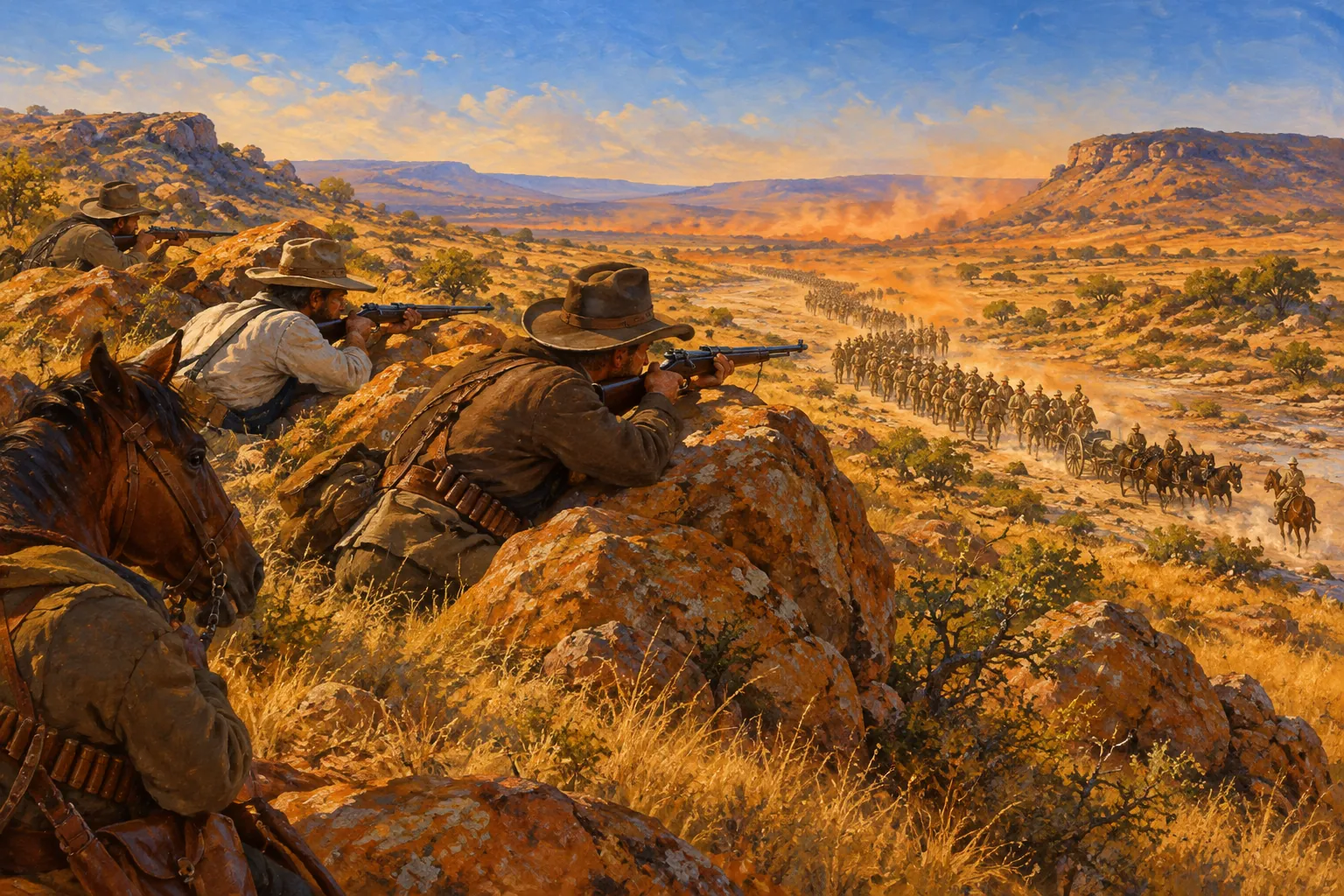
The Boers struck first, invading Natal and the Cape Colony and besieging three towns: Ladysmith, Mafeking and Kimberley. Their fighters were mounted riflemen who knew the land, shot accurately and used trenches, modern Mauser rifles and smokeless powder. British officers expected an easy campaign and often sent infantry forward in close order across open ground. In ‘Black Week’, 10–15 December 1899, Britain lost three battles in six days: Stormberg, Magersfontein and Colenso. The shock at home was enormous.
Phase two: Britain strikes back (1900)
Field Marshal Lord Roberts arrived in January 1900 with Lord Kitchener as his chief of staff, and with far larger forces. Kimberley was relieved on 15 February. At Paardeberg, the Boer general Piet Cronjé surrendered with about 4,000 men on 27 February, and Ladysmith was relieved the next day. Bloemfontein fell on 13 March. Mafeking was relieved on 17 May after 217 days under siege, which set off wild celebrations in London. Johannesburg fell on 31 May and Pretoria, the Transvaal capital, on 5 June. Britain declared both republics annexed in 1900, and Kruger went to Europe. Roberts thought the war was won and went home at the end of the year.
Phase three: guerrilla war and camps (1900–1902)
It was not won. Commanders such as Louis Botha, Jan Smuts, Christiaan de Wet and Koos de la Rey split their men into small, fast commandos that raided railways, supply columns and isolated garrisons, then vanished. Kitchener, who took over from Roberts in November 1900, answered with a harsh plan: burn farms that might feed the commandos, seize livestock, string barbed-wire lines between blockhouses to cut the country into pieces, and move families off the land.
Many of those families were put into what the British called ‘concentration camps’. Food and sanitation were poor, rations were smaller for families of men still fighting, and measles and typhoid spread. The campaigner Emily Hobhouse visited the camps in early 1901, and her report in June 1901 caused uproar in Britain. About 28,000 Boer civilians died, most of them children under sixteen. Black Africans, many of them farm workers moved off the same lands, were held in separate camps where at least 14,000 died; some estimates are higher. Black and Indian men also served the British army as labourers, scouts and drivers. The young Mohandas Gandhi led a corps of Indian stretcher-bearers. It was not only a white man’s war.
The peace and its results
The Treaty of Vereeniging, signed on 31 May 1902, ended the fighting. The Boers accepted British rule and gave up their weapons. Britain promised self-government in the future, £3 million for rebuilding farms, and the use of Dutch in schools and courts. The question of votes for Black Africans was left until after self-government, and that delay shaped what came next. In 1910 the Cape, Natal, the Transvaal and the Orange River Colony joined as the Union of South Africa. It was a self-governing dominion whose government, led by the former Boer general Louis Botha, was controlled by white voters. The foundations of later racial segregation were laid in that settlement.
For Britain the war was a shock. About 22,000 British and imperial soldiers died, roughly two-thirds of them from disease, and the cost was more than £200 million. Troops had come from Canada, Australia and New Zealand as well. The long struggle against a small enemy exposed weaknesses in the army, led to reforms, and fed criticism of empire, including J. A. Hobson’s book Imperialism (1902). For Afrikaners, the memory of the burned farms and the camps became a powerful part of their national identity.
What exams ask
- Causes: link the 1886 gold discovery, Uitlander rights, the Jameson Raid and Britain’s wish to secure southern Africa and the route to India.
- Significance: the war showed the limits of imperial power, saw early use of trenches, rapid-firing rifles and camps for civilians, and increased doubts about empire in Britain.
- Dates to know: 1899–1902; the ultimatum of 9 October 1899; Black Week in December 1899; the Treaty of Vereeniging on 31 May 1902; the Union of South Africa in 1910.
- Typical question: ‘To what extent was the war fought for gold?’ A strong answer weighs gold against strategy, imperial prestige and Boer nationalism.
Read next
- Imperialism: What It Was, Why It Happened, What It Left Behind: the big picture of the empire-building age in which this war took place.
- The Fashoda Incident (1898): a close call between Britain and France in Africa, one year before the war.
- The East India Company: the model for the chartered companies, like Rhodes’s, that opened the way for empire.
- The Abolition of the Slave Trade and Slavery: the background to the Great Trek and Boer resentment of British rule.