The Ottoman Empire timeline in five minutes
The Ottoman Empire began as a small frontier state in northwest Anatolia around 1299 and ended when the sultanate was abolished in 1922. In between, it conquered Constantinople in 1453, ruled much of southeast Europe, the Middle East and North Africa, and then spent the nineteenth century trying to reform fast enough to survive.
This Ottoman Empire timeline follows that arc in five stages, and its last stage belongs to the wider story of World War I.
One pattern holds the dates together. The empire grew through a strong army, a flexible way of governing many peoples, and control of key trade routes.
It weakened as rivals pulled ahead in military technology, finance and national movements, and as the state borrowed more than it could repay.
Rise: from frontier state to empire (c. 1299–1453)
Osman I led Turkish warriors on the Byzantine frontier, and the dynasty takes its name from him. Over the next 150 years his successors turned that frontier band into a state with lands on both sides of the Dardanelles.
- c. 1299 — Osman I's small principality in northwest Anatolia marks the start of the Ottoman dynasty.
- 1326 — Orhan takes Bursa, which becomes the first Ottoman capital. The state now governs a real city, not just a war band.
- 1354 — Ottoman forces gain a foothold at Gallipoli, their first lasting base in Europe. From here they expand through the Balkans.
- 1389 — At Kosovo, an Ottoman army fights a Balkan coalition. Sultan Murad I is killed, but Ottoman power in the region holds.
- 1402 — Timur defeats and captures Bayezid I at Ankara. A struggle among Bayezid's sons follows and slows expansion for years before the state recovers.
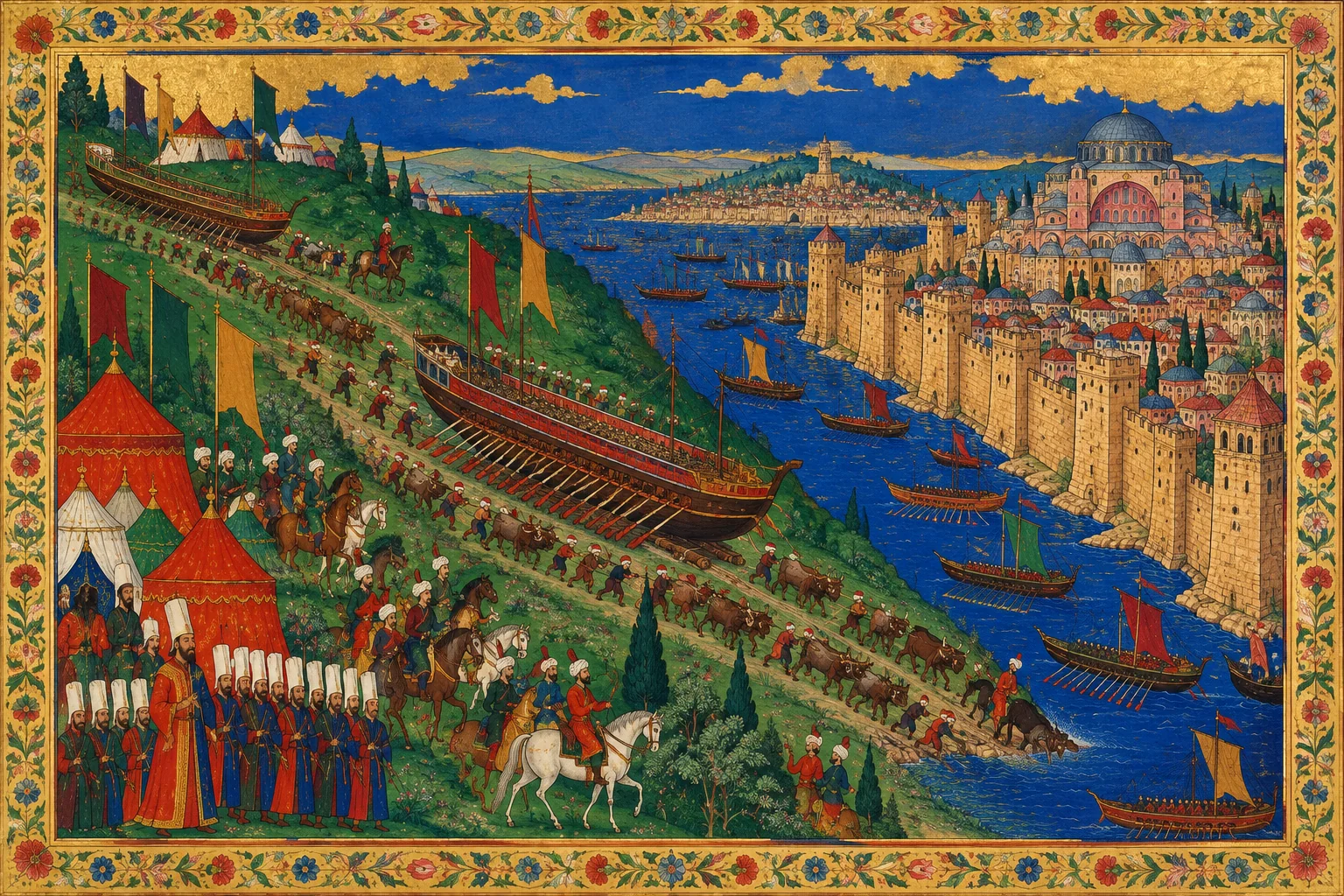
- 1453 — Mehmed II captures Constantinople after a siege of roughly seven weeks. The Byzantine Empire ends, and the city becomes the Ottoman capital, later known as Istanbul.
Peak: the sixteenth-century empire (1453–1566)
After Constantinople, the Ottomans pushed east and south, then back toward Central Europe. The reign of Suleiman I (1520–1566), called Suleiman the Magnificent in Europe, is usually treated as the high point.
- 1514 — Selim I defeats the Safavids of Iran at Chaldiran, securing eastern Anatolia. Ottoman firearms play a major part in the victory.
- 1516–1517 — Selim defeats the Mamluk Sultanate and takes Syria and Egypt. The Ottomans now protect the holy cities of Mecca and Medina, which raises the dynasty's prestige across the Muslim world.
- 1521 — Suleiman captures Belgrade, opening the road up the Danube toward Hungary.
- 1526 — At Mohács, the Ottomans destroy the Hungarian army and King Louis II dies. Much of central Hungary comes under Ottoman control in the following years.
- 1529 — The first siege of Vienna fails. It marks the limit of Ottoman advance in Central Europe for over a century.
- 1538 — The Ottoman fleet beats a Christian coalition at Preveza and holds the upper hand in the Mediterranean for decades.
- 1566 — Suleiman dies during the campaign at Szigetvár in Hungary, ending the longest reign in the dynasty's early history.
Long adjustment (1566–1789)
Historians now avoid calling these two centuries simple “decline”. The empire changed how it taxed, fought and chose officials, and it stayed a major power.
But the balance with Europe shifted, and a series of defeats showed it.
- 1571 — At Lepanto, a Holy League fleet destroys most of the Ottoman navy. The Ottomans rebuild it within a year and take Tunis in 1574, so the defeat hurts prestige more than it changes the map.
- 1683 — The second siege of Vienna fails when a relief army defeats the besiegers. A Holy League then pushes the Ottomans back through Hungary.
- 1699 — By the Treaty of Karlowitz, the empire gives up most of Hungary and Transylvania to the Habsburgs. It is usually cited as the first major loss of territory by treaty.
- 1774 — The Treaty of Küçük Kaynarca ends a war with Russia. The Crimean Khanate becomes independent of the Ottomans and Russia gains access to the Black Sea. Russia annexes Crimea in 1783.
- 1789 — Selim III becomes sultan and starts building a new European-style army. Conservative opposition removes him in 1807, but his reforms prepare the ground for later ones.
The nineteenth century: reform and pressure (1798–1908)
The nineteenth century is the heart of any Ottoman Empire timeline. The state faced three pressures at once: great powers that wanted its land or influence, nationalist movements among its Balkan Christians, and provincial governors who acted almost independently.
Its main answer was reform from the top.
- 1798 — Napoleon invades Egypt. The landing shows how easily a European army can reach an Ottoman province.
- 1805 — Muhammad Ali becomes governor of Egypt and builds a modern army and administration. Egypt stays Ottoman in name but becomes largely self-governing.
- 1821 — The Greek War of Independence begins. European public opinion backs the Greeks, and in 1827 a British, French and Russian fleet destroys the Ottoman-Egyptian fleet at Navarino.
- 1826 — Mahmud II abolishes the Janissary corps, the old infantry that had long resisted change. The event is called the Auspicious Incident.
- 1830 — The great powers recognise Greek independence. It becomes a model for other Balkan national movements.
- 1839 — The Gülhane Edict opens the Tanzimat, meaning “reorganisation”. It promises security of life and property, fair taxation and regular conscription under the rule of law.
- 1853–1856 — In the Crimean War, the Ottomans fight Russia alongside Britain and France and end on the winning side. Tsar Nicholas I's description of the empire as “the sick man of Europe” dates from these years.
- 1856 — The Reform Edict repeats the promise of legal equality for Muslims and non-Muslims and extends the Tanzimat.
- 1875–1881 — The state stops paying its foreign debt in 1875. In 1881 the Ottoman Public Debt Administration, run by European creditors, takes control of part of its revenue.
- 1876 — Abdulhamid II becomes sultan and proclaims the first Ottoman constitution. An elected parliament meets in 1877, and he suspends it in 1878 and rules with wide personal power.
- 1877–1878 — Russia defeats the Ottomans. At the Congress of Berlin in 1878, Serbia, Montenegro and Romania are recognised as independent, Bulgaria becomes an autonomous principality, Austria-Hungary gains the right to administer Bosnia and Herzegovina, and Britain takes control of Cyprus.
- 1881–1882 — France makes Tunisia a protectorate (1881) and Britain occupies Egypt (1882). Provinces that were Ottoman on paper pass into European hands.
Revolution, war and the end (1908–1924)
The last years move fast, and most of the empire's remaining land is lost in under two decades.
- 1908 — The Young Turk Revolution forces the sultan to restore the constitution and parliament. Reformers hope a constitutional state can save the empire.
- 1911–1913 — The empire loses Libya to Italy in 1911–1912 and most of its remaining European territory in the Balkan Wars of 1912–1913.
- 1914 — At the end of the year, the empire enters World War I on the side of the Central Powers. The war drains what strength it has left.
- 1918 — The Armistice of Mudros, signed on 30 October, ends the Ottoman war. Allied troops occupy Istanbul and other areas.
- 1920 — The Treaty of Sèvres would have divided Ottoman lands. Turkish nationalists led by Mustafa Kemal reject it, and it is never carried out.
- 1922 — The sultanate is abolished on 1 November. The last sultan, Mehmed VI, leaves Istanbul later that month.
- 1923 — The Treaty of Lausanne in July replaces Sèvres. On 29 October the Turkish Republic is proclaimed, with Mustafa Kemal as its first president.
- 1924 — The caliphate is abolished, ending the Ottoman family's claim to lead the Muslim world.
What exams ask
AP-style questions usually test significance rather than bare dates. Four ideas come up most often:
- The Eastern Question — how the great powers competed over Ottoman weakness, from the Greek war to the Congress of Berlin.
- Defensive modernisation — why the Tanzimat, from the Gülhane Edict to the 1876 constitution, aimed to strengthen the state, and why foreign pressure and debt limited it.
- Nationalism and empire — how Greek independence in 1830 and the Balkan settlement of 1878 show national movements breaking up a multi-ethnic empire.
- Finance and sovereignty — how the default of 1875 led to foreign control of Ottoman revenue.
To practise, link causes to results: why did failure at Vienna in 1683 lead to the Karlowitz settlement in 1699, and why did the Crimean War not cure the empire's weakness?
Read next
- The Young Turk Revolution (1908) — how officers and reformers forced the sultan to restore the constitution, and what they wanted to change.
- The Ottoman Empire in World War I — the empire's final war, from the decision to join in 1914 to the armistice.
- What Is Militarism? How It Led to WWI — the arms-race background that shaped the world the Ottomans were fighting to survive in.