In five minutes: Mary Shelley
Mary Shelley was an English novelist, born in London in 1797, who wrote Frankenstein; or, The Modern Prometheus. The book appeared in 1818, when she was 20.
It is often called the first science fiction novel. The reason is simple: a scientist makes a living being by method, and the story asks what he owes to what he has made.
She went on to write at least five more novels, travel books, short stories and biographies. She also edited her husband's poems after he died.
This page follows her life, the science behind her famous book, her other work and the myths that still cling to her name. It belongs to our History of Science Fiction, where she stands near the very start.
Her life
Mary was born Mary Wollstonecraft Godwin on 30 August 1797. Her mother, the writer Mary Wollstonecraft, died about ten days later.
Her father, William Godwin, was a philosopher and publisher. His house was full of writers and thinkers, and Mary read widely from a young age.
In 1814 she met the poet Percy Bysshe Shelley, who was already married. That July she left England with him and her stepsister Claire Clairmont.
The years that followed were hard. Her first baby, born early in 1815, died within days.
Debts and family quarrels followed the couple across Europe.
Percy's first wife, Harriet, died in December 1816, and Mary and Percy married that same month. Her half-sister Fanny had also died that autumn.
The summer of 1816
In May 1816 the group travelled to Lake Geneva. The poet Lord Byron and his physician John Polidori were staying at the Villa Diodati nearby, and Mary and Percy lived close by.
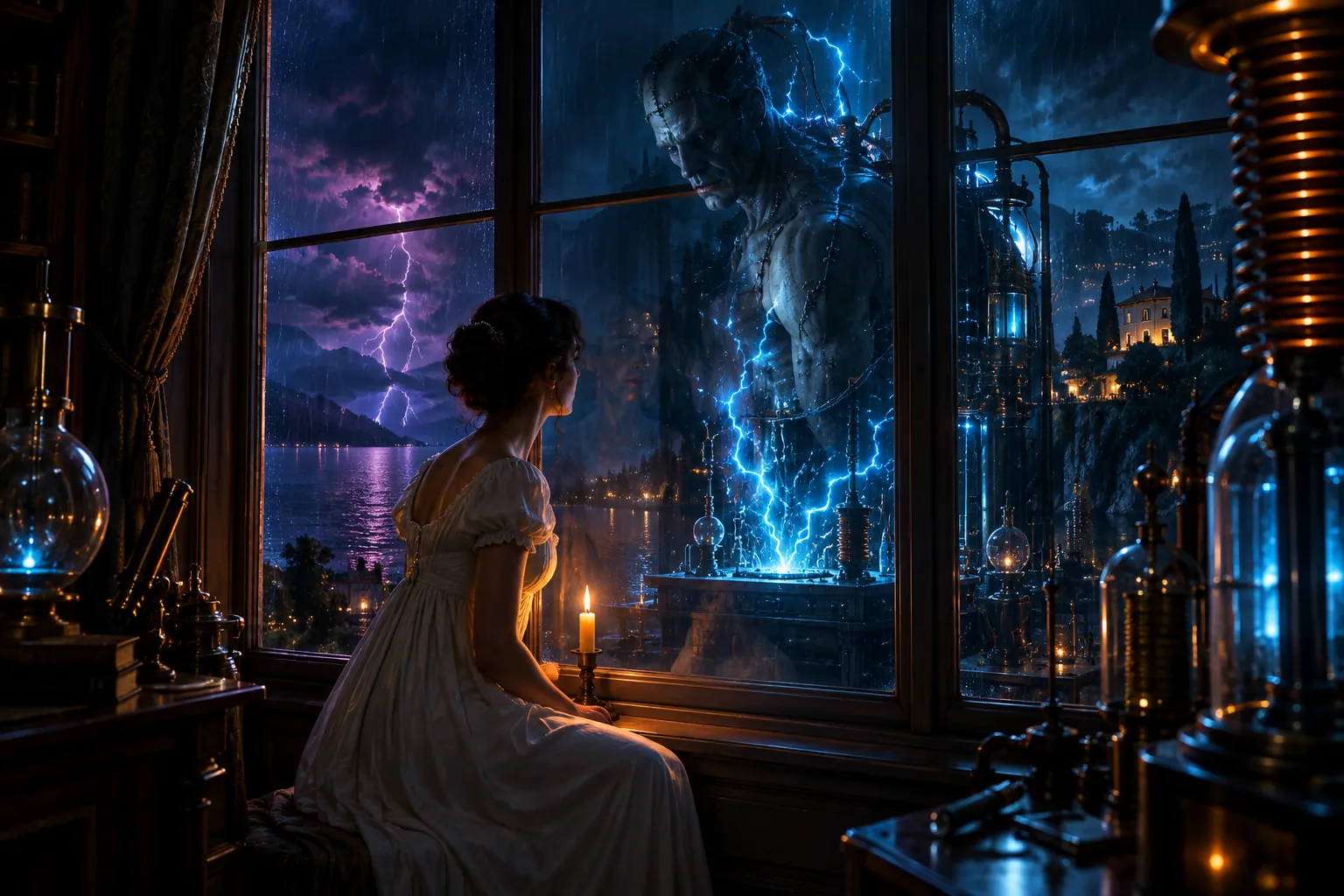
It was a cold, wet summer, partly because the 1815 eruption of Mount Tambora had cooled the weather across the northern hemisphere. Stuck indoors, the friends read German ghost stories aloud.
Byron proposed that each of them write one of their own. Mary struggled for several days, then described a waking vision of a scientist kneeling beside the creature he had brought to life.
That image became the seed of her novel. She expanded it from a short tale into a full book over the following year.
Later years
Her daughter Clara died in 1818 and her son William in 1819. Only her son Percy Florence, born in 1819, lived to adulthood.
In July 1822 Percy Shelley drowned when his boat sank in a storm off the Italian coast. Mary was 24 and returned to England in 1823.
She supported herself and her son by writing, and in 1839 she published an edition of her husband's poetry. She died in London on 1 February 1851, aged 53.
Writing was also her income. Besides novels, she produced travel books such as History of a Six Weeks' Tour (1817) and Rambles in Germany and Italy (1844).
She also wrote a series of short biographies of European writers and scientists for a popular encyclopedia in the 1830s. Few readers today know this work, yet it shows how seriously she took ideas.
Why Frankenstein counts as science fiction
Earlier stories about artificial life usually relied on magic or divine power. Victor Frankenstein is different: he studies, experiments and builds.
The novelist Brian Aldiss made this argument in his 1973 history of the genre. He placed Mary Shelley at the head of it, and many scholars have repeated the case.
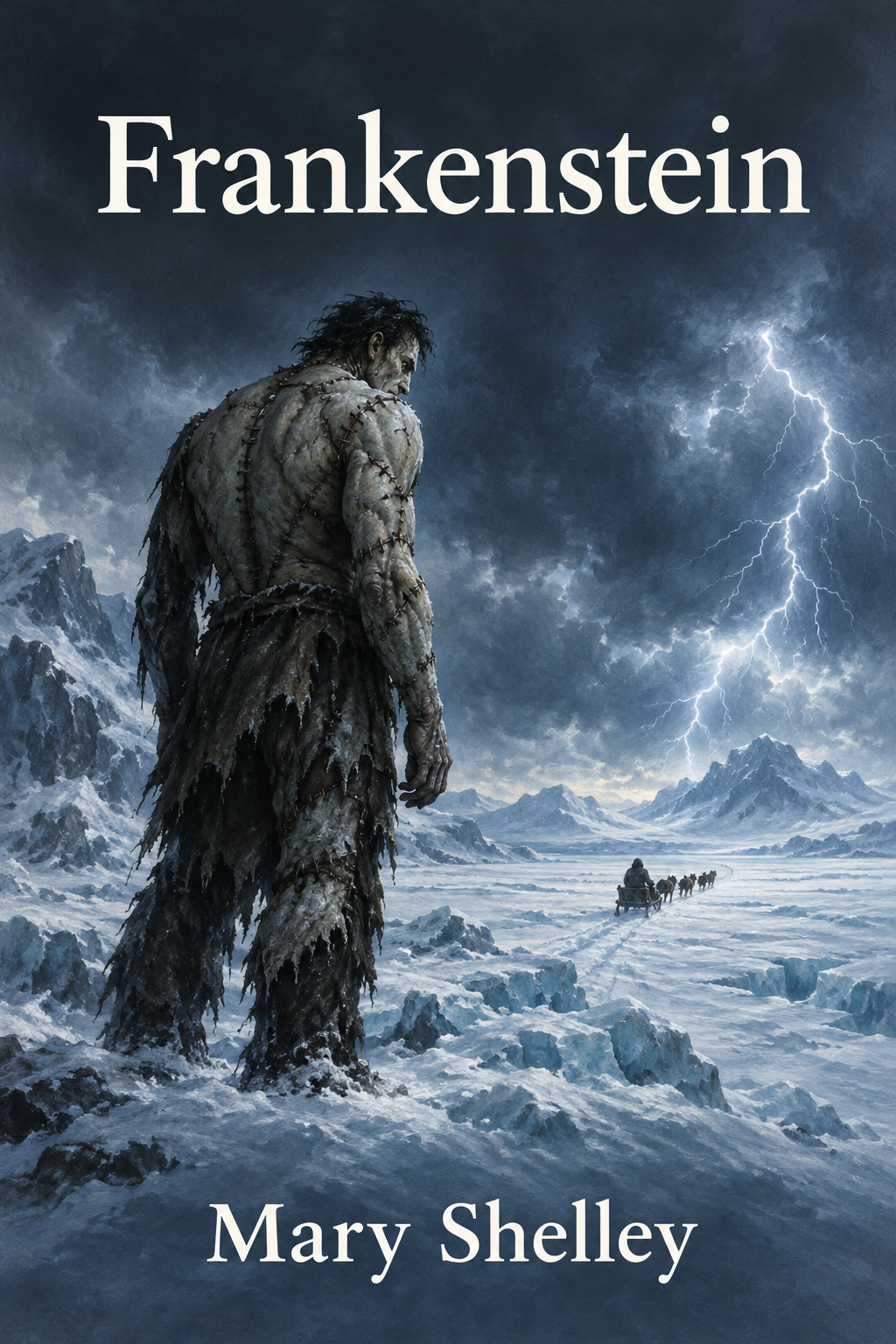
The book has a frame: a ship captain, Robert Walton, writes letters to his sister about meeting Victor in the Arctic. Inside that frame, Victor tells his story, and inside Victor's story the creature speaks for himself.
This layered structure lets the reader hear three voices who each claim to be the sensible one. The question the book keeps raising is responsibility: who answers for what a creator makes?
The subtitle points to the Greek myth of Prometheus, who stole fire for humans and was punished. Victor steals something too, and the cost falls on the people he loves.
The real science behind the story
Mary lived in an age when electricity and the nature of life were hot topics. Her book does not describe a method in detail, which is part of why it has lasted.
In 1780s Italy, Luigi Galvani made frog legs twitch with electric current, which suggested a link between electricity and living tissue. His nephew Giovanni Aldini took the idea further in 1803, applying current to the body of an executed criminal in London.
The chemist Humphry Davy gave popular lectures on new discoveries, and Mary's husband was keenly interested in science. Mary herself noted that her circle often talked about these experiments.
None of this could actually make a person, and the novel never claims to explain how Victor does it. What is established is the scientific mood of the time; the creature's making is invention.
Her other books
Frankenstein is not her only work of imagination. The Last Man (1826) is a novel about a plague that wipes out humanity in the late 21st century, told by one survivor.
It was poorly received at first and has been rediscovered since, and it ranks among the earliest stories of the end of the world. Her short story The Mortal Immortal (1833) follows a man who drinks an elixir and cannot die.
She also wrote the historical novels Valperga (1823) and The Fortunes of Perkin Warbeck (1830), and social novels such as Lodore (1835) and Falkner (1837).
Mathilda, a short novel she wrote around 1819 and 1820, stayed unpublished until 1959. It deals with grief and a difficult father-daughter bond.
Where it shows up in fiction
Frankenstein set a pattern that science fiction still repeats: people build something, and it turns around and questions them.
Karel Čapek's play R.U.R. (1920) imagines factory-made artificial workers who revolt. It spread the word robot around the world.
Isaac Asimov named the fear of made machines turning on their makers the "Frankenstein complex". His robot stories, with their Three Laws, can be read as an attempt to answer it.
Brian Aldiss, who credited Mary Shelley as the genre's starting point, also wrote Frankenstein Unbound (1973). In it a man from the future slips back into her world.
Why her book still matters
Frankenstein reached the stage quickly. A play based on it, Presumption, was running in London in 1823, and Mary went to see it.
The best-known film version came from Hollywood in 1931, with Boris Karloff as the creature. Its flat-headed, bolted look shaped how most people picture the story, far from the novel's eloquent figure.
Today the book is cited whenever people argue about new technology. Questions about artificial intelligence, gene editing and lab-grown life often sound like the question Victor refuses to face.
That is a large part of why readers keep returning to it. The story does not say that science is evil; it says that making something carries a duty to look after it.
Common misconceptions
Frankenstein is the monster. It is not: Frankenstein is the scientist, Victor.
The creature has no name in the book.
The creature is a mindless brute. In the novel he teaches himself to read and speaks in long, eloquent sentences.
The bolts, green skin and groaning came from later stage and film versions.
She wrote it in one night. The vision came during that famous summer, but she worked on the book for about a year and revised it for years afterwards.
She wrote it at the Villa Diodati. That was Byron's house.
Mary and Percy stayed in a smaller house nearby and visited in the evenings.
It was published under her name. The 1818 first edition had no author named, and many readers guessed Percy Shelley had written it.
Her name first appeared on the 1823 second edition, and she revised the text again in 1831.
Read next
Start with the book itself: our Frankenstein study guide covers the plot, characters and themes chapter by chapter, with spoilers clearly marked.
For the bigger picture, the History of Science Fiction shows where her work sits and which writers took the genre forward.