Ray Bradbury in five minutes
Ray Bradbury (1920–2012) was an American writer of science fiction, fantasy and horror. He is one of the few genre authors whose books are taught in schools almost everywhere.
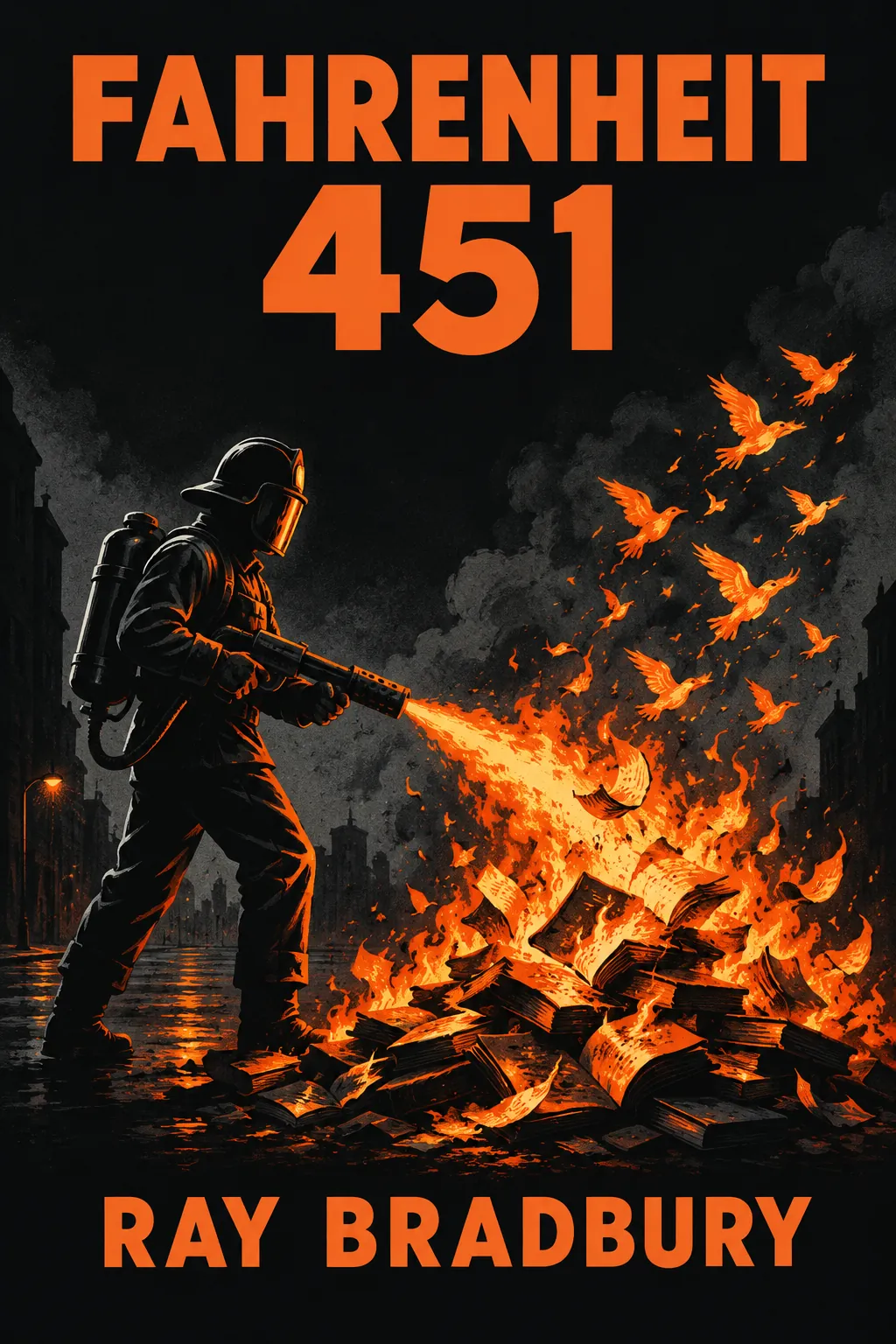
He wrote hundreds of short stories and a handful of novels. His most famous book is Fahrenheit 451, but many readers first meet him through a single short story in a school anthology.
His real subject is not machines. It is what people do with them, and what the machines do to people in return.
In his best work a rocket, a wall-sized television or a fire engine works like a mirror. It shows loneliness, curiosity, fear and wonder.
This page is part of our History of Science Fiction. Bradbury stands there as the writer who brought a lyrical, emotional voice into a genre that had often been about gadgets and plots.
Life: from Waukegan to Los Angeles
Bradbury was born on 22 August 1920 in Waukegan, Illinois, a small town on the shore of Lake Michigan. He later turned it into “Green Town”, the setting of Dandelion Wine and Something Wicked This Way Comes.
His family moved to Los Angeles in 1934, during the Great Depression. He loved pulp magazines, Saturday films, circuses and stage magic, and he started writing seriously as a teenager.
He never went to university. He said that public libraries were his real education, and he read there constantly.
His first stories appeared in pulp magazines in the early 1940s. His first book, the horror collection Dark Carnival, came out in 1947, the same year he married Marguerite McClure.
The breakthrough came in 1950 with The Martian Chronicles. After that his stories appeared in mass-market magazines, and he began to write for film and television too.
He worked with director John Huston on the screenplay of Moby Dick (1956), and later hosted and wrote for the television series The Ray Bradbury Theater. He never learned to drive, and for many years he avoided flying.
He died in Los Angeles on 5 June 2012, aged 91.
The books and stories that made him
The Martian Chronicles (1950)
This is a set of linked stories about people settling Mars. The first expeditions fail, then the settlers come in waves and bring their habits, prejudices and diseases with them.
Mars works as a stand-in for the American frontier and for guilt about what settlers do to the people already there. Bradbury’s Mars has air you can breathe and ancient cities, which is not real science, but the mood is the point.
The Illustrated Man (1951)
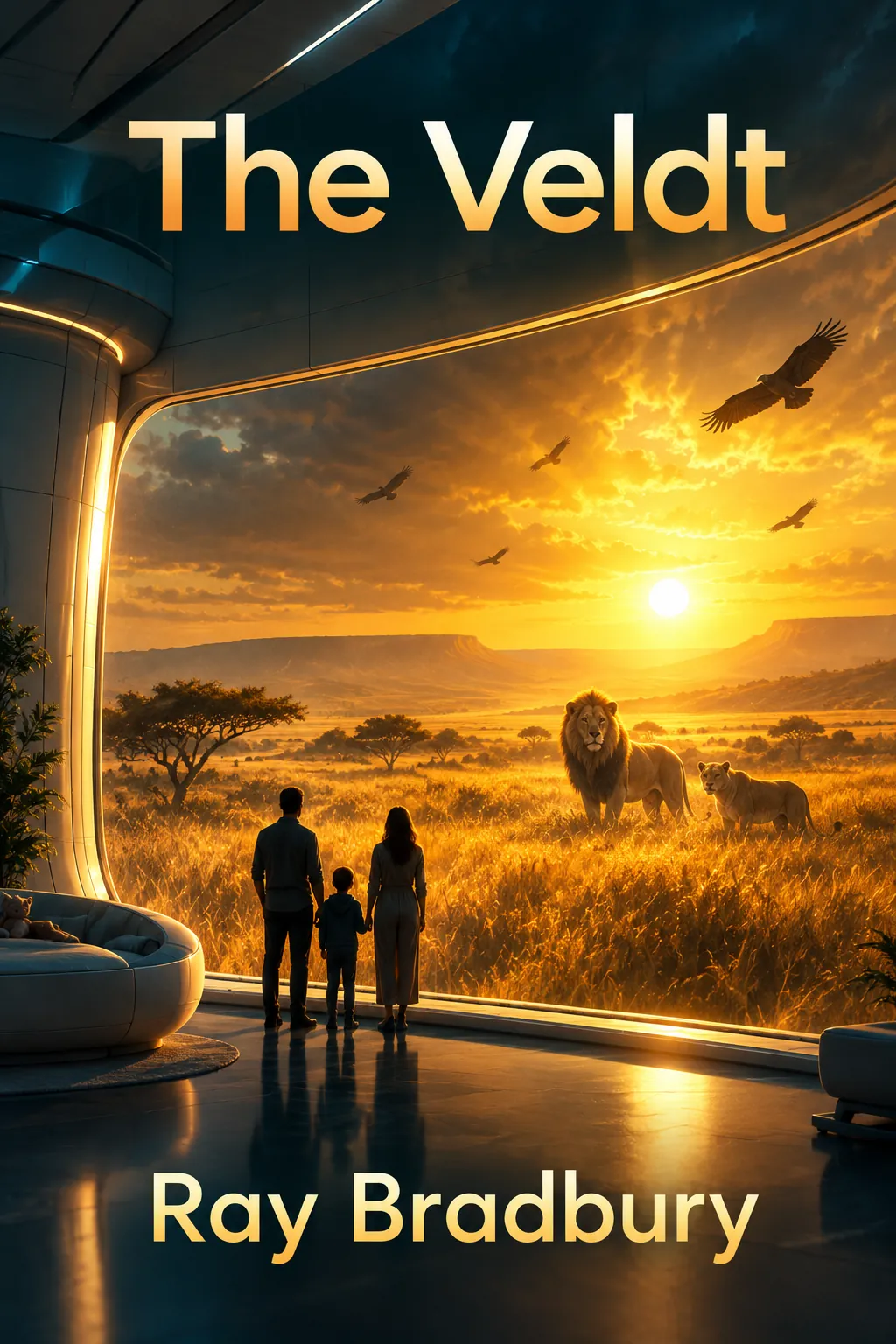
A wanderer’s tattoos come alive at night, and each picture tells a story. The frame lets Bradbury collect very different tales in one book, including “The Veldt”.
Fahrenheit 451 (1953)
Guy Montag is a fireman in a future America where firemen start fires to burn books. He begins to doubt his job after meeting a teenage neighbour, Clarisse, who asks him simple questions.
Bradbury grew the novel out of his novella “The Fireman” (1951). He wrote much of it on a rented typewriter in the basement of the UCLA library, paying by the half hour.
Read our full Fahrenheit 451 study guide for the plot and characters.
Dandelion Wine (1957)
This is a gentle, nostalgic book about one summer in Green Town, seen through a twelve-year-old boy, Douglas Spaulding. It is closer to fantasy and memory than to science fiction.
Something Wicked This Way Comes (1962)
A dark carnival arrives in a small town in October, and two thirteen-year-old friends, Jim and Will, discover what it really sells. It is Bradbury’s best-known horror and fantasy novel.
Short stories to know
- “A Sound of Thunder” (1952): a time-travel hunting trip goes wrong when a traveller steps off the path. It is often used to explain the butterfly effect, though it was written before that name became popular.
- “The Veldt” (1950): a house’s nursery makes the children’s thoughts real, and their parents lose control of it.
- “There Will Come Soft Rains” (1950): an automated house keeps going after its family has gone. The title comes from a poem by Sara Teasdale.
- “The Fog Horn” (1951): a lighthouse and a sea creature that answers its sound. It shows how Bradbury writes monsters as lonely, not just frightening.
How he wrote
Bradbury put feeling first and technology second. His sentences are full of images, smells and weather, and his stories often end on an emotion rather than a twist.
He told young writers to read poetry, to read widely and to write a short story every week. He believed quantity trains the instinct, and that bad stories have to be written before good ones come.
He loved libraries, rockets and space travel. He distrusted constant noise and screens that replace conversation, and that tension runs through his best-known work.
Bradbury and real science
Mars is the clearest case. The real planet has a thin carbon-dioxide atmosphere with a surface pressure of about 0.6 percent of Earth’s, no canals and no Martian cities, as space probes since the 1960s have shown.
Bradbury knew this was fantasy. He wrote about Mars as a place for human feelings, and he said himself that much of his work was closer to fantasy than to science fiction.
Science has still honoured him. In 1971 the Apollo 15 astronauts named a small lunar crater “Dandelion Crater” after his book.
In 2012 NASA named the Curiosity rover’s landing site on Mars “Bradbury Landing”.
Where to start reading
If you want the most famous book, start with Fahrenheit 451. It is short and fast, and it is the one most schools set.
If you like short stories, try “A Sound of Thunder”, “The Veldt” and “There Will Come Soft Rains” first. Each takes only a few minutes.
For a big sweep of imagination, read The Martian Chronicles. For something warmer and more personal, try Dandelion Wine.
If you like autumn chills, choose Something Wicked This Way Comes.
Where he fits in science fiction
In the 1940s and 1950s much American science fiction came from pulp magazines and focused on ideas, engineers and adventure. Bradbury wrote just as often about childhood, small towns and memory.
That helped bring the genre to readers who did not read pulps, and it made his books easy to teach. Film-makers have adapted his work often, including François Truffaut’s film of Fahrenheit 451 in 1966.
He received a Pulitzer Prize special citation in 2007 and the National Medal of Arts in 2004. The Science Fiction Writers of America named him a Grand Master in 1988.
Common misconceptions
- “Fahrenheit 451 is only about government censorship.” Bradbury said the book was more about how television and shallow media can make people stop reading on their own.
- “He wrote hard science fiction.” He cared far more about emotion and imagery than about accurate science, and he described much of his work as fantasy.
- “451 degrees is a scientific constant.” It is the figure the book gives for paper catching fire. The real temperature depends on the paper and the conditions.
- “He predicted the future.” He said he was trying to prevent futures he feared, not forecast them.
- “He only wrote science fiction.” He also wrote horror, fantasy, poetry, plays, essays and screenplays.
Read next
- Fahrenheit 451 by Ray Bradbury: the study guide to his best-known novel, with plot, characters and themes.
- History of Science Fiction: how the genre grew, and where Bradbury fits among the other writers.