In five minutes: what is a Von Neumann probe?
A Von Neumann probe is a hypothetical spacecraft that travels to another star system, builds copies of itself from the rocks and ice it finds there, and sends those copies on to more stars. Each generation repeats the trick. Nobody has built one. But the idea is simple enough to take seriously: a single successful probe could, in principle, end up visiting every star in the galaxy.
The name honours the mathematician John von Neumann, who worked out how a machine could, in theory, make a copy of itself. The space version came decades later. It belongs to the long tradition we follow in the history of science fiction, where a scientific thought experiment turns into a story engine.
Three things to remember:
- It copies itself. The probe is both the traveller and the factory.
- It grows exponentially. One probe becomes two, then four, then eight, so the number of probes grows far faster than the distance it covers.
- It is a thought experiment. Its main use is to ask why we see no sign of alien civilisations.
Where the idea comes from
The story starts with computing, not rockets. In the late 1940s John von Neumann (1903–1957), a Hungarian-born mathematician, asked whether a machine could build a copy of itself, including the instructions for building. He lectured on the problem in 1948 and 1949. With the mathematician Stanislaw Ulam he also described a self-reproducing pattern on a grid of cells, an early cellular automaton. His notes were edited by Arthur Burks and published in 1966 as Theory of Self-Reproducing Automata, nine years after his death.
His central insight was that such a machine needs three parts: a blueprint, a builder that follows the blueprint, and a copier that duplicates the blueprint so the child can build its own child. Biologists later found the same logic in living cells, where DNA is both read and copied.
The jump to space came later. In 1960 the radio astronomer Ronald Bracewell suggested that a civilisation might send an automatic probe to our system to make contact, an idea now called a Bracewell probe. That probe did not copy itself. In 1980 the engineer Robert Freitas published a design study for a self-reproducing interstellar probe in the Journal of the British Interplanetary Society, building on Project Daedalus, that society's 1970s study of an uncrewed, fusion-powered starship. In the same year the physicist Frank Tipler argued that if intelligent aliens existed, their self-replicating probes would already be in our solar system. Since we see none, he concluded we are probably alone. That made the probe a central character in the Fermi paradox.
How a probe would work
Most designs follow the same loop.
- Cruise. The probe leaves home and coasts to the next star at a few percent of the speed of light, or perhaps up to about a tenth. Studies assume fusion engines or sails.
- Settle on a small body. An asteroid or small moon is easier to work with than a planet, because it has weak gravity and exposed metal and ice.
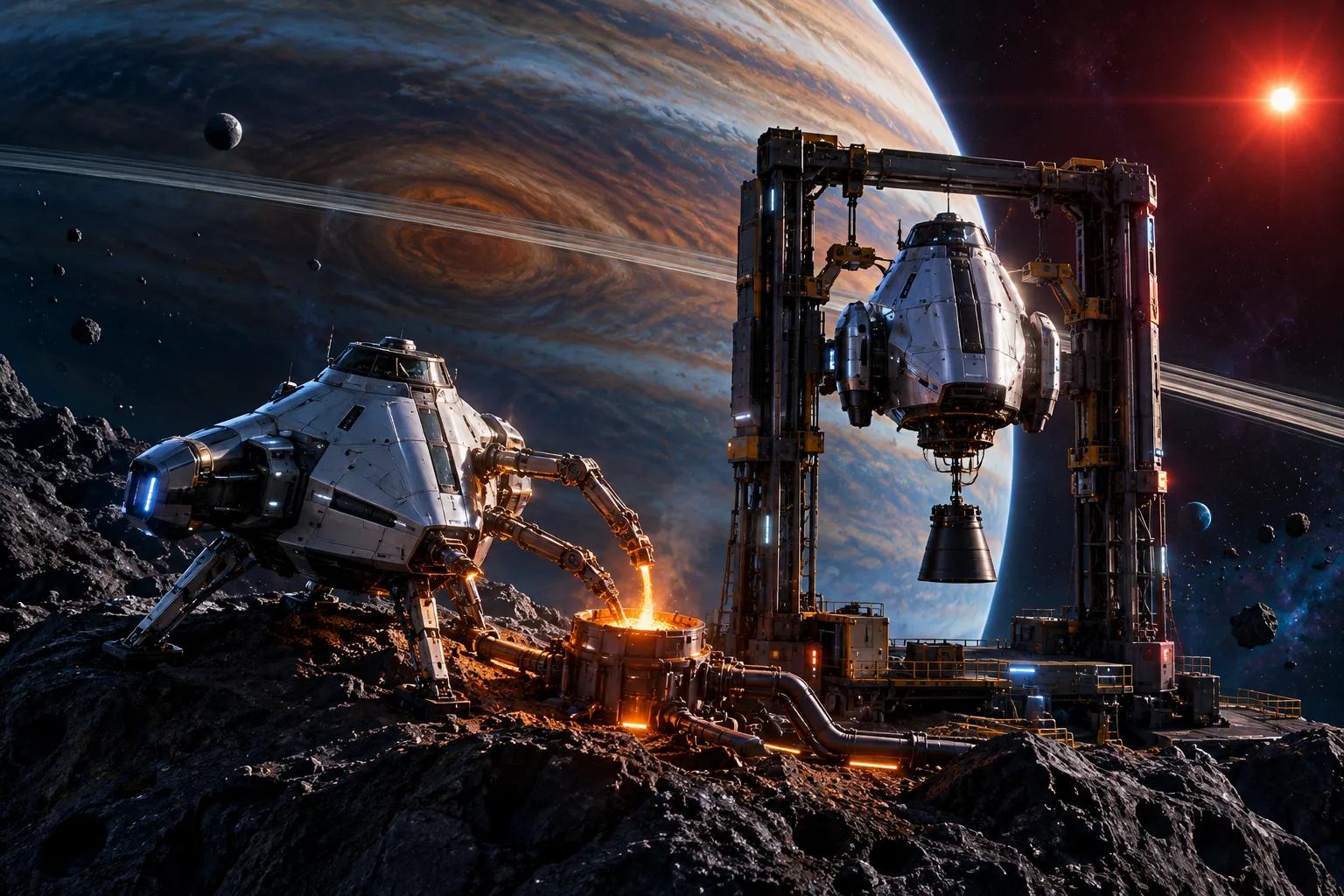
- Mine and build. Robots dig out raw material, refine it and build a small factory. The factory builds copies of the probe.
- Launch. Some copies head for nearby stars. The cycle starts again.
The galaxy is roughly 100,000 light-years across. Because each probe needs time to build its children, published estimates for covering the whole galaxy usually come out at millions of years or more, depending on the speed and the assumptions. That sounds long, but the Milky Way is more than 13 billion years old. This gap between the time needed and the time available is why the idea bites.
The real science: what is established, what is speculation
Established. Self-replication works in nature, so it is not forbidden by physics. Von Neumann's logic of blueprint, builder and copier is mathematically sound, and computer simulations of self-reproducing patterns exist. In 1980 a NASA-sponsored summer study, Advanced Automation for Space Missions, examined a replicating factory on the Moon and judged it a worthwhile long-term idea. Hobbyist projects such as RepRap, started in 2005, are 3D printers that print many of their own plastic parts, though they still need people to supply motors and electronics.
Hard. Interstellar distance is the biggest wall. The Voyager 1 spacecraft is the most distant human-made object, yet at its speed it would need tens of thousands of years to reach the neighbourhood of even the nearest star, Proxima Centauri, 4.2 light-years away. The Breakthrough Starshot project, announced in 2016, proposes gram-sized probes pushed by lasers to about a fifth of the speed of light. They would reach the Alpha Centauri system in about twenty years, but they would not copy themselves.
Speculation. Whether a machine can find, mine and refine every material it needs without help, whether copying errors would pile up over millions of years, and whether anyone would choose to launch such a thing are all open questions. No Von Neumann probe, ours or alien, has been observed.
Where it shows up in fiction
Self-copying machines are a favourite of science fiction, and they come in friendly and frightening kinds.
- Fred Saberhagen's Berserker stories, begun in the 1960s, imagine ancient self-replicating war machines that hunt all life.
- Stanislaw Lem's novel The Invincible (1964) sends a crew to a planet where tiny machines, the descendants of an earlier self-replicating system, have evolved into a swarm.
- In Arthur C. Clarke's 2010: Odyssey Two (1982), the black monoliths multiply, which many readers see as a replicating-probe idea.
- Alastair Reynolds' Revelation Space (2000) features the Inhibitors, machines that wait for young civilisations and suppress them.
- Dennis E. Taylor's We Are Legion (We Are Bob) (2016) turns the idea friendly: a human mind copied into probes that spread through the stars.
Common misconceptions
- "Von Neumann designed a spaceship." He did not. He worked on the logic of self-reproducing machines, and others applied it to space.
- "It is the same as grey goo." Grey goo, a term from Eric Drexler's 1986 book Engines of Creation, describes runaway molecular machines eating a planet's matter. A Von Neumann probe is a spacecraft that copies itself slowly across space. They share the worry of uncontrolled copying. See grey goo for the difference.
- "If probes were possible, they would be here by now." That is an argument, not a proof. Civilisations may never choose to build them, the probes may be hidden, or we may be early.
- "The galaxy would fill up overnight." Exponential growth needs time to travel and build. Even fast designs take millions of years.
- "It has to be dangerous." Danger comes from how a probe is programmed, not from the idea. A probe built to explore and stop at a set number of copies is just as logical.
Read next
- Fermi paradox: the question of why the galaxy looks empty, and where probes fit in.
- Grey goo: the nanotechnology cousin of the self-copying machine.
- History of science fiction: how thought experiments like this one became stories.