In five minutes
Dark forest theory is an idea from science fiction that tries to explain a real puzzle: why we have never detected another civilization, even though the galaxy holds hundreds of billions of stars. Its answer is grim. The universe is quiet because everyone who is out there is staying quiet on purpose. A civilization that announces itself may be found by a stronger one, and a stronger one has good reasons to destroy it before it can become a threat.
The name comes from a picture. Imagine a forest at night. Every living thing in it is a hunter carrying a weapon, moving without a sound, hoping not to be noticed. If one hunter meets another, the safest move is to shoot first. In this picture the universe is the forest, civilizations are the hunters, and silence is a survival strategy rather than a sign that nobody is home.
The idea is one of the best-known concepts in modern science fiction, and it is part of our wider guide to the history of science fiction. It is important to say from the start what it is not: it is not a proven scientific theory. It is a thought experiment, written by a novelist, built on a few assumptions that readers can accept or reject.
Where the idea comes from
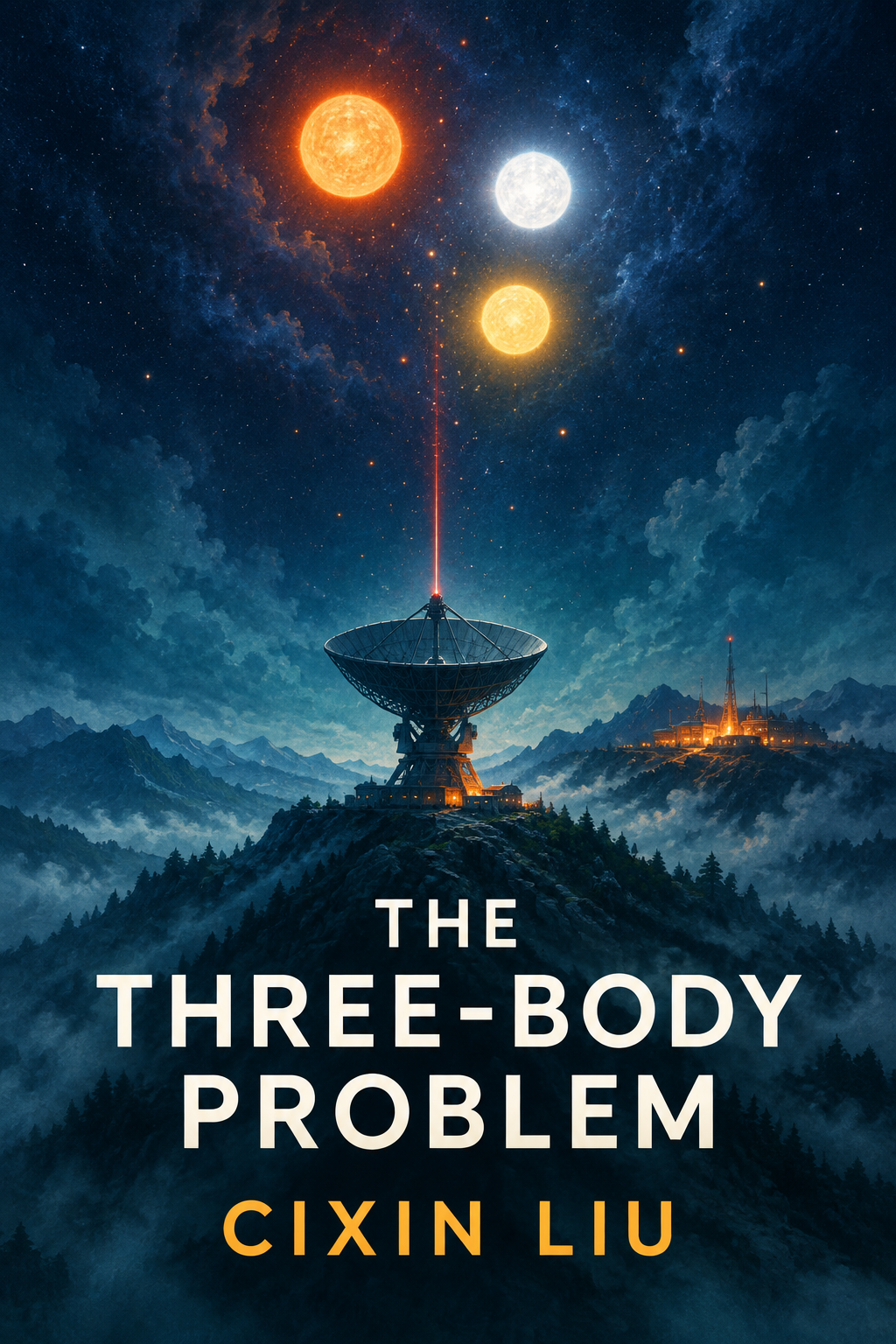
The name belongs to The Dark Forest (Chinese: 黑暗森林), the second novel in Liu Cixin's Remembrance of Earth's Past trilogy. The Chinese original appeared in 2008, and the English translation by Joel Martinsen followed in 2015. The first novel is The Three-Body Problem. You can read more about the author in our piece on Liu Cixin.
In the novels, humanity learns that an alien civilization called Trisolaris is on its way. The story then follows how people respond, including a project in which a few chosen individuals plan humanity's defence in secret. One of them, the astronomer Luo Ji, finally understands a pattern about how civilizations must behave toward each other. The book calls this study cosmic sociology, and the dark forest is its central result.
Spoiler note: this page explains the idea and its setup. It does not describe how the trilogy ends.
The logic: two axioms and two obstacles
The argument starts from two simple axioms, which are first stated in the story by the physicist Ye Wenjie.
- Axiom 1: survival is the first need of every civilization.
- Axiom 2: civilizations keep growing and expanding, but the total amount of matter in the universe stays the same.
Taken together, they mean that civilizations compete for limited resources, and that each one wants above all to still exist tomorrow. On their own, though, these axioms do not force a war. The novel adds two more ideas to explain why peace is so hard to reach between stars.
The chain of suspicion. You cannot know what another civilization intends. Worse, it cannot know what you intend, and you cannot tell it. Even if both sides are friendly, each knows the other might be hostile, and each knows the other knows this. The doubt feeds on itself and never settles, because messages between stars take years or centuries to cross the gap. There is no time to build trust.
The technological explosion. Civilizations do not grow at an even speed. A species can look primitive for a long time and then leap ahead in a few centuries, which is a blink on the scale of the universe. A harmless-looking neighbour today could be far stronger by the time your fleet or your message arrives.
Put these four pieces together and the reasoning in the story is simple. If you find another civilization, you cannot trust it, you cannot wait to see what it becomes, and you cannot afford to be wrong. The safest choice is to remove it quietly, and the second safest is to hide. In the novel, the one thing a wise civilization never does is shout its location into the dark.
The real science
The dark forest tries to answer the Fermi paradox. In 1950 the physicist Enrico Fermi is said to have asked over lunch where everybody was, meaning that if intelligent life is common, we should already see signs of it. You can find the full background in our guide to the Fermi paradox. Many answers have been suggested: life may be extremely rare, civilizations may destroy themselves, or the distances may simply be too large. One group of answers, usually called the Great Filter, says that something stops life before it becomes a visible, expanding civilization.
The dark forest is different because it assumes that other civilizations exist and are watching. What is established, and what is not, can be sorted like this:
- Established: we have found no confirmed signal from another civilization. Our own radio signals have been leaking into space for about a century, and a few messages were sent on purpose, such as the Arecibo message of 1974, aimed at a star cluster about 25,000 light-years away.
- Established: the Milky Way is about 100,000 light-years across, so any exchange of messages between civilizations would take years at the very least.
- Speculation: that other civilizations exist, that any of them is hostile, and that they can strike across such distances. There is no evidence for any of this.
Scientists take the question seriously, but they do not treat the novel's version as likely. Critics point out that a civilization able to destroy a distant world would need very advanced technology and a lot of energy, while the target might never have been a threat. Others note that the argument assumes every civilization thinks in the same cold, game-theory way, and there is only one example of intelligent life to learn from: us. Still, the debate has had real effects. Around 2010 the physicist Stephen Hawking warned that contact with a stronger civilization might go badly for us, and researchers disagree about whether humanity should deliberately transmit messages at all, a practice sometimes called METI. In this way a work of fiction has become a common reference point in a real discussion.
Where it shows up in fiction
The Remembrance of Earth's Past trilogy is the main home of the idea. Start with The Three-Body Problem, which sets up the contact and the two axioms, then read The Dark Forest for the full argument.
Earlier science fiction had explored related fears. Fred Saberhagen's Berserker stories, which began in the 1960s, feature self-replicating machines that hunt life across the galaxy. The question of a silent sky has also been discussed since at least David Brin's 1983 essay on the Great Silence. Liu Cixin's contribution was to join these themes into a single, memorable picture and to give it a clear rule. That is why people now use the phrase well outside the books, including in video games, essays and online debates about whether humanity should answer if it ever hears a signal.
Common misconceptions
- "It is a scientific theory." No. It is a hypothesis from a novel. Nobody has tested it, and it does not follow from physics.
- "Stephen Hawking proposed it." No. Hawking warned about contact in general terms. The dark forest, with its hunters and its rules, comes from Liu Cixin.
- "It means aliens are evil." Not quite. The argument says even peaceful civilizations might attack, because they cannot be sure the other side is peaceful. Fear, not hatred, drives the logic.
- "It is the same as the Fermi paradox." No. The Fermi paradox is the puzzle. The dark forest is one proposed solution among many.
- "We already broadcast, so it is too late." Our everyday radio and TV signals fade into the background noise within a few light-years, so they are very hard to detect from far away. Strong, aimed transmissions are the ones debated.
Read next
- Fermi paradox: the puzzle the dark forest tries to solve.
- Great Filter: another explanation for the silent sky, with a very different answer.
- Liu Cixin: the author and his career before and after the trilogy.
- The Three-Body Problem: the first novel, where the story begins.