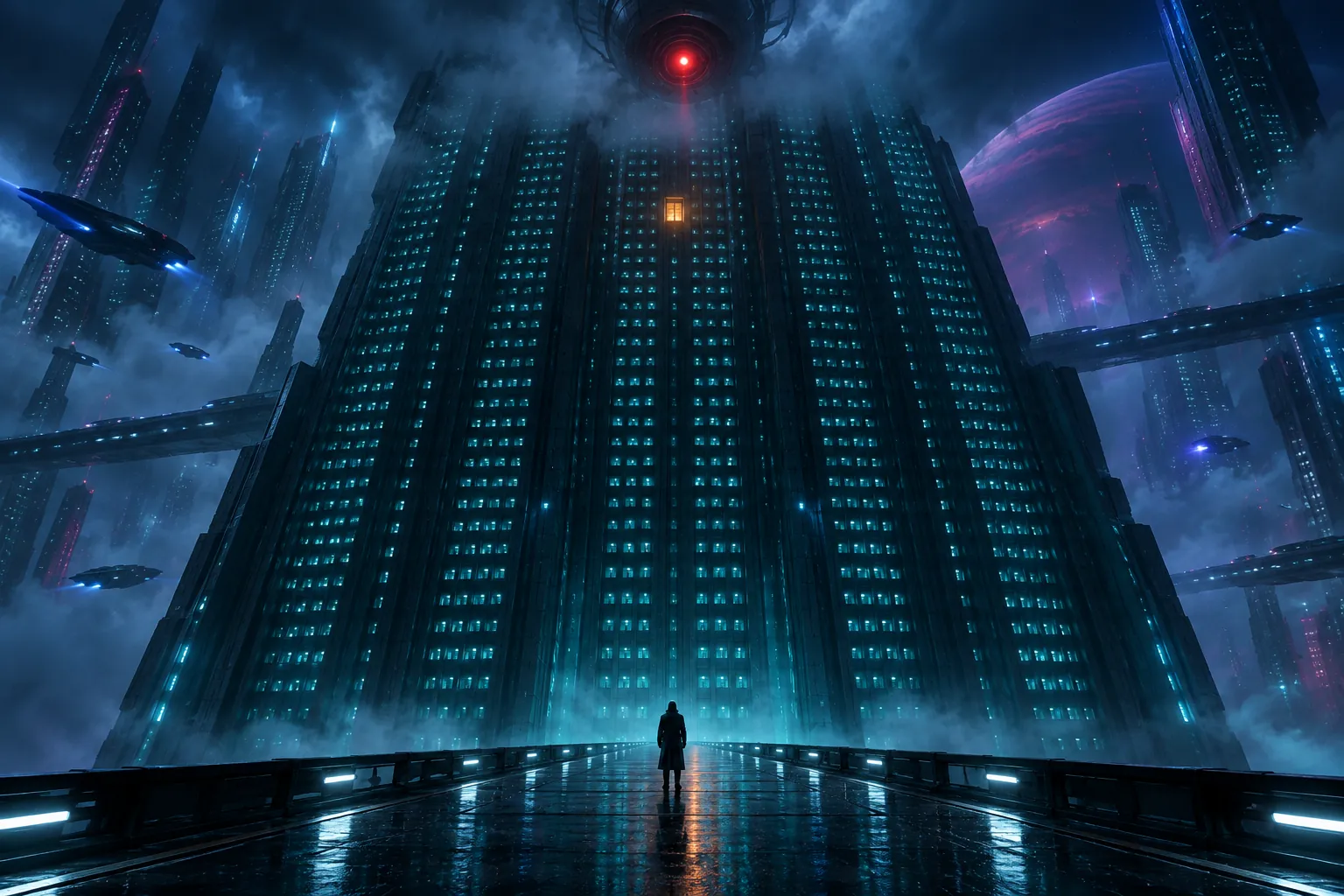
In five minutes: the dystopia meaning
The dystopia meaning in one line: a dystopia is an imagined society where life has gone badly wrong, usually because power is concentrated, freedom is crushed and ordinary people are managed instead of listened to. It is the dark mirror of a utopia, the “perfect place”, and it is one of the most important ideas in science fiction. This page is part of our guide to the History of Science Fiction.
Three points make the idea easy to hold. First, a dystopia is not simply a bad future. It is a story about the shape of power. Second, many people inside a dystopia do not know they are unhappy, because the system has trained them, entertained them or frightened them into calm. Third, the stories are written as warnings. The author takes a trend from the real world, pushes it to the extreme and asks what it would cost.
Where the word comes from
“Dystopia” is built from two Greek parts: dys, meaning bad or faulty, and topos, meaning place. It is a deliberate opposite of “utopia”, the word Thomas More used as the title of his 1516 book about an ideal island. More’s word is a pun. It can be read as “no place” or as “good place”, and that double meaning is a hint that a perfect society may not exist.
A well-known early use of the family of words comes from the British philosopher and politician John Stuart Mill. In a House of Commons speech in 1868, criticising government policy on Irish land, he called his opponents “dys-topians”, meaning people whose plans were too bad to be tolerated. That is a related word rather than the modern noun, and it stayed rare for decades. The word did not become common until the twentieth century, when novelists began to give the idea a full fictional world. You will also meet “anti-utopia” and “contre-utopie” (French) for the same family of stories.
What makes a society a dystopia
No single checklist defines the genre, but most dystopian stories share a handful of features:
- Concentrated power. A state, a party or a corporation controls almost everything, and nobody can remove it.
- Control of information. History is rewritten, books are banned or the language itself is shrunk, so that people cannot think the forbidden thought.
- Surveillance. Citizens are watched, or believe they are, and privacy has almost disappeared.
- Loss of individuality. People are turned into numbers, castes or roles, and love, family and private belief are managed or punished.
- A comfortable surface. The society claims to deliver safety, happiness or order, and uses that claim to justify everything else.
- A rebel with a small hope. Most stories follow one person who starts to see the system clearly, and the ending often tests whether that clarity can survive.
The last two points matter most. A dystopia is frightening because it offers something people really want, such as security or comfort, and then charges a price they only notice later.
Two great models: Orwell and Huxley
Two novels are used as the standard patterns. George Orwell’s Nineteen Eighty-Four (1949) shows control through fear and truth-twisting: telescreens, the Thought Police, a Party that rewrites the past and the ever-present Big Brother. Aldous Huxley’s Brave New World (1932) shows control through pleasure: engineered babies, a social caste system, endless entertainment and a drug called soma that keeps everyone content.
The critic Neil Postman made the contrast famous in his 1985 book Amusing Ourselves to Death. Orwell feared a world where books are banned, he argued, while Huxley feared a world where nobody wants to read them. Both ideas are useful, and many later dystopias mix the two: a little fear, a little comfort.
The real world behind the fiction
Dystopian fiction is a thought experiment, not a forecast. What is established is the history that inspired it. Orwell wrote after watching the rise of Nazi Germany and Stalin’s Soviet Union, and the one-party states, propaganda and secret police of the twentieth century are the raw material of the genre. Yevgeny Zamyatin wrote his novel We in 1920–21 in the early Soviet period, and it was first published in English in 1924, long before it could be printed in the Soviet Union.
What is speculation is the technology and the timeline. Cameras, data collection, algorithmic feeds and genetic engineering are real, and writers use them as the starting point. But no novel can say how a society will actually use them, and a dystopian world is built to prove a point, so it is tidier and more extreme than real life. The sensible way to read the genre is to ask which real habit the author is exaggerating.
Where it shows up in fiction
Books come first, and several have their own pages on FiveMinRead:
- We (Yevgeny Zamyatin, written 1920–21). The One State, where citizens are numbers who live in glass apartments. Often named as the model for the modern dystopian novel.
- Brave New World (1932). The World State and its engineered happiness. See our Brave New World study guide.
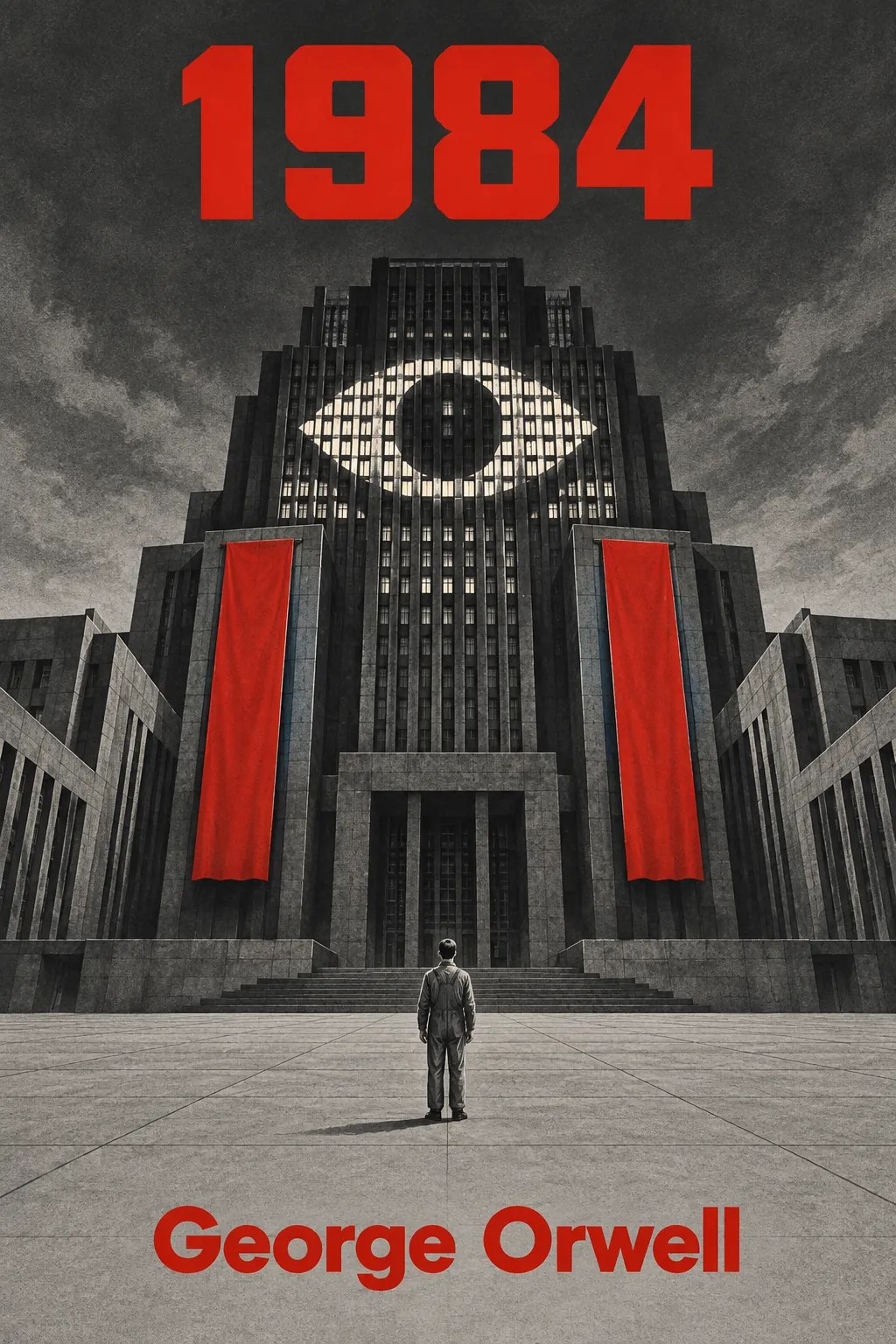
- Nineteen Eighty-Four (1949). Oceania, the Party and Winston Smith’s small rebellion. Read our 1984 study guide.
- Fahrenheit 451 (Ray Bradbury, 1953). Firemen burn books, and wall-sized screens keep people busy. See the Fahrenheit 451 study guide.
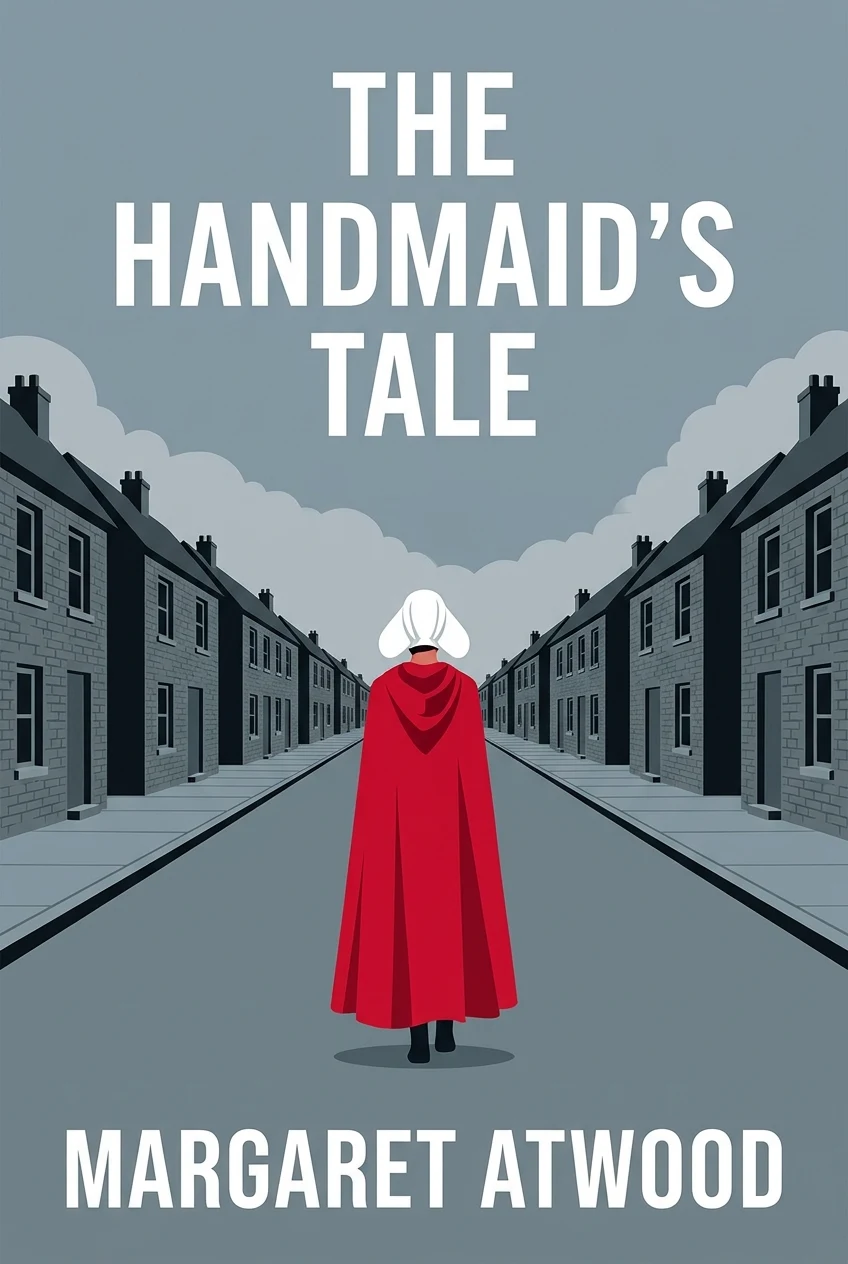
- The Handmaid’s Tale (Margaret Atwood, 1985). The religious regime of Gilead, where women’s lives are controlled. Read the Handmaid’s Tale study guide.
- The Hunger Games (Suzanne Collins, 2008). A capital city that keeps its districts in line with a yearly televised contest.
Earlier warnings include E. M. Forster’s short story “The Machine Stops” (1909), where people live underground and depend on a machine for everything. The genre is also huge in film, with Blade Runner (1982) a well-known example.
Common misconceptions
“Dystopia means the world has ended.” Not quite. Post-apocalyptic stories are about survival after a collapse. A dystopia is usually about a society that works, in the sense that it is organised and stable, but works against its people. The two overlap, as in The Hunger Games, but they are not the same.
“Orwell and Huxley predicted the same thing.” They did not. One imagined control by pain and fear, the other by pleasure and distraction. That is why the two names keep being compared.
“Dystopian authors are making predictions.” Most say they are not. The stories take present tendencies and exaggerate them so that readers can see them. A dystopia that “came true” in every detail would not be a good warning.
“Orwellian just means bad.” The adjective is usually used for official language that hides the truth, mass surveillance or the rewriting of facts. It is narrower than “unpleasant”.
“Everything in a dystopia is ugly.” Often the opposite is true. Many of these worlds are clean, bright and polite, which is exactly what makes them disturbing.
Read next
If this topic grabbed you, three connected pages are a good next step. Doublethink explains Orwell’s idea of holding two opposite beliefs at once. Newspeak and doublethink shows how a government can shrink language to shrink thought. Big Brother (Orwellian) covers the figure and the adjective most people know. For the full story behind these ideas, start the novel with our 1984 study guide.