In five minutes: the history of science fiction
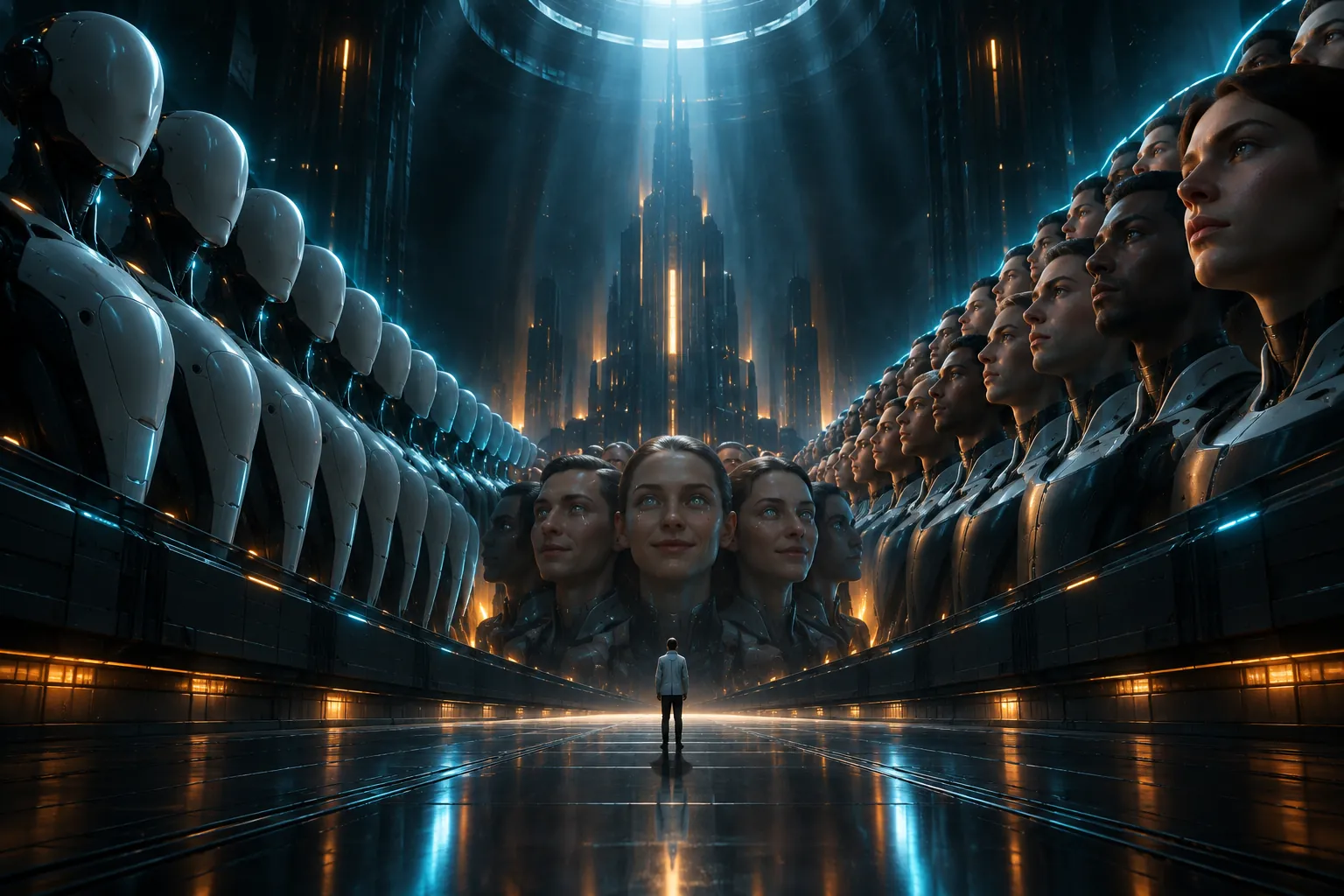
The history of science fiction is the story of how writers learned to ask “what if?” about science, machines and change. It begins in 1818 with Mary Shelley's Frankenstein, grows through Jules Verne and H. G. Wells, gets its name from American magazines in the 1920s, and then moves through the Golden Age, the New Wave, cyberpunk and today's global mix of voices.
Here is the whole route in one list:
- 1818–1900: Shelley, Verne and Wells show that a story can start from a scientific idea and follow it to its consequences.
- 1926–1950s: magazines build a community of writers and readers. The genre gets its name and its “Golden Age”.
- 1960s–1970s: the New Wave brings in literary experiment, politics and psychology.
- 1980s: cyberpunk turns to computers, corporations and life on the street.
- 1990s to today: writers from China, Japan, Africa and many other places reshape the field.
Before the label: the early roots
People told stories about journeys to other worlds long before anyone said “science fiction.” In the second century CE the Greek writer Lucian wrote True History, a joking tale in which sailors are carried to the Moon by a whirlwind. In 1608 the astronomer Johannes Kepler wrote Somnium, a story of a trip to the Moon that uses real astronomy. It was published in 1634, after his death.
Most historians treat these as ancestors, not as the first science fiction. The missing ingredient was a public that believed science and machines could change everyday life. That belief arrived with the scientific and industrial revolutions, and with it came stories that explain their wonders by science rather than by magic.
1818–1900: Shelley, Verne and Wells
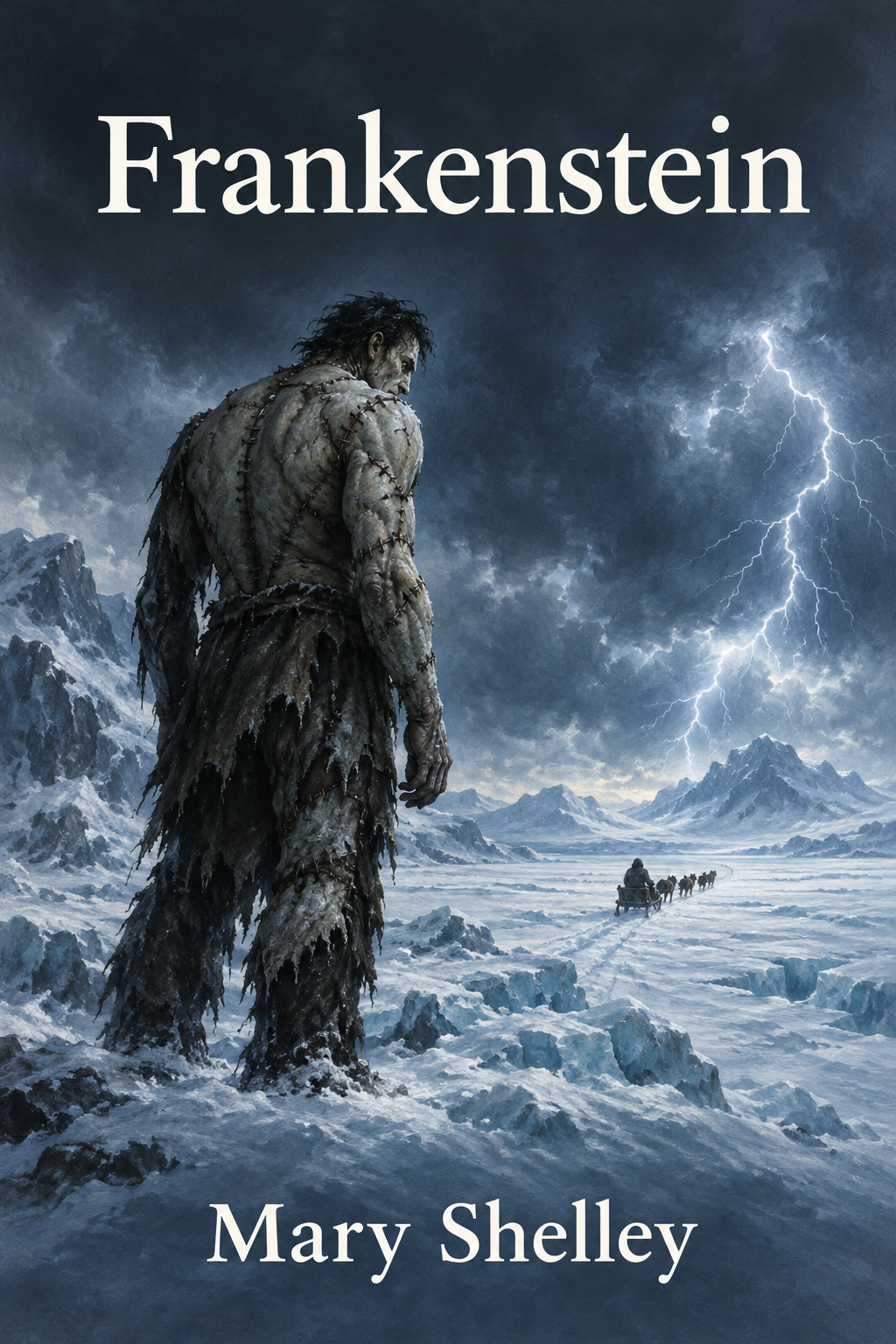
Mary Shelley. Frankenstein (1818) is about a young scientist who builds a living being and then cannot face what he has made. The critic Brian Aldiss argued that it is the first true science fiction novel, because the creature comes from an experiment, not a spell. Not every scholar agrees, but the book set a pattern the genre still uses: a scientific idea, followed by human consequences. Our Frankenstein study guide walks through the story.
Edgar Allan Poe. In 1835 Poe published “The Unparalleled Adventure of One Hans Pfaall”, about a balloon trip to the Moon. It mixes calculation with humour and shows that magazine readers already enjoyed this kind of tale.
Jules Verne. The French writer Jules Verne wrote a long series of adventure novels called the Voyages extraordinaires. Five Weeks in a Balloon (1863), Journey to the Center of the Earth (1864), From the Earth to the Moon (1865) and Twenty Thousand Leagues Under the Seas (1870) were bestsellers. Verne liked to take the technology of his day, such as submarines, balloons and big guns, and push it a few steps forward with careful numbers.
H. G. Wells. H. G. Wells published The Time Machine (1895), The Island of Doctor Moreau (1896), The Invisible Man (1897) and The War of the Worlds (1898). He called them scientific romances. Where Verne usually extended machines that already existed, Wells often invented one impossible thing and followed it through, using it to ask about class, evolution and empire. When Martians land in Victorian England, the question is really how a powerful empire feels when it is the one being invaded.
1900–1925: Adventure and the first warnings
Early in the new century, adventure stories moved to other planets. Edgar Rice Burroughs's A Princess of Mars appeared as a magazine serial in 1912 and began a long line of swashbuckling tales set on Mars.
At the same time, darker stories appeared. The Czech writer Karel Čapek's play R.U.R. (1920) shows factory-made workers who rebel. The word “robot” entered English through this play; it comes from the Czech robota, meaning forced labour. Yevgeny Zamyatin wrote We around 1920–21, a novel about a state where people have numbers instead of names. Later dystopias such as 1984 are often compared with it.
1926–1950s: The pulps and the Golden Age
In April 1926 the publisher Hugo Gernsback launched Amazing Stories, the first magazine devoted entirely to this kind of fiction. He first called it “scientifiction”. By the end of the 1920s the plainer name “science fiction” was spreading, and it stuck. The Hugo Awards, first given in 1953, are named after him.
The next step came in 1937, when John W. Campbell became editor of Astounding. He asked writers for stories in which the science was taken seriously and the characters felt like real people. Around him gathered Isaac Asimov, Robert Heinlein and, soon after, Arthur C. Clarke. Fans call the period from the late 1930s to the 1950s the Golden Age.
Isaac Asimov gave the era two lasting ideas. His Three Laws of Robotics were set out fully in the story “Runaround” (1942) and collected in I, Robot (1950). His Foundation stories imagine a mathematician who tries to shorten the fall of a galactic empire. Clarke's Childhood's End (1953) looked at humanity meeting something far larger than itself.
Not all of the period's best-known books came from magazines. Aldous Huxley's Brave New World (1932), George Orwell's 1984 (1949) and Ray Bradbury's Fahrenheit 451 (1953) used future societies to warn about comfort, control and the loss of books and freedom.
1960s–1970s: The New Wave
In the 1960s many writers felt that rockets and gadgets were not enough. Under the editor Michael Moorcock, the British magazine New Worlds pushed for experiment from 1964, and the movement was called the New Wave. It cared about language, psychology and politics as much as about hardware.
Famous books of these years include Frank Herbert's Dune (1965), which treats ecology and religion as seriously as space travel, and Philip K. Dick's The Man in the High Castle (1962), an alternate history in which the Axis powers won the Second World War. Ursula K. Le Guin's The Left Hand of Darkness (1969) asked how people would live on a world where gender works differently. Harlan Ellison's anthology Dangerous Visions (1967) collected daring new stories. The Nebula Awards began in 1966, voted on by the writers themselves.
Real events fed the boom. The Soviet satellite Sputnik flew in 1957, and Apollo 11 landed on the Moon in 1969. Stanley Kubrick's film 2001: A Space Odyssey (1968), made with Arthur C. Clarke, showed that science fiction could be serious cinema. At the same time, more women and writers of colour, such as Le Guin and Octavia Butler, became central to the field.
1980s: Cyberpunk
In the 1980s the future moved from deep space to the city street. Cyberpunk pictured powerful corporations, hackers, networks and artificial bodies. William Gibson's Neuromancer (1984) is its best-known novel, and it won the Hugo, the Nebula and the Philip K. Dick Award. Bruce Sterling's anthology Mirrorshades (1986) helped present the movement as a group. The film Blade Runner (1982), based loosely on a Philip K. Dick novel, gave it a look: rain, neon and crowded streets.
1990s to today: A global field
Since the 1990s science fiction has been written in more places and by more kinds of people. Afrofuturism, a term coined by the critic Mark Dery in 1993, names a movement that imagines futures from Black history and culture. Climate fiction and stories about artificial intelligence have grown with real-world worries.
The biggest recent shift is the rise of Chinese science fiction. Liu Cixin's The Three-Body Problem came out in China in 2008. In Ken Liu's English translation it won the Hugo Award for Best Novel in 2015, the first time a novel translated from Asia had won it. Andy Weir's The Martian (2011), which began as a self-published online serial, showed that readers still love problem-solving stories built on real physics.
Japan's own line of science fiction
Japan built a strong tradition of its own. Osamu Tezuka's manga Astro Boy began in 1952 and made a kind, thinking robot a national favourite. In 1959 the publisher Hayakawa launched S-F Magazine, and in 1963 the Science Fiction and Fantasy Writers of Japan was founded. Writers such as Shin'ichi Hoshi, Sakyo Komatsu and Yasutaka Tsutsui became its first big names. Komatsu's Japan Sinks (1973), about an archipelago destroyed by earthquakes and volcanoes, became a huge bestseller. Japanese science fiction has since shaped anime, games and novels all over the world.
The real science: how SF and science talk to each other
Science fiction is not a forecasting service. Most of its guesses are wrong, and many are not meant as predictions at all. Verne's moon cannon is a good example. He placed the launch in Florida, not far from where NASA later launched its Apollo rockets, but a real gun barrel would produce acceleration far beyond what a human body could survive.
What the genre does well is shape what people want to build and what they worry about. In 1945 Arthur C. Clarke wrote an article in Wireless World proposing relay stations in geostationary orbit, the idea behind today's communications satellites. That was a technical proposal, not a story, but it came from the same habit of thought. The word “robot” and the Three Laws, on the other hand, are fiction that has become the language engineers and the public use when they talk about real machines.
A simple rule helps: when a book describes an idea as measured, check it against NASA, ESA or JAXA. When it describes a thought experiment, treat it as one.
Where it shows up in fiction: a reading path
If you want to follow the history by reading, try this order. Start with Frankenstein for the origin, then a Verne novel and a Wells novel for the two great founders. Move to Asimov for the Golden Age, Orwell, Huxley and Bradbury for the great warnings, and Le Guin or Dick for the New Wave. Gibson's Neuromancer is the doorway to cyberpunk, and The Three-Body Problem shows where the genre stands today.
Common misconceptions
- “Science fiction predicts the future.” It explores possible futures and often gets details wrong. Its value is in the questions it asks.
- “It began with space films.” Written science fiction is about two centuries old, long before modern film.
- “It is only about space and robots.” It also covers time travel, society, ecology, language and the mind.
- “It was always a Western genre.” Japan, China, Russia and many other countries have had strong traditions for generations.
- “Frankenstein is just horror.” It is a horror story and a science fiction story. The two are not opposites.
Read next
- Jules Verne: the life and books of the writer who sent travellers to the Moon and under the sea.
- H. G. Wells: how one writer invented the time machine, the invisible man and the alien invasion.
- Isaac Asimov: the Three Laws, Foundation and the Golden Age in one career.
- Cyberpunk: neon, networks and the 1980s turn toward the street.
- Frankenstein study guide: the novel that many critics call the first science fiction.